Beitragsentlastung: the premium relief component for retirement
An optional rider that pre-funds a guaranteed premium reduction from a set age. For employees it can be subsidised twice over; for anyone who might leave Germany it has a catch worth knowing first.


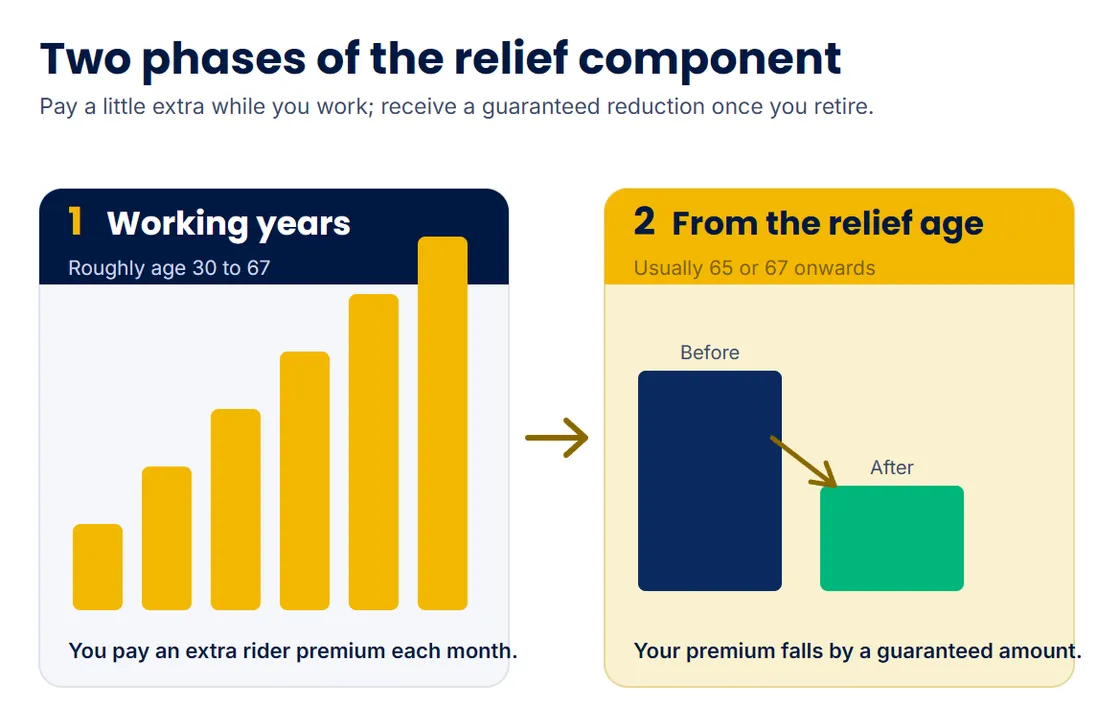
How the premium relief component works
You choose a monthly contribution and a relief age, typically 65 or 67 and often configurable between roughly 55 and 70. The insurer invests the money and guarantees a fixed euro reduction of your premium from that age. Two honest caveats belong in every explanation. The guaranteed amount is fixed in euros and not indexed to inflation, so its real value shrinks over decades; surplus participation can top it up, but that part is not guaranteed. And the rider's own premium is not frozen: like any tariff it can be adjusted over time, and you keep paying it during the relief phase.
- Guaranteed euro reduction from the agreed age, often up to 60 to 100 percent of the premium.
- The fixed amount is not inflation-indexed; surplus top-ups are possible but not guaranteed.
- The rider premium continues during retirement and can itself be adjusted.
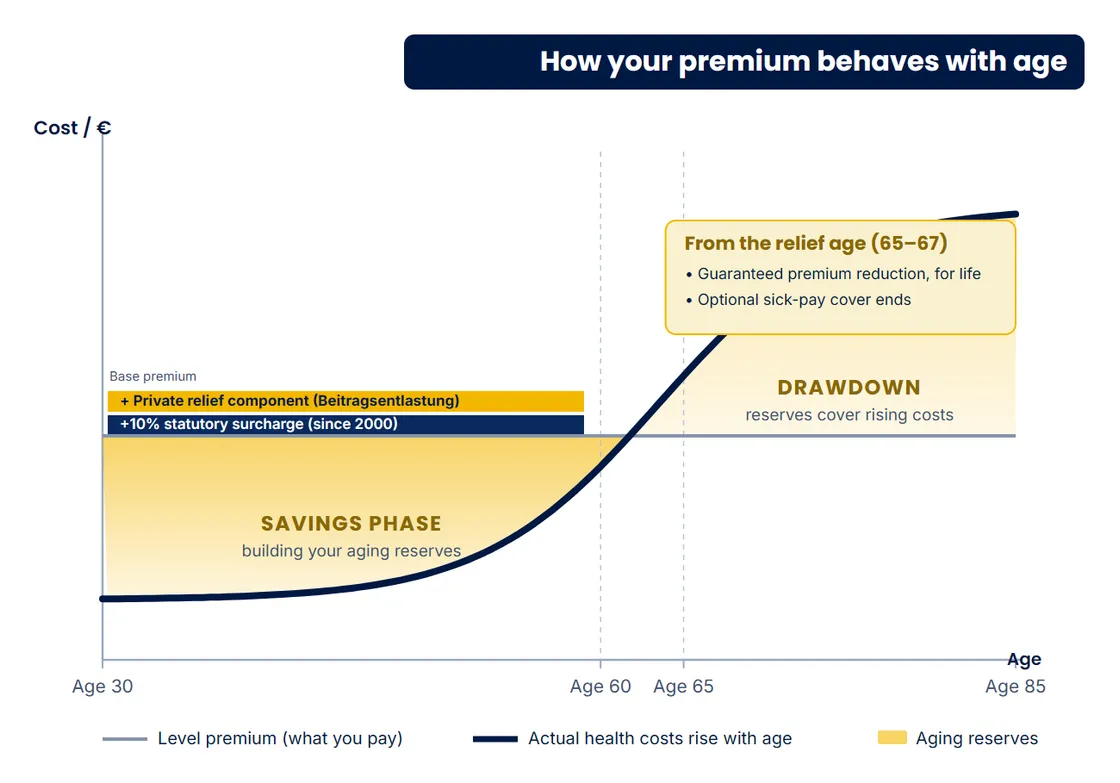
How your relief capital builds up
The relief component works like a private, faster version of the aging reserves already built into every private premium. During your working years you pay a little more than your cover actually costs, and the insurer sets that surplus aside and invests it. That is the savings phase. From your chosen relief age, usually 65 or 67, the pool is drawn down to fund a fixed, contractually guaranteed reduction in your monthly premium for the rest of your life. Because the euro amount is locked in from the start, the relief is predictable. The trade-off is that it is not indexed to inflation, so its real value slowly erodes across a long retirement.
- Savings phase: you slightly overpay while you work, and the surplus is invested as extra reserves.
- Drawdown phase: from age 65 to 67 the reserves cut your premium by a guaranteed euro amount for life.
- It is the same idea as the statutory aging reserves, just topped up voluntarily and built faster.
How private premiums stay stable as you age
Private premiums are not designed to climb just because you get older. In your younger years you pay a little more than your care actually costs, and the insurer sets that surplus aside as aging provisions (Alterungsrückstellungen). Those reserves are invested and later used to cover the higher costs of old age, so the age component of your premium is balanced out across your lifetime. This is the Ausgleich im Alter: the equalisation that keeps a private premium calculated to stay level for life rather than rising year after year.
On top of that, since 2000 every insured person pays a statutory 10 percent surcharge from age 21 to 60. It is held back as additional reserves and released from age 65, in full from age 80, with one job: to keep your premium stable in retirement. Together, the aging provisions and this surcharge are what insurers mean by Beitragsstabilität, premium stability at the point when your income typically falls.
It is worth being precise about what the reserves do and do not do. They neutralise the pure effect of getting older. They do not switch off medical inflation, rising treatment costs or changes in the technical interest rate, and any of those can still lift premiums for every age group at once. So a well-run private tariff aims for stability, not a frozen price.
The premium relief component shown above is the voluntary lever on top of all this. You pre-fund extra reserves during your working life to buy a fixed, guaranteed reduction from a relief age you choose, usually 65 or 67. Combined with the levers that already apply at 60 and 65, when age-related increases stop and the statutory surcharge is redirected, it is how many privately insured residents plan for a genuinely affordable premium in retirement.
Aging provisions do the heavy lifting
Reserves built from your premiums in younger years fund the higher costs of old age, so age alone does not push your premium up.
A 10% statutory surcharge since 2000
Added from age 21 to 60, set aside, and released from 65 (in full from 80) for one purpose: keeping your premium stable in retirement.
What can still move your premium
Medical inflation and interest-rate changes lift costs for every age group. The reserves offset ageing, not general cost growth.
Extra stability, on request
The relief component pre-funds a further guaranteed reduction from your chosen relief age, on top of the built-in mechanisms.
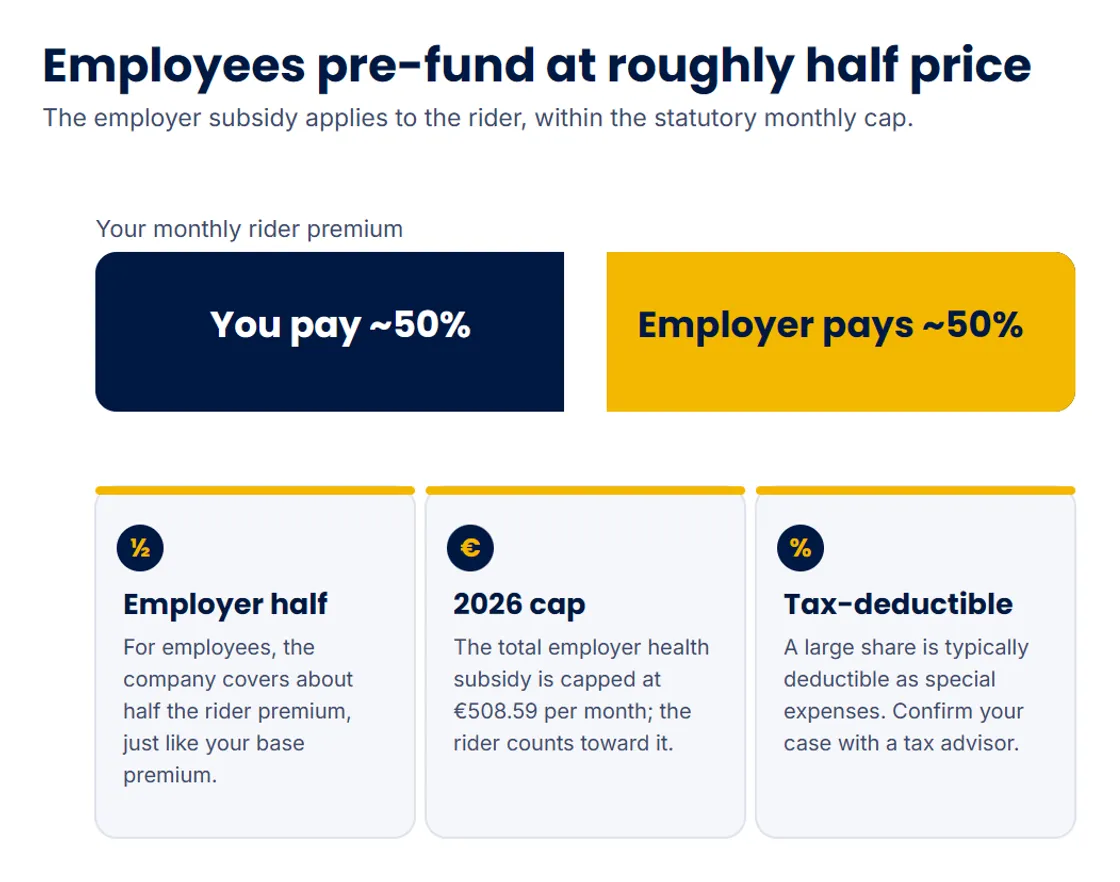
Employer subsidy and taxes
The reason the component works best for employees: the employer subsidy applies to it. Your employer pays roughly half of the rider premium, as long as your total subsidy stays under the statutory monthly maximum of just over EUR 500 in 2026. Effectively you pre-fund your retirement premium at half price. A large share of the contribution is also typically deductible as special expenses when the tariff is classed as basic cover; the exact share depends on the tariff composition, so confirm your case with a tax advisor. Self-employed clients get neither the employer half nor, usually, a compelling case: without the subsidy, flexible private investing tends to beat the rider on returns.
- Employees: employer pays about half the rider premium within the statutory cap.
- A large share is typically tax-deductible; confirm the exact treatment with a tax advisor.
- Self-employed: usually better served by flexible investing.
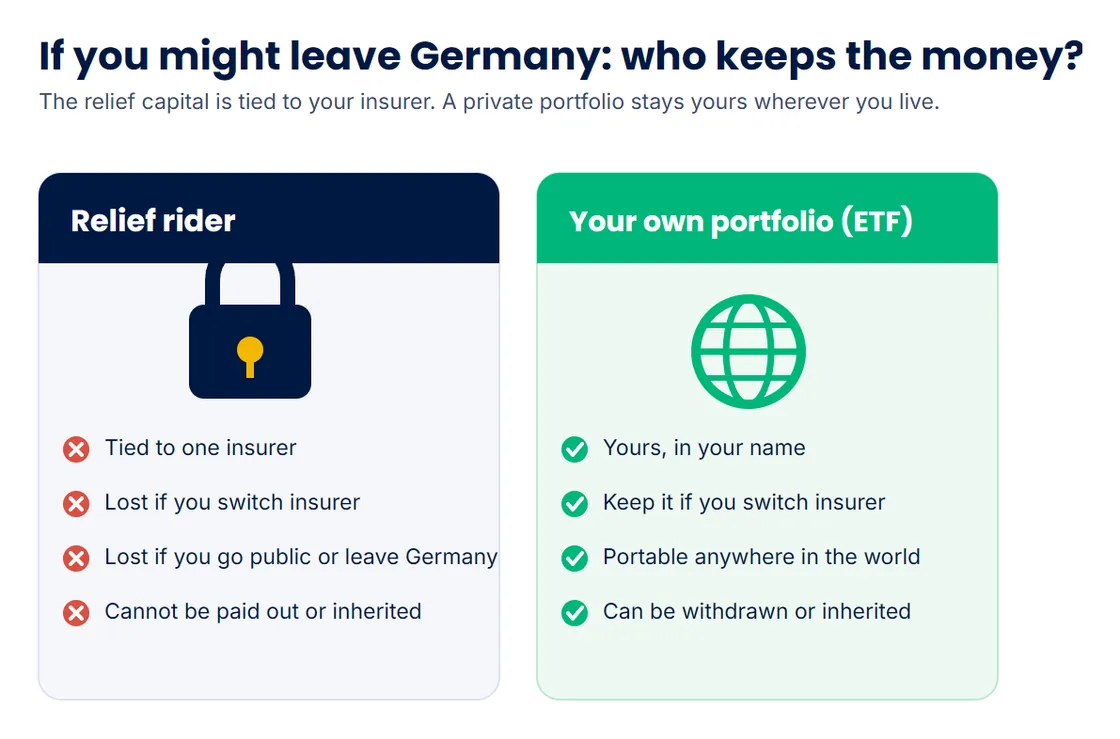
The catch for international residents
The paid-in capital is tied to your insurer. If you switch to a different private insurer, return to public insurance or leave Germany for good, the accumulated relief capital generally stays behind; it cannot be paid out, transferred or inherited. That makes the component a bet on staying with your insurer until retirement. For internationals who are confident about their long-term future in Germany and employed, the double subsidy makes it attractive. For anyone with a realistic exit scenario, an ETF portfolio does the same job and stays yours wherever you live. Compare it with your aging reserves, which follow similar rules, before you commit.
- Switch insurer, go public or leave Germany: paid-in capital is generally lost.
- Attractive for employees committed to Germany and their insurer long-term.
- Flexible investing beats the rider whenever an exit is realistic.
Relief rider vs. investing it yourself
Same goal, a cheaper premium later, reached in two very different ways.
Feature
Relief rider
Invest it yourself
How they compare
Choose a plan to compare
Common questions about premium relief

Check your situation in
Related guides
Two more pages that come up most often when people are at this stage.