
How Insurance Affects Net Salary in Germany: 2026 Guide
Germany's statutory health insurance system is defined by mandatory contributions that directly reduce your monthly take-home pay. Understanding how insurance affects net salary in Germany means knowing that about 17.5% of your gross salary goes toward health insurance alone, split equally between you and your employer. Add pension, unemployment, and long-term care contributions, and total deductions typically land between 30% and 40% of gross pay. Expats frequently receive their first German payslip and feel the shock of seeing their Nettoeinkommen (net income) sit well below expectations. This guide breaks down every deduction, shows you a real calculation, and explains how private health insurance can shift the numbers in your favor.
How insurance affects net salary in Germany: the full contribution picture
Germany's payroll deductions fall into five mandatory categories. Health insurance is the largest single item, but the others add up quickly.
| Contribution type | Total rate (2026) | Employee share |
|---|---|---|
| Health insurance | ~17.5% | ~8.75% |
| Pension insurance | 18.6% | 9.3% |
| Unemployment insurance | 2.6% | 1.3% |
| Long-term care (with children) | 3.6% | 1.8% |
| Long-term care (childless) | 4.2% | 2.4% |

The statutory health insurance base rate is 14.6%, with an official average supplementary contribution (Zusatzbeitrag) of 2.9% on top in 2026, for 17.5% in total. Each insurer sets its own Zusatzbeitrag, so your exact rate depends on which statutory fund you join. The employee pays half of the combined rate, which works out to approximately 8.75% of gross salary.
Long-term care insurance adds another layer. Childless employees pay 4.2% in total, while those with children pay 3.6%. As an employee you pay 2.4% without children and 1.8% with children, because the childless surcharge is not shared with the employer, so childless professionals lose a larger slice of their paycheck to this single line item.
One important limit applies to all these deductions. Contributions stop increasing once your salary hits the contribution ceiling of €69,750 per year for health and long-term care insurance. Earning above that threshold means your deductions are capped, which softens the blow for higher earners.
Pro Tip: Check your statutory fund's Zusatzbeitrag before enrolling. The difference between the lowest and highest rates across funds can amount to several hundred euros per year in net salary.
How do gross and net salary differ after insurance and taxes?
Your gross salary is what your employment contract states. Your net salary, or Nettoeinkommen, is what lands in your bank account after all deductions. The gap between the two surprises most expats.
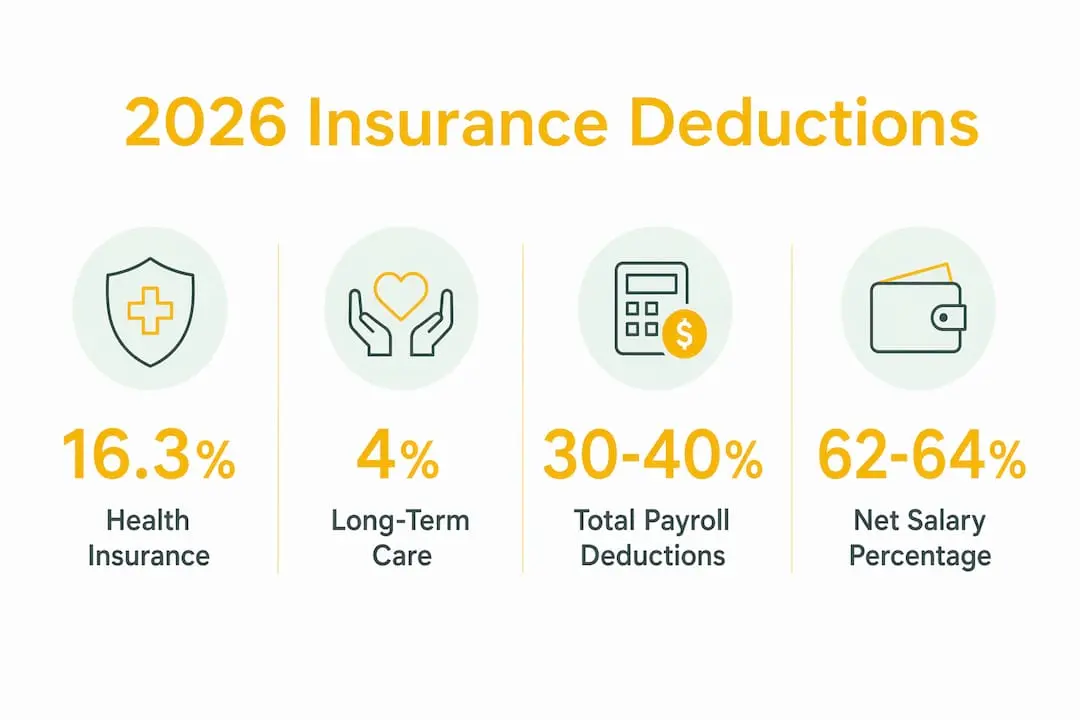
Expats typically take home between 58% and 70% of their gross monthly salary after taxes and social security contributions. That range is wide because tax class, family status, and church tax all shift the final number.
A concrete example makes this clearer. Take a gross monthly salary of €4,000:
- Health insurance (employee share, ~8.75%): €350
- Pension insurance (employee share, 9.3%): €372
- Unemployment insurance (employee share, 1.3%): €52
- Long-term care (childless employee share, 2.4%): €96
- Income tax (Tax Class I, no church tax, approximate): €520–€530
Total deductions land around €1,390–€1,410, leaving a net salary of roughly €2,590–€2,610. That is about 65% of gross, which sits squarely in the typical range. Church tax, if you pay it, takes roughly another €45.
Your employer pays an equal share of social contributions on top of your gross salary. That amount never appears in your payslip. Tax class selection and family status significantly affect net salary, which is why general percentage estimates are only a starting point. A formal gross-net calculator gives you a personalized figure that beats any rule of thumb.
| Gross monthly salary | Approx. total deductions | Approx. net salary |
|---|---|---|
| €3,000 | €930–€970 | €2,030–€2,070 |
| €4,000 | €1,380–€1,420 | €2,580–€2,620 |
| €6,000 | €2,330–€2,380 | €3,620–€3,670 |
What impact does private health insurance have on net salary for expats?
Private health insurance works on a fundamentally different model from statutory coverage. Public health insurance premiums scale with your income. Private health insurance premiums are based on your age and health profile at the time you apply. That distinction creates a real net salary opportunity for higher earners.
Above the compulsory insurance threshold of €77,400 per year, you can opt out of statutory coverage and join a private insurer. For a healthy professional in their 30s, a private health insurance premium is often lower than the public health insurance contribution calculated on a high salary. The result is a higher monthly net take-home pay.
Your employer still contributes to your health insurance costs under private health insurance, but only up to the amount they would have paid under public health insurance. That employer subsidy partially offsets your private health insurance premium. You pay the difference between the subsidy and your actual premium out of pocket.
Key considerations before switching to private health insurance:
- Age matters. private health insurance premiums rise with age, so switching later in your career can be expensive.
- Dependents are not covered automatically. Under public health insurance, children and non-working spouses are covered for free. Private health insurance requires a separate policy for each family member.
- Returning to public health insurance is difficult. Once you leave statutory coverage, switching back is restricted once you are over 55.
- Health status affects eligibility. Pre-existing conditions can lead to premium surcharges or exclusions.
For a single, healthy expat earning above the threshold, private insurance can increase net pay meaningfully each month. For a family with children, the calculation often favors staying in public health insurance. Myhealthcarebroker runs this comparison for expats in plain English, so you can see the actual numbers before committing.
Pro Tip: Use a [private health insurance calculator](/calculator) to estimate your private health insurance premium before comparing it to your current public health insurance deduction. The difference is often larger than you expect.
How can expats optimize their net salary given insurance and social contributions?
Several legal strategies reduce the impact of insurance deductions on your net pay. None require complex tax schemes. They require knowing the rules.
Understand the contribution ceiling. Contributions for health and long-term care insurance cap at €69,750 annually. Once your salary crosses that line, additional income carries no additional social security deduction for those categories. This creates an inflection point where your effective deduction rate drops.
Choose the right tax class. Married expats often benefit from Tax Class III if one partner earns significantly more. This shifts the tax burden and raises the higher earner's net salary. Tax class changes require a formal application to the Finanzamt (German tax office).
Evaluate private health insurance eligibility annually. The compulsory insurance threshold is reviewed each year. If your salary crosses €77,400, you gain the option to switch. Reviewing this each january keeps you from missing the window.
Use a gross-net calculator. Net salary varies widely by individual factors like tax class and family status. A personalized calculation beats a general estimate every time. Myhealthcarebroker offers independent advice that combines insurance comparison with payroll context.
Negotiate employer benefits. Some employers offer tax-free allowances for transportation, meals, or equipment. These reduce your taxable gross without affecting your social contribution base, which raises net pay without changing your contract salary.
What hidden costs and benefits should expats know about?
The employer's contribution to your social insurance is mandatory and exactly equal to your own share. That employer share does not appear in your net salary, which causes many expats to underestimate their total compensation package. Your true employment cost to your employer is substantially higher than your gross salary.
Viewing deductions as pure loss misses the point. Each contribution funds a specific benefit:
- Health insurance covers doctor visits, hospital stays, and prescriptions with minimal out-of-pocket costs.
- Pension insurance builds your entitlement to a state retirement pension.
- Unemployment insurance provides income replacement if you lose your job.
- Long-term care insurance covers nursing home or home care costs if you need them later in life.
German payroll deductions are better understood as pre-paid benefits than as taxes. The statutory system means you rarely face a large medical bill, and your employer's matching contribution effectively doubles the value of what you put in.
The Zusatzbeitrag variation between statutory funds is a commonly overlooked cost. Funds set their own supplementary rate, and the spread between the lowest-cost and most expensive funds can be meaningful over a full year. Switching statutory funds is allowed once per year and takes effect the following month.
Long-term care contributions are income-dependent and scaled by number of children since 2023. Childless employees pay a higher rate, which is a permanent feature of the system, not a temporary surcharge. If you have children, registering them correctly with your insurer reduces your contribution rate.
Key Takeaways
Germany's mandatory insurance and social contributions reduce net salary by 30–40% of gross, but each deduction funds a concrete benefit that protects your financial security while living and working in Germany.
| Point | Details |
|---|---|
| Health insurance rate | The statutory rate is 17.5% in 2026 (14.6% plus the 2.9% official average Zusatzbeitrag), with the employee paying roughly 8.75% of gross salary. |
| Typical net salary range | International employees take home 58–70% of gross after taxes and all social contributions. |
| Contribution ceiling | Health and long-term care deductions cap at €69,750 annual gross, limiting costs for high earners. |
| Private insurance threshold | Earning above €77,400 per year makes you eligible to switch to private health insurance and potentially raise net pay. |
| Family status impact | Childless employees pay a higher long-term care rate; tax class choice also shifts net salary significantly. |
What expats notice when they read their first German payslip
The reaction is almost always the same. A professional earning a solid salary sees their net figure and assumes something has gone wrong. Nothing has gone wrong. The German system is simply different from what most expats experienced in the US, the UK, or Southeast Asia.
The detail expats miss most often is the employer's matching contribution when they weigh a job offer. Your employer pays roughly the same amount in social contributions as you do. That is real compensation, even if it never touches your bank account. When you compare a German salary to an equivalent offer in a lower-tax country, you need to account for what those contributions replace: private health coverage, private pension contributions, and income protection insurance that you would otherwise buy yourself.
The private insurance question causes the most confusion. Expats earning above the threshold sometimes switch to private health insurance without fully understanding the family coverage gap. A single professional in their 30s can genuinely come out ahead on net pay. A professional with a non-working spouse and two children almost always pays more in total private health insurance premiums than they would under public health insurance, even if their own premium looks attractive. The math only works when you run the full household calculation.
One honest point stands out: treat your first year in Germany as a learning year. Get the personalized calculation done, understand your tax class options, and revisit the private health insurance question every january when the threshold is reviewed. The public vs. private insurance comparison is not a one-time decision. It is an annual checkpoint.
How Myhealthcarebroker helps expats make sense of their net salary
Understanding German health insurance in a second language, while also trying to make sense of payroll deductions, is genuinely hard. Myhealthcarebroker exists to make that process straightforward.
As an independent consultancy, Myhealthcarebroker compares Private health insurance options across providers and explains the real impact on your net salary in plain English. The team works with expat employees at every income level, from those just crossing the private health insurance eligibility threshold to senior professionals renegotiating their coverage. You can start with the private health insurance calculator to see estimated premiums instantly, then speak with an advisor who will walk through the full household calculation with you. No jargon, no pressure, and no obligation to any single insurer.
 Written and reviewed byBettina Ostermann