
Family Coverage Public Health Insurance in Germany (2026)
Family coverage public health insurance in Germany is defined as the statutory co-insurance system known as Familienversicherung, which allows eligible spouses, registered partners, and children to be covered under a primary public health insurance member's plan at no additional cost. Governed by § 10 SGB V, this system is one of the most financially significant benefits in Germany's public health insurance framework. For families new to Germany or reassessing their coverage, understanding Familienversicherung is the difference between paying hundreds of euros per month in extra premiums and paying nothing. The 2026 income threshold for dependents sits at €565 per month, making eligibility both specific and worth verifying carefully.
Who qualifies for family coverage under public health insurance?
Eligibility for Familienversicherung rests on four core conditions. The dependent must be a spouse, registered partner, or child of the primary public health insurance member. They must reside primarily in Germany. Their income must stay below the statutory threshold. And they cannot hold their own independent statutory insurance obligation or be privately insured.

The 2026 income limits are precise. Dependents may earn up to €565 per month under standard conditions. For those in a minijob arrangement, the limit rises to €603 per month. These figures are calculated as one-seventh of the monthly social-insurance reference value (Bezugsgröße). Exceeding either threshold by even one euro disqualifies the dependent from free co-insurance for that month.
Children receive especially generous coverage terms. Children are covered until age 18, with the period extended to age 25 if they are in education or vocational training. Children with disabilities face no upper age limit at all. This makes Familienversicherung a long-term planning tool for families with children in university or with special needs.
Several groups are automatically excluded from eligibility:
- Spouses or partners who are themselves subject to compulsory statutory insurance (for example, as employees above the mini-job threshold)
- Family members who are privately insured under a private health insurance contract
- Individuals who are self-employed above the income limit
- Children whose higher-earning parent is in private health insurance and whose income exceeds the public health insurance threshold (more on this in the mixed-household section)
Pro Tip: If your spouse recently changed jobs or started freelancing, re-check their income against the €565 monthly limit immediately. A mid-year income increase can terminate free family coverage retroactively.
Marital status also matters. Unmarried partners do not qualify as "family members" under § 10 SGB V. Only legally married spouses and registered partners (eingetragene Lebenspartner) are eligible. Cohabiting but unmarried couples must each carry their own insurance.
How to apply for family co-insurance: process and documents
Family co-insurance is not automatic. You must actively apply through the primary member's Krankenkasse (statutory health insurance fund). Many families assume coverage begins the moment a child is born or a spouse stops working. It does not. The application triggers the coverage.
The standard application process follows these steps:
- Contact the primary member's Krankenkasse. Request the family co-insurance application form. Most major funds offer this online or in English upon request.
- Gather the required documents. These typically include proof of income for the dependent (recent payslips or a self-declaration), a marriage certificate or civil partnership certificate for spouses, and a birth certificate for children.
- Submit proof of student or trainee status for children over 18. A current enrollment certificate from a university or vocational school is required each semester.
- Receive written confirmation. The Krankenkasse will issue a confirmation letter and, where applicable, a health insurance card for the co-insured family member.
- Report any changes immediately. Income increases, a child finishing school, or a spouse returning to work all affect eligibility and must be reported without delay.
Failing to report changes is the most common and costly mistake families make. Unreported income or status changes can trigger retroactive premium demands or termination of coverage. The Krankenkasse can bill the primary member for the full individual contribution going back to the date the eligibility condition was broken.
Pro Tip: Set a calendar reminder each september to submit a fresh enrollment certificate for any child in university. Missing this deadline is the single most common reason children lose free coverage mid-year.
Most Krankenkassen accept documents by email or through their online portals. If you are communicating in English, state this upfront. Many funds have English-speaking staff or can route your inquiry accordingly.
What does Familienversicherung actually cover?
Co-insured family members receive the full standard public health insurance benefit package. This includes visits to general practitioners and specialists, hospital treatment, prescription medications (subject to standard co-payments), preventive care, dental checkups, and mental health services. The coverage is identical to what the primary insured member receives.
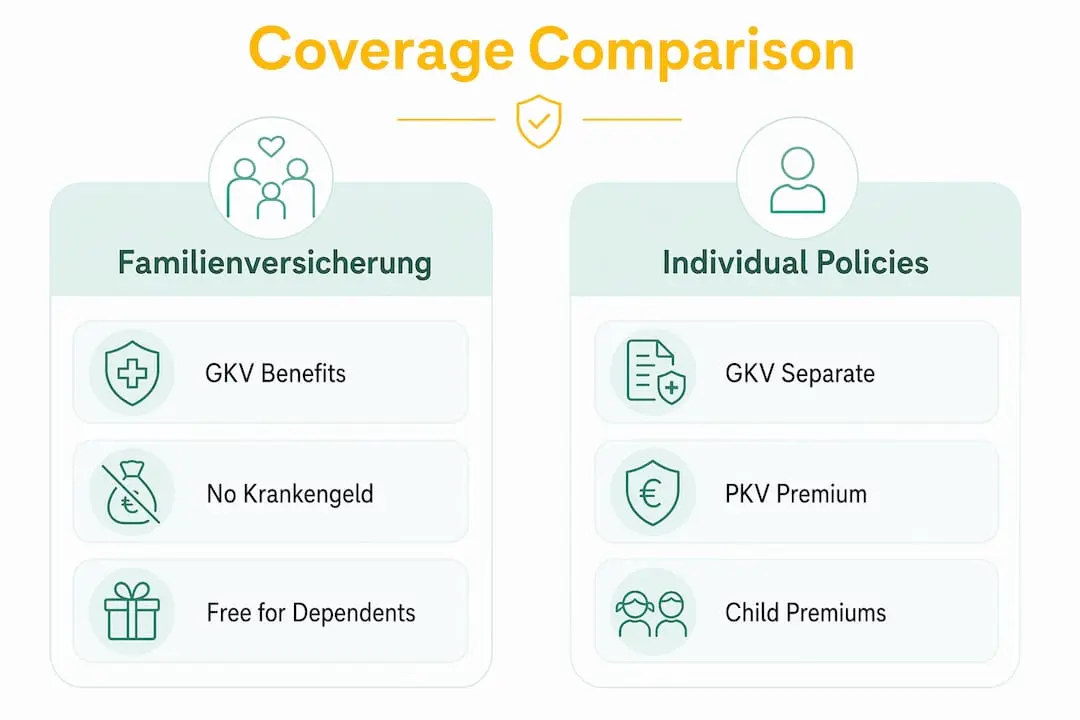
The most significant limitation is the absence of Krankengeld. Co-insured dependents have no independent entitlement to sickness benefit (Krankengeld). Only the primary insured member, who pays contributions, can claim Krankengeld after six weeks of illness. A co-insured spouse who falls seriously ill and cannot work receives no income replacement from the public health insurance. This is a meaningful financial gap for families where the non-working spouse has no other income protection.
The table below shows the key differences between Familienversicherung and individual public or private health insurance policies:
| Feature | Familienversicherung | Individual public health insurance policy | Individual private health insurance policy |
|---|---|---|---|
| Monthly premium | €0 for dependent | Contribution-based | Risk-based, age-dependent |
| Doctor and hospital coverage | Full standard public health insurance | Full standard public health insurance | Broader, tariff-dependent |
| Sickness benefit (Krankengeld) | Not available | Available | Optional add-on |
| Prescription coverage | Standard public health insurance | Standard public health insurance | Tariff-dependent |
| Dental coverage | Basic public health insurance | Basic public health insurance | Often more extensive |
| Coverage for children | Until 18, or 25 in education | Per individual contract | Per individual contract |
Private health insurance requires a separate contract and premium for every family member. Child premiums in private health insurance range from €100 to €250 per month depending on age and the chosen tariff. For a family with two children, that alone adds €200–€500 per month in insurance costs. This contrast makes Familienversicherung one of the most financially compelling features of the German public vs. private insurance decision for families.
How do mixed public and private health insurance households work?
Mixed households, where one parent holds public health insurance and the other holds private health insurance, create the most complex eligibility questions in German family health insurance. The rules here are specific and often misunderstood.
The governing rule comes from § 10 Abs. 3 SGB V. In a married couple where one parent is in public health insurance and the other is in private health insurance, children can only access free family co-insurance under the public health insurance parent's plan if the private health insurance parent's income does not exceed the public health insurance parent's income. If the private health insurance parent earns more, the children cannot be co-insured for free under public health insurance. They must be individually insured, either through private health insurance or through their own public health insurance policy.
The 2026 income test threshold is €6,450 per month, equivalent to one-twelfth of the annual income threshold (Jahresarbeitsentgeltgrenze) of €77,400. This figure is used to assess whether the private health insurance parent's income triggers the exclusion rule.
Key scenarios for mixed households:
- Public health insurance parent earns more than private health insurance parent: Children qualify for free family co-insurance under the public health insurance parent's plan.
- Private health insurance parent earns more than public health insurance parent: Children must be individually insured. Private health insurance contracts are required for each child, or the children can join public health insurance independently.
- Unmarried parents: The income comparison rule does not apply. Children of unmarried parents can be co-insured under the public health insurance parent's plan regardless of the other parent's income, provided all other eligibility conditions are met.
- Employer subsidies in private health insurance: When children must hold individual private health insurance contracts, the private health insurance parent's employer subsidy (Arbeitgeberzuschuss) can be applied toward the child's premium. This partially offsets the cost.
The unmarried parent exception is one of the least-known rules in this area. Families who are not legally married but are raising children together may actually face lower insurance costs for their children than married couples in the same income situation. For Private health insurance for families, the structure of your household matters as much as your income.
Key Takeaways
Free family co-insurance under Germany's public health insurance system is one of the most valuable benefits available to families, but it requires active management, accurate income reporting, and a clear understanding of eligibility rules to retain.
| Point | Details |
|---|---|
| Income threshold for 2026 | Dependents must earn no more than €565/month (€603 for minijobs) to qualify. |
| Application is not automatic | Families must actively apply and submit documents to the Krankenkasse to activate coverage. |
| No sickness benefit for dependents | Co-insured family members cannot claim Krankengeld, unlike the primary insured member. |
| Mixed households follow income rules | In married public or private health insurance households, children's eligibility depends on which parent earns more. |
| Private health insurance costs significantly more per child | Individual private health insurance child premiums run €100–€250 per month, making public health insurance co-insurance a major cost advantage. |
What families most often get wrong about Familienversicherung
Families most often run into trouble not because they misunderstand the rules, but because they assume the system will manage itself. It will not. Familienversicherung is a conditional benefit. The Krankenkasse does not send reminders when your child turns 25 or when your spouse's freelance income creeps above €565. That responsibility sits entirely with you.
The most expensive mistake is the retroactive billing scenario. A spouse starts a small side business, earns €600 in one month, and forgets to report it. Twelve months later, the Krankenkasse audits and issues a back-bill for individual contributions covering the entire period. That bill can run into thousands of euros. One conversation with your fund at the start of any income change prevents this entirely.
For mixed public or private health insurance households, get the income comparison in writing before making any decisions about children's coverage. The rules under § 10 Abs. 3 SGB V are clear, but applying them to a specific household requires actual numbers. Assumptions here are costly.
The broader point is this: Familienversicherung is genuinely generous. Free coverage for a spouse and multiple children, with full public health insurance benefits, is a financial advantage that families in most countries do not have access to. The system rewards those who understand it and manage it actively. For families weighing whether to stay in public health insurance or move to Private health insurance in Germany, the value of free family co-insurance is often the single most important factor in the calculation.
How Myhealthcarebroker helps families choose the right coverage
Choosing between public and private health insurance for your family is rarely straightforward, especially when income thresholds, marital status, and children's education timelines all interact. Myhealthcarebroker provides independent advice in English, with no ties to any single insurer.
Whether you need help confirming your family's eligibility for free co-insurance, understanding what happens when a child finishes university, or comparing the real cost of Private health insurance options against public health insurance family coverage, Myhealthcarebroker walks you through every step. You can also use the insurance cost calculator to see what individual private health insurance premiums would look like for your family before making any decisions. The advice is clear, the process is in English, and the goal is always the plan that genuinely fits your situation.
 Written and reviewed byBettina Ostermann