
Private Ambulance Coverage in Germany: 2026 Guide
Private ambulance coverage in Germany is included within your health insurance plan, whether statutory or private, and emergency transport costs are rarely billed directly to you as a patient. Calling 112 connects you to the national emergency dispatch system, and the resulting ambulance ride is covered under both statutory health insurance and private health insurance when paramedics determine the transport is medically necessary. The key differences lie in co-payment amounts, billing processes, and tariff conditions. This guide breaks down exactly how private ambulance coverage works in Germany, who qualifies for private insurance, and what steps protect you from unexpected costs.
What is private ambulance coverage in Germany?
Ambulance coverage in Germany is defined by one core principle: medical necessity determines whether your insurance pays, not the type of insurance you hold. Paramedics at the scene make that call. If they confirm the transport is medically necessary, your insurer is obligated to cover it under the terms of your plan.
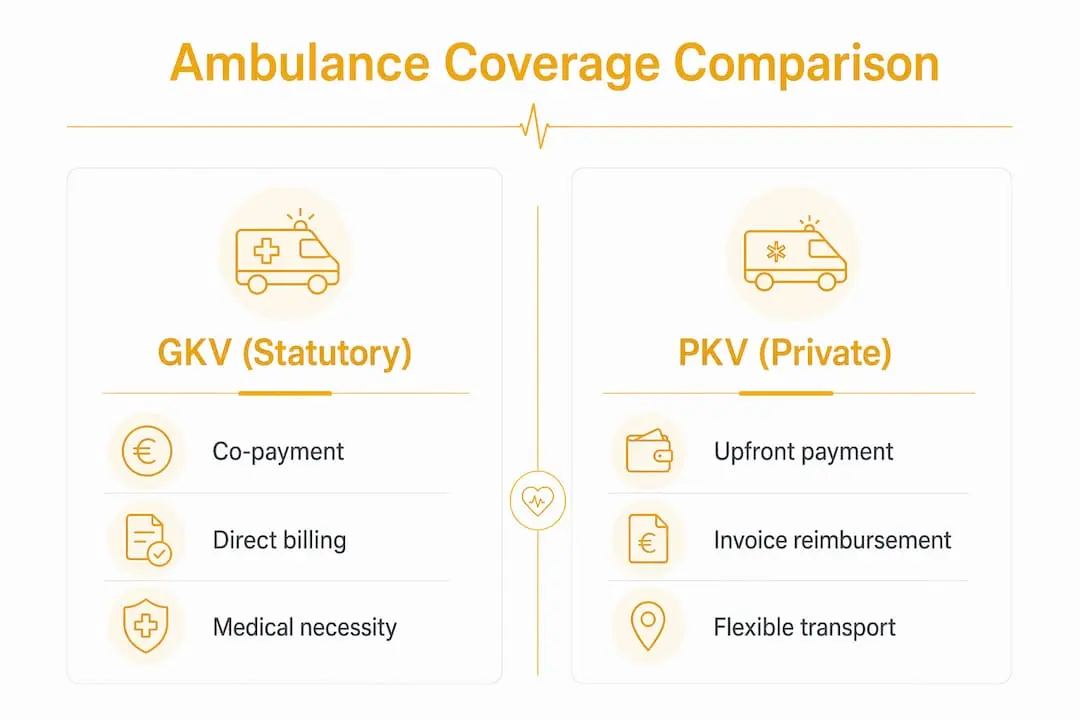
Under public health insurance, the statutory system, you pay a co-payment of 10% per ambulance trip, with a minimum of €5 and a maximum of €10. Children under 18 pay nothing. Under private health insurance, private insurance typically covers the full cost of emergency ambulance transport, though the exact terms depend on your tariff.
A common misconception among expats is that ambulance rides in Germany generate enormous personal bills. Legitimate emergency calls are rarely billed to patients personally when the call is justified. The fear of a four-figure invoice is largely unfounded for genuine emergencies.
Patients often assume they need a separate ambulance insurance policy on top of their health plan. Comprehensive private health insurance tariffs include ambulance coverage by default. No add-on policy is required.
Who is eligible for private ambulance coverage?
Eligibility for private health insurance directly shapes the ambulance service benefits and billing options available to you. Not everyone in Germany can choose private health insurance freely.
Employees must earn above the annual income threshold of €77,400 to opt into private health insurance. Freelancers, the self-employed, and civil servants (Beamte) can choose private insurance regardless of income. Approximately 10% of the population is privately insured in Germany. That relatively small share reflects the income and employment barriers that keep most residents in the statutory system.
If you work for yourself, the freelancer guide to private cover covers how the application works.
Eligibility affects more than just plan access. It determines your billing relationship with providers, your reimbursement timeline, and the range of tariffs you can select. A higher-tier private health insurance tariff may cover helicopter transport or advanced life support ambulances in ways that a basic tariff does not.
Key eligibility facts at a glance:
- Employees: Must exceed the €77,400 annual income threshold to switch to private health insurance
- Freelancers and self-employed: Free choice of private health insurance regardless of income level
- Civil servants: Entitled to private health insurance with partial government subsidy (Beihilfe)
- Students: May access specific student private health insurance tariffs with different conditions
- Dependents: Each family member requires a separate private health insurance policy, unlike public health insurance family coverage
Pro Tip: If you are a freelancer or newly self-employed, [check your private health insurance eligibility](/eligibility-check) before assuming you must stay in the statutory system. Many freelancers qualify immediately and gain access to significantly broader ambulance and medical transport benefits.
How does ambulance coverage work under public health insurance versus private health insurance?
The billing process is where public and private health insurance diverge most sharply. Understanding this difference prevents surprises after an emergency.
Statutory insurance billing
Public health insurance operates on a solidarity principle. The insurer pays the ambulance provider directly, and you pay a co-payment of 10% per trip, capped at €10. The process is straightforward: show your electronic health card (eGK) at the scene, and the billing flows between the provider and your insurer automatically. No receipts, no reimbursement forms, no upfront payment.
Private insurance billing
Private health insurance works differently. Private ambulance invoices can range from €400 to €1,200 depending on the transport type and distance. You typically pay the invoice upfront and then submit it to your private health insurance insurer for reimbursement. That reimbursement timeline varies by insurer and tariff, but most process claims within a few weeks.

This upfront payment requirement catches many privately insured people off guard. Keeping a financial buffer for medical expenses is a practical necessity under private health insurance, not just a precaution.
Non-emergency transport rules
Non-emergency medical transport operates under stricter rules in both systems. A doctor's prescription (Verordnung) is required before the transport takes place. Without it, your insurer has the legal right to deny the claim entirely. Out-of-pocket costs for unprescribed non-emergency transport can reach €200–€500 or more.
Pro Tip: For planned medical transport, such as dialysis trips or post-surgery transfers, ask your doctor to issue the Verordnung before the transport date. Retroactive prescriptions are rarely accepted by insurers.
| Feature | Public health insurance (Statutory) | Private health insurance (Private) |
|---|---|---|
| Emergency coverage | Yes, when medically necessary | Yes, per tariff conditions |
| Co-payment | 10%, min €5, max €10 | Usually none (tariff-dependent) |
| Billing method | Direct to insurer, you pay co-pay | You pay upfront, then claim reimbursement |
| Children under 18 | No co-pay | Per tariff |
| Non-emergency transport | Requires Verordnung | Requires Verordnung |
| Invoice range | Capped co-pay only | €400–€1,200 before reimbursement |
What steps protect you from unexpected ambulance costs?
Avoiding personal liability for ambulance costs comes down to three things: calling correctly, carrying the right documents, and understanding what "medically necessary" means in practice.
- Call 112 for genuine emergencies. The number connects to the national dispatch system. Do not hesitate over cost concerns. A justified emergency call is covered.
- Carry your eGK and photo ID. public health insurance patients need their electronic health card at the scene. Private health insurance patients should carry their insurance details and policy number so the ambulance provider can issue the invoice to the correct address.
- Understand medical necessity. Paramedics determine whether the transport qualifies. If they assess that the situation does not require ambulance transport, they can decline to transport you. In that case, your insurer can reject the claim and you face the full municipal fee.
- Get a Verordnung for planned transport. Any non-emergency medical transport requires a written prescription from your treating physician before the trip. File this document with the invoice when submitting your claim.
- Keep all billing documents. private health insurance patients must retain the original invoice and any supporting medical documentation. Submit these together to your insurer for reimbursement.
Calling 112 for a non-emergency situation, such as a minor injury that does not require immediate hospital care, can result in full personal liability for the ambulance fee. Paramedics can deny transport if the situation does not meet the medical necessity threshold, and the municipal ambulance fee then falls entirely on the caller.
What are the key differences in private ambulance service benefits?
Private insurance offers broader potential coverage, but it is not unlimited. Tariff conditions set reimbursement limits and self-payment requirements that vary significantly between plans. Choosing a private health insurance plan without reading the ambulance-specific tariff clauses is a common mistake.
Several nuances separate private health insurance ambulance benefits from the simpler public health insurance model:
- Tariff variation: A basic private health insurance tariff may reimburse only standard ground ambulance transport. A premium tariff may cover helicopter evacuation and international medical repatriation.
- Prior notification requirements: Some private health insurance tariffs require you to notify the insurer before non-emergency transport. Skipping this step can reduce or void reimbursement.
- Waiting periods: Certain private plans impose waiting periods for specific benefits. Ambulance coverage for pre-existing conditions may be subject to exclusions in the first policy year.
- Premium structure: Private health insurance premiums are not income-based. They reflect your age, health status, and chosen tariff. A comprehensive tariff with full ambulance benefits costs more than a basic plan, and premiums rise with age.
- Reimbursement caps: Some tariffs cap ambulance reimbursement at a fixed euro amount per year. If your transport costs exceed that cap, you pay the difference.
The public vs. Private health insurance comparison is not simply about ambulance coverage. It is about the entire financial and medical relationship you enter with your insurer. Ambulance benefits are one line item in a much larger tariff document.
Private insurance requires active management. Submitting claims promptly, tracking reimbursements, and reviewing your tariff annually are responsibilities that public health insurance patients never face. That trade-off is worth understanding before you switch.
Key Takeaways
Private ambulance coverage in Germany is determined by medical necessity first and insurance type second, with private health insurance offering broader potential benefits but requiring active claim management that public health insurance does not.
| Point | Details |
|---|---|
| Medical necessity is the deciding factor | Paramedics determine coverage eligibility, not your insurance card type. |
| Public health insurance co-pay is capped | Statutory insurance limits your ambulance co-pay to a maximum of €10 per trip. |
| Private health insurance requires upfront payment | Private patients pay invoices of €400–€1,200 first, then claim reimbursement from their insurer. |
| Non-emergency transport needs a prescription | A doctor's Verordnung is required before any planned medical transport in both systems. |
| Tariff details define private health insurance benefits | Ambulance coverage scope, caps, and exclusions vary by private insurance tariff. |
Why ambulance coverage should not drive your private health insurance decision
Ambulance coverage is the wrong reason to choose private health insurance. A common pattern is people listing "better ambulance coverage" as a top reason for switching to private, when in almost every case they had not read the tariff conditions that actually govern that coverage.
The honest reality is this: for genuine emergencies, both public and private health insurance protect you. The €10 co-pay cap under public health insurance is not a financial hardship. Where private health insurance genuinely outperforms public health insurance is in areas like specialist access, dental benefits, single hospital rooms, and faster appointment scheduling. Those are the differences that affect your daily healthcare experience.
Treat ambulance coverage as a baseline expectation, not a differentiator. Every credible private tariff includes it. What you should scrutinize is the reimbursement cap, the prior notification clause, and whether helicopter transport is included if you spend time in rural or mountainous areas of Germany.
The long-term financial picture matters more than any single benefit. Private health insurance premiums rise with age, and a plan that looks affordable at 32 can become expensive at 55. Choosing a tariff with strong ambulance benefits but weak long-term premium stability is a trade-off that catches people off guard years later. Read the full tariff. Ask the hard questions. And if the German-language policy documents feel impenetrable, get help from someone who reads them every day.
How Myhealthcarebroker helps you find the right private health plan
Sorting through private health insurance tariffs in German is time-consuming, and the ambulance coverage clauses are rarely the clearest section of any policy document. Myhealthcarebroker works as an independent consultancy, comparing private health insurance options across providers to find the plan that fits your situation, not just the one with the most polished brochure.
Whether you want to understand what your current plan actually covers, compare private insurance providers in Germany, or use the Private health insurance premium calculator to estimate your costs, Myhealthcarebroker guides you through the process in plain English. The advice is independent, the process is transparent, and the support continues after your policy starts.
 Written and reviewed byBettina Ostermann