
Switching Insurers Mid-Year Germany: Your 2026 Guide
Switching insurers mid-year in Germany is legally possible, and the process is more manageable than most expats expect. German health insurance operates under two distinct systems: statutory insurance (Gesetzliche Krankenversicherung) and private insurance (Private Krankenversicherung). Each system has its own rules for when and how you can change providers. Follow the correct procedure for your system, and you can improve your coverage, reduce your monthly contribution, or both, without a single day of uncovered care.
When can you switch statutory health insurance mid-year?
The standard rule for public health insurance is a 12-month binding period before you can switch providers. That commitment starts from the date your current membership began, not from the calendar year. Once that period ends, you must give two months' notice to the end of a month.
The timing math is straightforward. Apply by May 31 and your new coverage starts August 1. Apply by March 31 and you switch on June 1. Missing a deadline by even one day pushes your start date back a full month, so mark your calendar carefully.
A more powerful option is the Sonderkündigungsrecht, or special cancellation right. This right activates whenever your current insurer raises its Zusatzbeitrag, which is the additional contribution rate charged on top of the base statutory rate. The special cancellation right lets you exit regardless of how long you have been a member, as long as you terminate by the end of the month the increase takes effect and apply a two-month notice period. Even a tiny rate increase triggers this right.
New employment also creates a brief switching window. When you start a new job, you have 14 days to choose a different statutory insurer. If you miss that window, your employer typically assigns you to a default provider.
- Confirm your 12-month period has passed (or identify a valid special cancellation trigger).
- Choose your new public health insurance provider and submit your application directly to them.
- Receive your membership certificate (Mitgliedsbescheinigung) from the new insurer.
- Hand the certificate to your employer or HR department promptly so payroll redirects contributions correctly.
- Let the new insurer handle cancellation. Since 2021, the new insurer notifies your old insurer electronically. You do not need to write a cancellation letter.
Pro Tip: Keep a copy of your membership certificate for your own records. HR departments occasionally misplace documents, and having your own copy prevents payroll errors that can take months to unwind.
How does switching private health insurance work mid-year?
Changing your private health insurance provider mid-year is a different challenge entirely. The German private insurance market distinguishes between two types of change: an Anbieterwechsel (switching companies) and a Tarifwechsel (switching tariffs within the same company). These two paths have very different financial consequences.

An Anbieterwechsel triggers a full new health assessment with the incoming insurer. Any pre-existing conditions you have developed since your original policy began can result in exclusions or higher premiums. More significantly, switching private health insurance providers causes you to lose most of the ageing provisions (Alterungsrückstellungen) you have built up. Only the Basistarif-equivalent portion transfers to the new insurer. The rest stays with your old company. For anyone over 50, that financial loss can be substantial.
To understand what builds up inside a policy over the years, read how ageing reserves in private health insurance work.
The ordinary cancellation notice for private health insurance is three months to the end of the insurance year. If your insurer raises premiums, a special cancellation right applies, giving you two months from the date of notification to exit. A signed new contract is legally required before you cancel your existing private health insurance policy. Canceling first and applying second creates an uninsured gap, which is both illegal and financially risky.
Key considerations before switching private health insurance providers:
- Age matters significantly. The older you are, the more ageing provisions you stand to lose in a company switch.
- Health history affects new premiums. Conditions developed after your original enrollment can raise your new premium or trigger exclusions.
- Internal tariff changes preserve provisions. A Tarifwechsel within your current insurer keeps your ageing provisions intact and skips the health assessment entirely.
- Returning to public health insurance after 55 is nearly impossible. Legal restrictions intentionally block late re-entry to statutory insurance to prevent adverse selection.
Pro Tip: Before contacting a new private health insurance insurer, ask your current provider about available tariffs within your existing contract. A [tariff change within private health insurance](/blog/tariff-levels-in-private-insurance-germany-2026-guide) often delivers the same cost savings without the financial penalties of a full company switch.
What paperwork and steps does a smooth insurer switch require?
A mid-year policy adjustment in Germany requires more than just picking a new insurer. The administrative side is manageable, but skipping any step creates delays or coverage gaps.
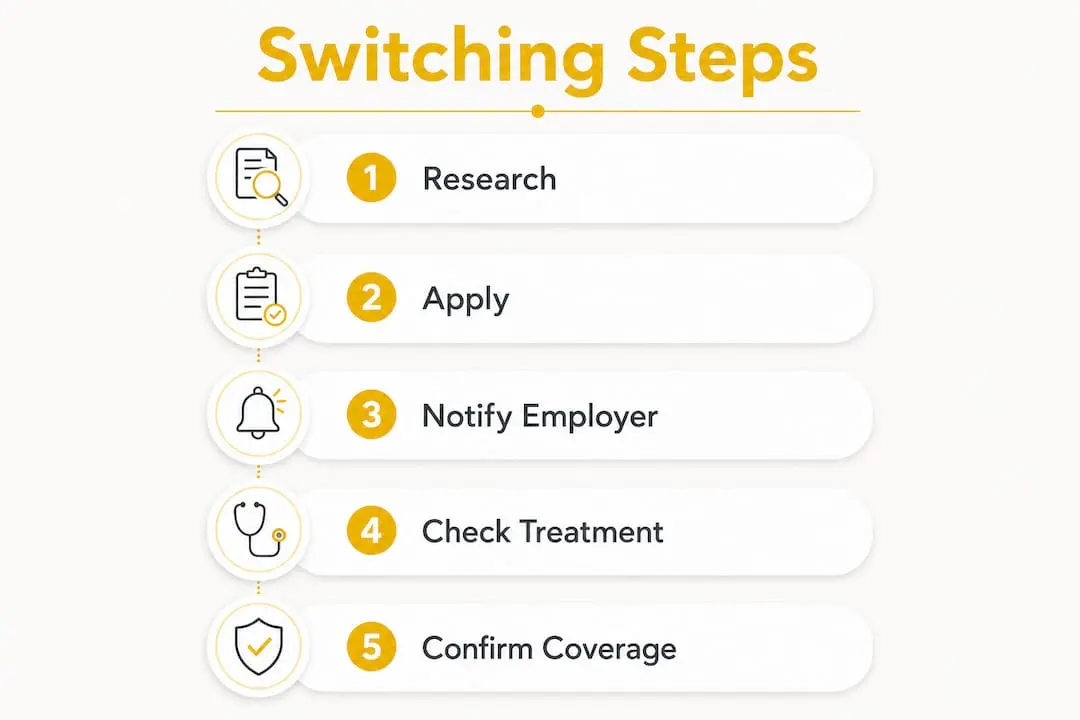
Research your options first
Compare providers on three factors: the Zusatzbeitrag rate, additional benefits beyond the legal minimum (such as dental, vision, or English-language service), and the insurer's track record with expat members. The Public health insurance options available in Germany vary more than most people realize, particularly in supplemental benefits and customer service quality.
Apply to the new insurer directly
Submit your application to the new provider. For public health insurance switches, the new insurer handles the rest electronically. For private health insurance switches, confirm your new contract is fully signed and active before taking any cancellation steps.
Notify your employer without delay
Failing to provide your membership certificate to your employer causes payroll to keep sending contributions to your old insurer. This creates a mess that can take several months to correct. Hand the certificate to HR the same week you receive it.
Check ongoing treatments
Notify your doctors and specialists of your new insurer. Some treatments require pre-authorization, and a mid-year switch can interrupt that process if your providers are not informed.
Bridging coverage for new arrivals
Expats arriving in Germany face a specific challenge: statutory coverage only starts on your official employment or enrollment date. If there are days between your arrival and that start date, you need transitional private insurance to cover the gap. This is a short-term policy, not a long-term commitment, and it prevents uninsured days that could otherwise create legal and financial complications.
What are the most common pitfalls when changing health insurance in Germany?
Most problems during a mid-year insurance change come from timing errors or missing paperwork. Knowing the pitfalls in advance saves you from weeks of administrative headaches.
- Ignoring the binding period. Attempting to switch before your 12-month public health insurance commitment ends results in rejection. Your application will not be accepted, and you remain with your current insurer.
- Missing the special cancellation deadline. The Sonderkündigungsrecht window is tight. If your insurer raises the Zusatzbeitrag and you miss the end-of-month deadline, you lose the right to exit early and must wait out the standard period.
- Not telling your employer. This is the most common administrative error. Payroll systems do not update automatically. Your HR department needs the membership certificate in hand.
- Canceling private health insurance before securing a new contract. This creates an uninsured period. German law requires continuous coverage, and a gap can result in back-payments and penalties.
- Underestimating health assessment requirements. private health insurance applicants with any health history since their last enrollment face scrutiny. Conditions that seem minor can affect your new premium significantly.
- Assuming you can return to public health insurance later. Once you are in private health insurance and past 55, returning to statutory insurance is effectively blocked by law. This is not a reversible decision for most people.
The single most expensive mistake private health insurance members make is canceling their old policy before the new one is confirmed in writing. Always have the signed contract in hand before you send any cancellation notice.
Key Takeaways
Switching health insurance mid-year in Germany is achievable for both public and private health insurance members, but the rules, timelines, and financial consequences differ sharply between the two systems.
| Point | Details |
|---|---|
| Public health insurance binding period | You must complete 12 months with your current statutory insurer before switching. |
| Special cancellation right | A Zusatzbeitrag increase lets you exit public health insurance early, with two months' notice from the increase date. |
| Private health insurance ageing provisions | Switching private health insurance companies forfeits most accumulated ageing provisions; an internal tariff change avoids this loss. |
| Employer notification | Deliver your membership certificate to HR immediately to prevent payroll errors. |
| Private health insurance return restriction | Returning to statutory insurance after age 55 is legally blocked in almost all cases. |
What mid-year switching really looks like in practice
The automation introduced in 2021 genuinely changed the experience for public health insurance switchers. Before that, you had to send a formal cancellation letter, track acknowledgment, and hope the timing aligned. Now the new insurer handles it digitally, and the process is far less stressful. For most expats in public health insurance, switching today is closer to changing a phone plan than working through a bureaucracy.
Private health insurance is a different story, and the industry tends to undersell how complex it really is. The ageing provisions issue is not just a footnote. Policyholders in their mid-40s sometimes assume switching private health insurance providers will save them money, only to find the provisions they would lose outweigh years of premium savings. An internal tariff change is almost always the smarter first move, and it is consistently overlooked because it does not feel like a "real" switch.
Another frequent problem is expats who arrive in Germany and assume their coverage starts immediately. It does not. The gap between arrival and your first working day is real, and transitional insurance is not optional. A single hospital visit during that window without coverage can cost thousands of euros.
Myhealthcarebroker's advice: review your insurance plan every year, not just when something goes wrong. Zusatzbeitrag rates shift annually, and what was competitive two years ago may not be today. If you are in private health insurance, get a proper comparison of Private health insurance options before assuming your current plan is still the right fit. And if the process feels complicated, that is because it genuinely is. There is no shame in getting expert help.
How Myhealthcarebroker helps you switch with confidence
Myhealthcarebroker specializes in guiding expats and skilled professionals through exactly this process, in plain English, with no pressure and no jargon.
Whether you are weighing a public health insurance switch to cut your Zusatzbeitrag or evaluating whether a private health insurance company change actually makes financial sense, Myhealthcarebroker compares options across providers and explains the real numbers. The Private health insurance companies in Germany page gives you a current overview of private health insurance providers, while the eligibility check tool helps you confirm whether private insurance is even an option for your situation. From your first question to your final application, Myhealthcarebroker handles the complexity so you can focus on making the right decision, not decoding German insurance law.
 Written and reviewed byBettina Ostermann