
Moving to Germany from the USA: Your 2026 Practical Guide
Yes — U.S. citizens can move to Germany long-term. Most Americans can enter visa-free for up to 90 days and, under §41 AufenthV, apply for a long-term residence permit from inside Germany without returning home first. The single most important thing you can do the moment you decide to move: secure accommodation that allows Anmeldung (address registration) and get your Wohnungsgeberbestätigung from the landlord. That one document unlocks your tax ID, your bank account, and your path to a residence permit.
Your three immediate priorities are straightforward. First, gather your visa documents or book a consulate appointment if your chosen route requires one (the Opportunity Card is the main exception that must be applied for before you travel). Second, arrange day-one health insurance or proof of coverage, because Germany requires it from the moment you establish residency. Third, plan to register at the Bürgeramt within 14 days of arrival and book your Ausländerbehörde appointment as early as possible, since wait times in major cities can stretch for weeks.
The rest of this guide walks you through every step in the order you will actually need it.
Key Takeaways
Americans moving to Germany from the USA must complete Anmeldung within 14 days of arrival, arrange day-one health insurance, and book their Ausländerbehörde appointment immediately, because each step unlocks the next.
| Point | Details |
|---|---|
| Secure Wohnungsgeberbestätigung first | Ask your landlord for this form before signing; without it, Anmeldung and everything downstream stalls. |
| Arrange day-one health insurance | Germany requires proof of coverage from the moment you establish residency; start private health insurance underwriting before you leave the U.S. |
| Book Ausländerbehörde immediately | Appointment slots in major cities fill weeks out; book online on arrival day and request a Fiktionsbescheinigung if your 90-day window is at risk. |
| File U.S. taxes and FBAR annually | U.S. citizens abroad still file federal returns; FBAR is required when foreign accounts exceed $10,000 in aggregate at any point during the year. |
| Blue Card offers the fastest PR path | Degree-holders with a qualifying job offer who reach B1 German can apply for permanent residence after 21 months. |
Table of Contents
- Which visa or residence permit fits your situation when moving to Germany from the USA?
- How do you apply for a residence permit, and how long does it take?
- Why Anmeldung is the gateway to everything else in Germany
- How to open a German bank account and what Schufa means for you
- What you need to know about mandatory health insurance in Germany
- Finding a rental in Germany as an American newcomer
- Working in Germany: taxes, social contributions, and your U.S. filing obligations
- Special paths: students, families, and freelancers
- Your first 30 days in Germany: a sequenced action plan
- Complete documents checklist for your consulate or Ausländerbehörde appointment
- Realistic costs and first-year budget for Americans moving to Germany
- Language requirements and getting your qualifications recognized
- How Myhealthcarebroker can simplify your health insurance setup
- What actually trips people up when moving from the U.S. to Germany
- Sources
Which visa or residence permit fits your situation when moving to Germany from the USA?
Germany offers several distinct routes for Americans, and the right one depends on whether you have a job offer, a degree, a German spouse, or simply the savings and skills to job-search on the ground. BAMF defines the permit categories and the Ausländerbehörde (Foreigners' Authority) is the office that issues them once you are in Germany.
EU Blue Card
The Blue Card is the fastest route for degree-holders with a concrete job offer. According to Workvisa, the EU Blue Card requires a recognized university degree and a salary meeting the annual threshold for your occupation (general professions and shortage occupations have different floors, so confirm the current figure with your employer or the Federal Foreign Office before signing). The Blue Card's biggest advantage is the PR timeline: holders who reach B1 German can apply for permanent residence after just 21 months.
Skilled worker visa
If your qualifications are vocational rather than academic, the Skilled Worker Visa covers recognized trade and vocational credentials. You will need your U.S. qualifications formally recognized through the relevant German authority before applying. The Make-it-in-Germany portal at Make-it-in-germany runs a Quick-Check tool that maps your occupation to the right permit type and recognition body.
Opportunity Card (Chancenkarte)
The Chancenkarte is Germany's points-based job-search permit, introduced to let qualified candidates come to Germany and find work without a pre-arranged offer. Points are awarded for qualifications, work experience, language skills, and age. This is the one route that cannot be applied for inside Germany. You must apply at a German consulate or embassy before you travel. Once in Germany on a Chancenkarte, you have up to a year to find qualifying employment and convert to a work permit.
Job Seeker visa
Similar in spirit to the Chancenkarte but predating it, the Job Seeker Visa allows degree-holders to enter Germany for up to six months to search for work. A recognized degree, proof of funds to support yourself, and health insurance are required. It does not allow you to work during the search period.
Freelance and self-employment visa
Freelancers and entrepreneurs can apply for a residence permit under §21 AufenthG. The Ausländerbehörde will want to see a credible business plan, evidence of client demand or existing contracts, and proof that your work is financially sustainable. Acceptance criteria vary noticeably by city, with some offices more receptive than others.
Student visa
A letter of admission from a recognized German university is the core requirement. You will also need a blocked account (Sperrkonto) showing sufficient funds for the academic year, health insurance, and proof of German language proficiency if your program requires it.
Family reunification
If your spouse or parent is a German citizen or holds a German residence permit, you may qualify for family reunification. The sponsoring family member must demonstrate sufficient income and housing space. A1-level German is typically required for spouses joining non-EU nationals.
Quick eligibility self-check
Before you apply, run through these questions:
- Do you hold a recognized university degree or vocational qualification?
- Do you have a job offer, or do you need time to search?
- Is your U.S. degree or credential recognized in Germany (check anabin.kmk.org)?
- Can you demonstrate sufficient funds to support yourself during a job-search or study period?
- Do you have a German-language certificate, or do you need to obtain one?
- Are you joining a family member already in Germany?
Your answers will point you to the right route. The Federal Foreign Office publishes route-specific checklists and recommends using the Consular Services Portal to confirm current requirements before submitting anything.
How do you apply for a residence permit, and how long does it take?
The §41 AufenthV advantage for Americans
Under §41 AufenthV, U.S. citizens who enter Germany visa-free can apply for most residence permits directly at the local Ausländerbehörde without first obtaining a national visa from a consulate. This is a meaningful practical advantage: you can arrive, complete Anmeldung, and then file your permit application in Germany. The Opportunity Card is the clear exception — it must be applied for abroad.
National visas issued by a German consulate are typically valid for up to a year and must be converted to a full residence permit after entry, as the Federal Foreign Office explains. If you choose the consulate route (for example, because you want certainty before leaving the U.S.), expect the consulate to issue a visa that you then convert at the Ausländerbehörde within the first few months of arrival.
Typical processing times and fees
| Permit type | Typical processing time | Approximate fee |
|---|---|---|
| EU Blue Card | 4–8 weeks | €100 to €140 |
| Skilled Worker | 4–10 weeks | €100 to €140 |
| Freelance/Self-employment | 6 weeks or more | €100 to €140 |
| Student | 4–8 weeks | €100 to €140 |
| Family Reunification | 6 weeks or more | €80 to €140 |
| Opportunity Card | several weeks (consulate) | €75 |
Processing times vary significantly by city. Berlin and Munich Ausländerbehörde offices are often booked weeks or months out. Smaller cities tend to move faster.
What to do if your 90 days run out before your appointment
If your Ausländerbehörde appointment or permit decision extends beyond your 90-day visa-free window, you can request a Fiktionsbescheinigung under §81 AufenthG. This document legally bridges your stay during processing and confirms you are permitted to remain in Germany while your application is pending. Note that different types of Fiktionsbescheinigung carry different rules about re-entering Germany if you travel abroad during that period, so clarify with your local office before booking any international travel.
Practical tactics for your appointment
Book your Ausländerbehörde appointment the day you arrive, or even before you land if the local office allows online booking. Bring certified translations of any non-German documents (degree certificates, birth certificates, employment contracts). Many offices require biometric photos taken to German specifications (35mm x 45mm, plain light background). Originals and copies of every document are standard practice.
Your local Ausländerbehörde is determined by your registered address, which is another reason Anmeldung comes first.
Why Anmeldung is the gateway to everything else in Germany
The Local describes Anmeldung and the Wohnungsgeberbestätigung as the most critical early paperwork items, because they unlock your tax ID, bank account, and access to health insurance. That assessment is accurate. Without a Meldebescheinigung (the confirmation you receive after registering), most German banks will not open an account for you, and many insurers cannot complete enrollment.
The legal deadline and what you need
You must register at the Bürgeramt within two weeks of moving into your accommodation. The key document your landlord must provide is the Wohnungsgeberbestätigung, a written confirmation that you live at that address. Without it, the Bürgeramt cannot process your registration.
Documents to bring to your Bürgeramt appointment:
- Valid U.S. passport
- Completed Anmeldung form (available on the Bürgeramt website or at the office)
- Wohnungsgeberbestätigung signed by your landlord
- Rental contract (advisable to bring, though not always mandatory)
The Bürgeramt issues your Meldebescheinigung on the spot. Your Steuer-ID (tax identification number) arrives by post within two to four weeks at your registered address. Keep that postcard — you will need the number for payroll, banking, and tax filing.
Practical tips for securing Anmeldung quickly
Pro Tip: Ask your landlord for the Wohnungsgeberbestätigung in writing before you sign the rental contract. Some landlords are unfamiliar with the form; having the official template ready (downloadable from most Bürgeramt websites) speeds things up considerably.
If you are in temporary housing (a hotel, Airbnb, or short-term furnished apartment), check explicitly whether the host will provide a Wohnungsgeberbestätigung. Many short-term rental hosts will not, which means you cannot register at that address. Furnished apartments listed on platforms targeting expats often advertise "Anmeldung possible" precisely because they know this matters. Registering as a subtenant is also valid, provided the primary tenant or landlord provides the confirmation.
Bürgeramt appointments in Berlin and Munich fill up fast. Book online the moment you have a confirmed address. Some offices accept walk-ins early in the morning, but this is not guaranteed.
How to open a German bank account and what Schufa means for you
Opening a German bank account is straightforward once you have your Meldebescheinigung, but U.S. citizens face one specific complication: FATCA. Under the Foreign Account Tax Compliance Act, German banks are required to report U.S. account holders to the IRS. Some banks, particularly smaller regional institutions, decline U.S. customers entirely to avoid the compliance burden. This is worth knowing before you walk into a branch.
What banks typically require
Most German banks ask for your passport, Meldebescheinigung, and residence permit (or proof of pending application). A basic current account (Girokonto) is what you need first. N26's expat guide lists opening a German bank account as one of the core newcomer tasks, alongside Anmeldung and health insurance enrollment.
N26 is an online bank that has historically been more accessible to U.S. citizens than traditional branches, though FATCA compliance requirements apply there too. Deutsche Bank, as one of Germany's largest universal banks, has dedicated expat services and English-speaking staff at many branches, making it a practical choice for Americans who prefer in-person support. Sparkassen (savings banks) are widely available and useful for everyday banking, but their willingness to open accounts for U.S. citizens varies by branch.
A practical workaround: keep your U.S. bank account active and use an international transfer service to bridge funds while your German account is being set up. This also gives you a fallback if your first German bank application is declined.
Understanding Schufa
Schufa is Germany's primary credit reference agency. Landlords check it before signing a lease; banks check it before approving credit. As a newcomer, you will have no Schufa history, which is not the same as bad credit but can still make landlords nervous. You can request a free Schufa self-disclosure (Datenkopie) once per year at schufa.de. When applying for a rental without a Schufa record, a bank statement showing sufficient funds, a letter from your employer, or a guarantor can substitute.
FBAR and FATCA: the U.S. filing side
Once your German account is open, U.S. filing obligations kick in. If the aggregate value of your foreign financial accounts exceeds $10,000 at any point during the calendar year, you must file an FBAR (FinCEN Form 114) with the Financial Crimes Enforcement Network. FATCA reporting thresholds are higher but apply to a broader range of foreign financial assets. The Starting-in-Germany guide covers these requirements in detail and is worth bookmarking for your first tax season abroad.
What you need to know about mandatory health insurance in Germany
Everyone living in Germany must have health insurance from day one of residency. Your visa or residence permit application will require proof of coverage, so this is not something you can sort out after you arrive. The German system splits into two tracks: statutory public insurance (gesetzliche Krankenversicherung) and private health insurance (private Krankenversicherung).
Public vs. private: who qualifies for what?
Salaried employees earning below the annual income threshold (Jahresarbeitsentgeltgrenze) are generally required to enroll in public health insurance. Employees earning above that threshold, self-employed individuals, freelancers, and civil servants can opt for private health insurance. Students have their own subsidized public rate through age 30.
The income threshold for switching to private insurance changes annually. For 2026, confirm the current figure with a broker or directly with the relevant authority, as it is adjusted each year.
| Feature | Public insurance | Private insurance |
|---|---|---|
| Who can join | All employees below income threshold; students | Employees above threshold; self-employed; freelancers |
| Monthly contribution | Income-based percentage (employer shares cost) | Risk-based premium (age, health, plan level) |
| Family coverage | Spouses and children covered at no extra cost | Each family member pays a separate premium |
| Coverage scope | Standardized statutory benefits | Customizable; often broader specialist access |
| Switching back to public health insurance | Restricted once you opt out | Possible under certain conditions (income drop, job change) |
| English-language support | Varies by insurer; DAK Gesundheit offers English options | Often available through brokers |
DAK Gesundheit is one example of a statutory insurer with English-language customer support, which makes enrollment less daunting for Americans who are still building their German. For a deeper look at what private plans actually cover, this breakdown is a useful reference.
Day-one proof of coverage
For visa applications, a signed employer confirmation of public health insurance enrollment or a private insurance certificate is the standard proof. If you are arriving before your employment starts, a short-term arrival insurance policy can satisfy the visa requirement temporarily, but you must transition to full German coverage promptly. Salaried employees are typically enrolled in public health insurance automatically through their employer within the first days of work.
If you arrive before your long-term policy starts, temporary cover for your first months can bridge the gap.
For freelancers and self-employed individuals, the path to health insurance coverage requires applying directly to a public health insurance insurer or going through private health insurance underwriting, which involves a health questionnaire. Starting that process before you arrive saves weeks.
Pro Tip: If you are eligible for private health insurance, the underwriting process can take two to four weeks. Start your private health insurance application before your move date so your coverage certificate is ready for your visa or permit appointment.
For a full comparison of public and private plans available in Germany, this 2026 guide covers the tradeoffs in plain English.
Finding a rental in Germany as an American newcomer
The German rental market is competitive, particularly in Berlin, Munich, Hamburg, and Frankfurt. Landlords hold significant leverage, and your application needs to be thorough from the start.
What landlords typically expect
- Valid passport and (if available) residence permit or visa
- Proof of income: employment contract, last three payslips, or bank statements
- Schufa report or, for newcomers, a substitute (bank statement, employer letter, guarantor)
- Mietschuldenfreiheitsbescheinigung (rent-debt-free certificate from a previous landlord) where applicable
- Anmeldung confirmation, if you already have one
Security deposits and legal protections
German law caps the security deposit (Kaution) at three months' cold rent (Kaltmiete, excluding utilities). The deposit must be held in a separate account and returned within a reasonable period after you move out, minus any legitimate deductions. Never pay a deposit in cash without a written receipt.
Practical tactics for a competitive market
Prepare a rental CV (Mieterselbstauskunft) in advance: a one-page document with your employment details, income, and references. Translate your U.S. employment contract into German or provide a certified translation. If you are arriving before your permit is issued, a letter from your employer confirming your start date and salary can substitute for a payslip.
Short-term furnished apartments that explicitly allow Anmeldung are worth the premium in the first month. They give you a registered address to unlock your bank account and tax ID while you search for a permanent place. Relocation agents, particularly in major cities, can negotiate on your behalf and often have relationships with landlords who are comfortable with international tenants.
Working in Germany: taxes, social contributions, and your U.S. filing obligations
If you work in Germany, you pay German income tax and social insurance contributions. U.S. citizens also continue to file U.S. tax returns regardless of where they live, but two mechanisms prevent double taxation: the Foreign Earned Income Exclusion (FEIE) and the Foreign Tax Credit.
German payroll taxes and Steuerklassen
German income tax is withheld from your paycheck through Lohnsteuer. Your tax class (Steuerklasse) determines the withholding rate. Single employees are typically assigned Steuerklasse I; married couples can choose between Steuerklassen III and V or both take IV. Your Steuer-ID, which arrives by post after Anmeldung, is the number your employer uses to set up payroll correctly.
If too much tax is withheld during the year, you can file a Steuererklärung (annual tax return) to claim a refund. This is optional for most employees but often worth doing, especially in your first partial year when you may have had no German income for part of the calendar year.
Social insurance contributions
German social insurance covers five areas: health, long-term care, pension, unemployment, and accident insurance. Contributions are split between employer and employee, so your payslip will show deductions for each. The U.S.-Germany Totalization Agreement prevents double social security taxation for Americans on temporary assignments: if you are sent to Germany by a U.S. employer for a defined period, you may continue paying into U.S. Social Security rather than the German pension system. For long-term relocations where you are hired directly by a German employer, you will generally contribute to the German system. Confirm your specific situation with a tax advisor who handles cross-border cases.
U.S. filing obligations that continue after you move
U.S. citizens must file a federal tax return every year regardless of where they live. The FEIE (Form 2555) lets you exclude a portion of foreign-earned income from U.S. tax; the Foreign Tax Credit (Form 1116) offsets U.S. tax with German taxes already paid. Most Americans in Germany use one or the other, not both simultaneously, so the choice matters.
FBAR threshold: If your German bank account (or the aggregate of all foreign accounts) exceeds $10,000 at any point during the year, you must file FinCEN Form 114 with the Financial Crimes Enforcement Network by April 15 (with an automatic extension to October 15). FATCA reporting on Form 8938 applies at higher thresholds but covers a broader range of foreign financial assets. The Starting-in-Germany guide is a useful starting point, but a cross-border CPA is worth the cost for your first year abroad.
Special paths: students, families, and freelancers
Students
A German university admission letter is your foundation. Beyond that, you need:
- A blocked account (Sperrkonto) holding roughly €11,208 per year (the current standard amount set by German authorities; verify the exact figure with your university or the Federal Foreign Office before applying)
- Health insurance: students under 30 can enroll in subsidized public health insurance; older students or those on private plans should check student-specific private health insurance options
- Proof of German language proficiency if your program requires it
- University enrollment confirmation (Immatrikulationsbescheinigung) for insurance and banking
Family reunification
The sponsoring family member must show sufficient income to support the household and adequate housing. Spouses joining non-EU nationals typically need A1-level German before the visa is issued. Processing times for family reunification visas at German consulates in the U.S. can run longer than work permit routes, so apply as early as possible. The Federal Foreign Office publishes the specific income benchmarks and document checklists for each family category.
Freelancers and entrepreneurs
The self-employment visa under §21 AufenthG requires:
- A detailed business plan with realistic revenue projections
- Evidence of existing clients, signed contracts, or letters of intent
- Proof of financial sustainability (savings, projected income)
- Relevant professional qualifications or portfolio
Acceptance criteria vary significantly by city. Some Ausländerbehörde offices consult with local chambers of commerce or industry bodies before approving freelance permits. Berlin and Munich have more established processes for creative and tech freelancers; smaller cities may be less familiar with certain business models. The Make-it-in-Germany portal lists official contacts and guidance for self-employed applicants.
Your first 30 days in Germany: a sequenced action plan
The order of these tasks matters. Each step unlocks the next.
- Day 1: Arrival basics. Buy a local SIM card (Telekom, Vodafone, and O2 all offer prepaid options at airports and electronics stores). Carry enough cash for the first few days; card acceptance is improving but not universal everywhere.
- Days 1–3: Confirm your accommodation and get the Wohnungsgeberbestätigung. If your landlord has not already provided it, request it in writing immediately. You cannot register without it.
- Days 1–14: Book and attend your Bürgeramt appointment for Anmeldung. The 14-day deadline is legal, not advisory. Bring your passport, the Wohnungsgeberbestätigung, and the completed registration form.
- Day of Anmeldung: Open a German bank account. Take your Meldebescheinigung to your chosen bank or apply online with N26 or Deutsche Bank. Having a German IBAN immediately speeds up insurance enrollment and rental deposits.
- Week 1–2: Enroll in health insurance. Salaried employees are enrolled through their employer; freelancers and self-employed individuals should have started this process before arriving. Confirm your coverage certificate is in hand.
- Week 1: Book your Ausländerbehörde appointment. Do this the day you arrive if the local office allows online booking. Slots fill weeks or months in advance in major cities.
- Week 2–3: Your Steuer-ID arrives by post. Provide it to your employer for payroll setup. If it has not arrived within four weeks, contact the Bundeszentralamt für Steuern.
- Week 2–4: Set up a mobile phone contract and internet. Prepaid works fine initially, but a contract (Vertrag) requires a German bank account and often a Schufa check. Telekom, Vodafone, and O2 are the main providers; 1&1 and Freenet are common for home internet.
- Week 3–4: Attend your Ausländerbehörde appointment. Bring your full document set (see the checklist below). If your appointment falls after day 90, request a Fiktionsbescheinigung from the office to cover your stay legally during processing.
- Day 30 and beyond: File your U.S. tax return on schedule. Mark the FBAR deadline (April 15, extendable to October 15) and gather your German account details for reporting.
Complete documents checklist for your consulate or Ausländerbehörde appointment
Core documents for most permit types
- Valid U.S. passport (with at least six months' validity beyond your intended stay)
- Biometric passport photos (35mm x 45mm, plain light background, taken recently)
- Completed application form (obtain from the relevant consulate or Ausländerbehörde website)
- Meldebescheinigung (proof of Anmeldung) — for in-country applications
- Rental contract and Wohnungsgeberbestätigung
- Health insurance certificate or proof of coverage
- Proof of financial means (bank statements, payslips, or employment contract)
- Employment contract or job offer letter (for work-based permits)
- University degree or vocational qualification certificate
- Degree recognition confirmation from the relevant German authority (check anabin.kmk.org for your specific qualification)
- Certified German translation of any non-German documents
Translation and certification guidance
| Document type | Translation required? | Certification needed? |
|---|---|---|
| University degree | Yes | Certified translation + apostille often required |
| Birth certificate | Yes (for family reunification) | Certified translation + apostille |
| Employment contract | Recommended | Simple translation usually sufficient |
| Bank statements | Recommended | Simple translation usually sufficient |
| Marriage certificate | Yes (for family reunification) | Certified translation + apostille |
| U.S. driver's license | Not for permit application | IDP recommended for driving |
Certified translations must be done by a sworn translator (vereidigter Übersetzer) recognized in Germany. A list of recognized translators is available through German consulates and the Ausländerbehörde. Apostilles for U.S. documents are obtained through the relevant U.S. state authority (usually the Secretary of State's office for the state where the document was issued).
Organize your documents in a labeled folder with one original and two copies of each item. Digital backups on your phone or cloud storage have saved many applicants when a copy goes missing at the counter.
Realistic costs and first-year budget for Americans moving to Germany
One-time startup costs
- International flight: Varies widely; budget $800–$1,500 for a one-way ticket from major U.S. cities
- Shipping or excess baggage: Depends on volume; a small air freight shipment runs roughly €500–€2,000
- Security deposit (Kaution): Up to three months' cold rent; in Munich or Frankfurt, that can mean €3,000–€6,000 upfront
- First month's rent: Paid in advance in most cases
- Visa or permit fees: €75–€140 depending on permit type
- Short-term furnished housing (if needed before permanent rental): €800–€2,500 per month in major cities
Monthly recurring costs by city tier
- Small city (e.g., Erfurt, Magdeburg): Rent €500–€800 cold, utilities €150–€200, health insurance €200–€400 (public or private health insurance depending on income), groceries €250–€350. Total: roughly €1,100–€1,750 per month.
- Mid-sized city (e.g., Leipzig, Nuremberg, Düsseldorf): Rent €700–€1,200 cold, utilities €150–€250, health insurance €200–€500, groceries €300–€400. Total: roughly €1,350–€2,350 per month.
- Major city (Berlin, Munich, Hamburg): Rent €1,200–€2,500 cold for a one-bedroom, utilities €200–€300, health insurance €200–€600, groceries €350–€500. Total: roughly €1,950–€3,900 per month.
Health insurance costs depend heavily on whether you are in public health insurance (income-based, employer shares half) or private health insurance (age and health-based, no employer share for self-employed). The Myhealthcarebroker calculator gives you a personalized private health insurance estimate in minutes.
Budgeting tips
A gross salary that looks generous can leave less take-home pay than expected. The guide on how insurance affects your net salary breaks this down clearly. Set aside at least two to three months of living expenses as an emergency buffer for Ausländerbehörde delays or unexpected deposit requirements.
Language requirements and getting your qualifications recognized
Basic German (A1) is required for some visa routes and genuinely useful for daily life from day one. B1 is where the system starts rewarding you: Blue Card holders who demonstrate B1 German can apply for permanent residence after 21 months rather than the standard 33 months.
Which visas require German language proof?
- Opportunity Card: Language skills earn points in the scoring system; higher German levels improve your score
- Family reunification (spouse joining non-EU national): A1 is typically required before the visa is issued
- Permanent residence (standard route): B1 is required
- Blue Card fast-track PR: B1 unlocks the 21-month pathway
- Skilled Worker Visa: German is not always required, but it strengthens applications in regulated professions
Getting your U.S. qualifications recognized
The anabin database at Anabin is the official tool for checking whether a foreign degree is recognized in Germany. Degrees from accredited U.S. universities are generally well-regarded, but regulated professions (medicine, law, engineering in certain fields) require formal recognition through the relevant professional body. The Make-it-in-Germany portal provides contacts for recognition authorities by profession.
Integration courses and language resources
The BAMF-funded integration course (Integrationskurs) combines 600 hours of German language instruction with an orientation course on German society and law. Eligibility and cost depend on your permit type; some permit holders are required to attend, others may attend voluntarily at a subsidized rate. Volkshochschulen (adult education centers) in every German city offer affordable language classes at all levels. Goethe-Institut courses are recognized for visa language certificates. Local volunteer programs and language tandem partnerships (Sprachtandem) are free and often the fastest way to build conversational fluency.

How Myhealthcarebroker can simplify your health insurance setup
Health insurance is the one piece of the German bureaucratic puzzle that most Americans find genuinely confusing, and it is also the one where a wrong choice is hard to undo. Opting into private health insurance when you are eligible is straightforward enough, but comparing plans across insurers, understanding what each covers, and completing the application in German is where things slow down.
Myhealthcarebroker is an independent health insurance consultancy working specifically with expats and international professionals in Germany. Because the service is not tied to any single insurer, the comparison covers the full market.
Here is what working with a broker actually looks like in practice:
- Eligibility check: A broker confirms whether you qualify for private health insurance or must enroll in public health insurance based on your employment type and income, before you waste time on the wrong application
- Plan comparison: Side-by-side comparison of private plans across major German insurers, in English, with plain-language explanations of coverage differences
- Application assistance: The broker handles the paperwork, communicates with the insurer, and tracks your application so you have a coverage certificate ready for your permit appointment
- Ongoing support: Questions after enrollment (claims, coverage queries, switching plans) are handled in English without you needing to navigate German-language phone trees
- Digital onboarding: The process works remotely, so you can start before you leave the U.S.
The service is free to you. Myhealthcarebroker receives a regulated commission from the insurer when your policy is placed, with no markup on your premium.
If you are ready to compare private health insurance options or want a quick premium estimate, the private health insurance calculator is the fastest starting point. For a full overview of private insurers available in Germany, the 2026 insurer comparison covers the main options with plan-level detail. Americans specifically can find targeted guidance at health insurance in Germany for Americans.
What actually trips people up when moving from the U.S. to Germany
Three bottlenecks catch most Americans off guard, and all three are avoidable with a little advance planning.
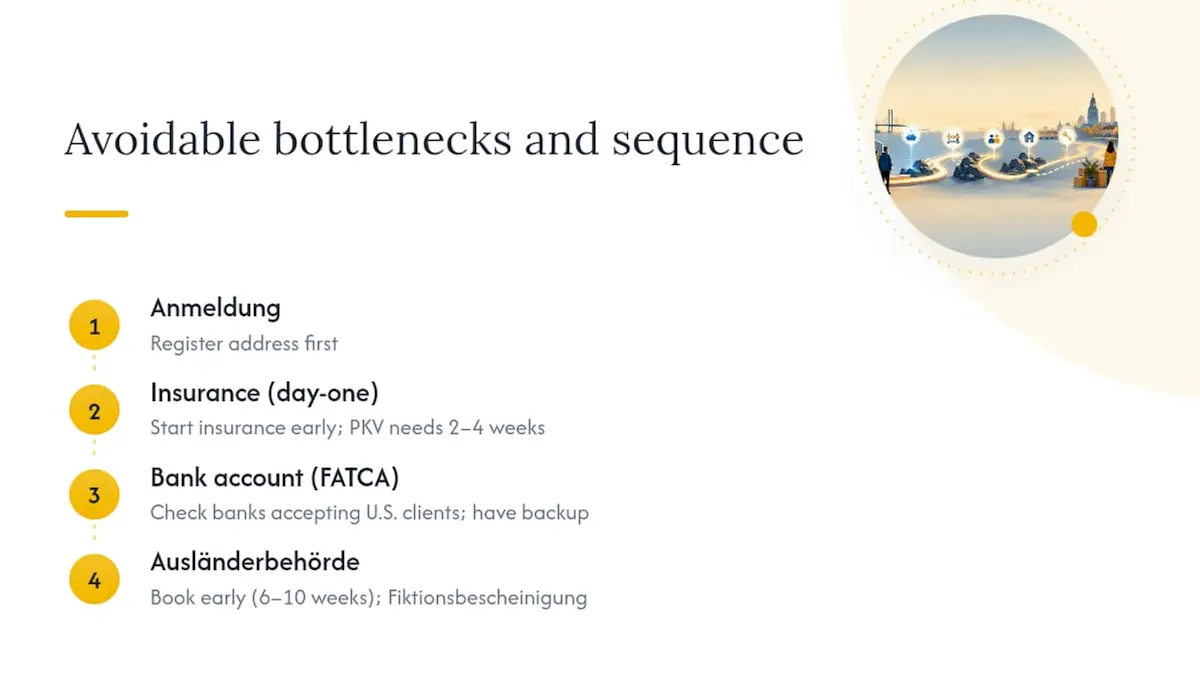
The first is the Ausländerbehörde appointment backlog. In Berlin, Munich, and Hamburg, appointment slots can be booked out six to ten weeks in advance. Americans who arrive assuming they can walk in and sort their permit within a few days are in for a shock. Book your appointment online the day you land, or even before you arrive if the local office allows it. If your 90-day window is at risk, request a Fiktionsbescheinigung immediately rather than waiting to see if the appointment comes through in time.
The second trap is misunderstanding day-one insurance. "I'll sort out insurance once I'm settled" is a phrase that has caused real problems for Americans who then discover their visa application or permit filing requires proof of coverage from the moment they established residency. If you are self-employed or freelancing, private health insurance underwriting takes two to four weeks. Start before you move.
The third is bank rejections due to FATCA. Some German banks simply will not open accounts for U.S. citizens, and finding this out at the branch after you have already moved is frustrating. Research which banks in your target city are known to accept U.S. clients before you arrive, and have a backup plan (an international account or a digital bank) ready.
The German system is structured and predictable once you follow the correct sequence: Anmeldung first, then insurance and bank account, then Ausländerbehörde. Every step feeds the next. Get the sequence right and the rest follows.
Sources
This article provides general information about relocating to Germany and is not a substitute for legal, tax, or insurance advice. Confirm current visa requirements, fee schedules, and tax rules with the relevant German authorities or a qualified professional before making decisions.
Recommended
- Health insurance for newcomers in Germany: 90-day guide
- Permanent Residence in Germany: 2026 Guide & Fast Tracks
- Health Insurance in Germany for Newcomers
- Switching Insurers Mid-Year Germany: Your 2026 Guide
Written by Marco Maurelli, editorial lead ·
Reviewed by Bettina Ostermann, insurance broker
(§ 34d Abs. 1 GewO) · Last reviewed: 2026-08-12
*This article is general information, not individual advice. Your age, income,
residence status and health history change the answer. Get a free quote
or book a consultation before you decide.*
*Myhealthcarebroker is an insurance broker registered under § 34d GewO.
See our initial information and imprint.*
*Parts of this article were drafted with AI assistance and reviewed by a
licensed broker. Images marked "AI-generated" were created with generative AI.*
 Written and reviewed byBettina Ostermann