
Specialist Access With Private Insurance in Germany (2026)
Private health insurance in Germany typically gives you faster specialist appointments, direct access to private-only practices, longer consultation times, and the option of chief-physician treatment in hospital — advantages that statutory insurance rarely matches. A 2024 Cologne University study confirmed insurance status as a strong predictor of waiting-time differences, and empirical data shows private patients receive appointments roughly three times faster for selected procedures. For expats and high earners evaluating the types of specialist access private insurance in Germany provides, the practical implications are real:
- Faster first appointments: private patients typically see a specialist sooner than patients with statutory insurance.
- Direct booking: many specialists accept private patients without a GP referral.
- Longer consultations: privately insured patients report higher perceived consultation quality and more thorough communication.
- Private-only practices: some of Germany's most sought-after specialists operate outside the statutory system entirely.
- Hospital upgrades: chief-physician treatment and private ward options are standard add-ons in most private health insurance tariffs.
The public system does offer a mitigation: regional appointment service centers (116 117) can arrange statutory appointments, but they cannot guarantee a specific doctor and have not closed the access gap. Myhealthcarebroker helps expats and high earners navigate eligibility, compare tariffs, and apply in English.
Key Takeaways
Private health insurance in Germany typically delivers faster specialist appointments than statutory insurance, but the outpatient tariff you choose determines how much of that advantage you actually receive.
| Point | Details |
|---|---|
| Eligibility comes first | The 2026 employee threshold is €77,400 gross per year; self-employed and civil servants qualify regardless of income. |
| Outpatient tariff drives access | Reimbursement at the full GOÄ rate (2.3x minimum) is the single most important plan feature for specialist access. |
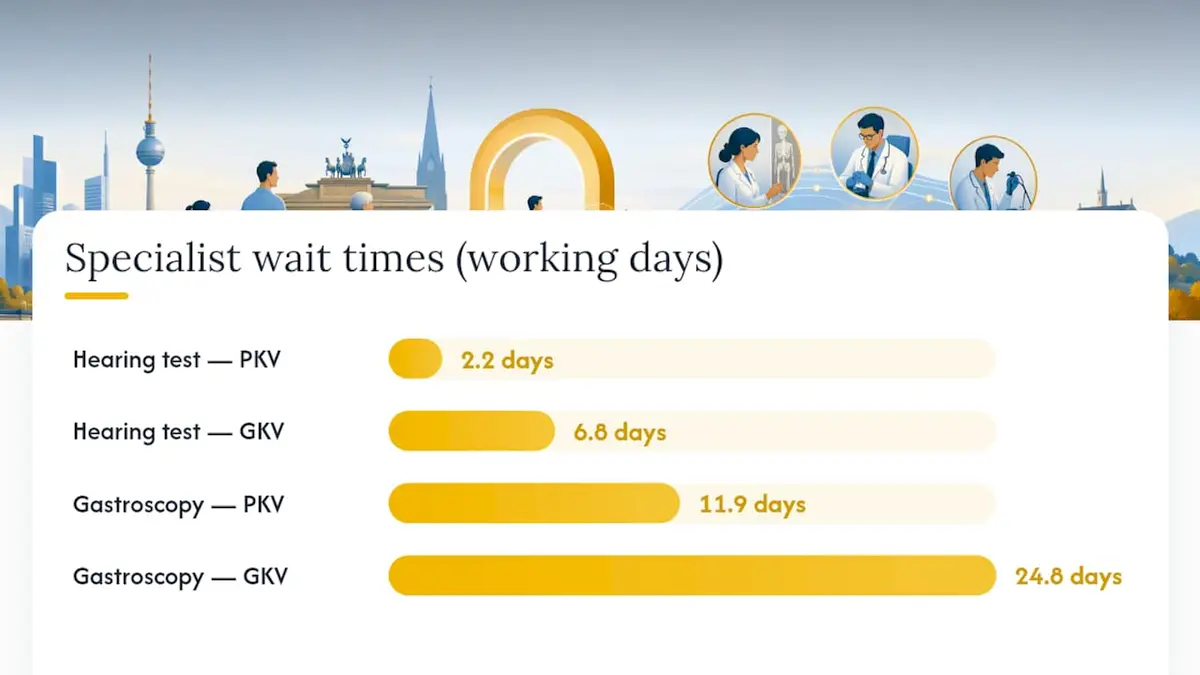
| Speed advantage is documented | Private patients waited 2.2 vs 6.8 working days for a hearing test, and 11.9 vs 24.8 days for a gastroscopy. |
| Family costs change the math | Each family member needs a separate private health insurance policy; for families with children, total premiums can exceed public health insurance costs. |
| Myhealthcarebroker | Independent English-language broker comparing all major private health insurance tariffs, with eligibility checks and full application support. |
Table of Contents
- What specialist access actually covers in the German system
- How private insurance changes specialist access day-to-day
- Who qualifies for private insurance in Germany?
- How private health insurance premiums and reimbursement affect specialist access
- How to choose a plan when specialist access is your priority
- Step-by-step: switching from public health insurance to private health insurance
- When private insurance may not improve specialist access
- How we advise expats and high earners on specialist access
- Myhealthcarebroker makes the switch straightforward
- Sources
What specialist access actually covers in the German system
"Specialist access" in Germany is not a single benefit — it is a cluster of administrative rules, practice types, and booking channels that work differently depending on your insurance status.
Referral rules. For most outpatient specialists, public health insurance patients need a GP referral each quarter. Radiology, laboratory medicine, and certain hospital outpatient departments require referrals regardless of insurance type, per federal guidance on doctor choice and appointment search. Private health insurance patients can often book directly with many specialists without that quarterly gatekeeping step.
Practice types. Three categories matter here. Kassenärztlich (statutory-approved) practices treat both public and private health insurance patients but operate under per-quarter budget caps for public health insurance billing. Private-only practices (Privatpraxen) treat exclusively private health insurance patients and bill without those caps. Hospital outpatient departments sit in between, with rules that vary by specialty and contract type.
The 116 117 appointment service. Statutory patients can call 116 117 to request a specialist appointment. The service issues a Vermittlungscode and routes the request to regional Kassenärztlichen Vereinigungen. It speeds access compared with calling practices individually, but it cannot place you with a specific doctor or guarantee timing.
| Procedure | Private patient wait (working days) | Statutory patient wait (working days) |
|---|---|---|
| Hearing test | 2.2 | 6.8 |
| Gastroscopy | 11.9 | 24.8 |
The gap is structural, not incidental. Research on German acute hospitals links preferential scheduling for private patients directly to hospital financial performance — meaning the incentive to prioritize private health insurance patients is built into how providers get paid.
How private insurance changes specialist access day-to-day
The practical differences show up quickly once you hold a private health insurance card.
- Short waiting times for non-urgent specialist consultations are common at private practices, compared with longer waits under public health insurance.
- Priority scheduling at mixed practices: many clinics maintain separate booking slots for private patients.
- Access to private-only specialists, including some of Germany's leading consultants in fields like oncology, orthopedics, and cardiology, who do not accept statutory insurance at all.
- Chief-physician treatment (Chefarztbehandlung) in hospital, meaning the senior consultant leads your care rather than a resident.
- Private ward options (single or double room) included as a tariff add-on.
- Longer consultations: the Cologne University study found privately insured patients reported both shorter waits and higher perceived consultation quality, including more thorough communication.
Why does this happen? Outpatient billing for private patients uses the GOÄ fee schedule with no quarterly budget cap, so a practice earns more per private health insurance consultation than per public health insurance one. Analyses of the payment structure confirm this billing difference is the central structural driver of faster access. Some insurers, such as Debeka through its 4sigma appointment service, also offer members a dedicated booking interface that routes requests directly to specialist practices.
Who qualifies for private insurance in Germany?
Eligibility is the gating factor. Before comparing tariffs, confirm you actually qualify.
- Employed workers must earn above the 2026 income threshold of €77,400 gross per year and must have exceeded that threshold for at least one full calendar year.
- Self-employed and freelancers can switch to private health insurance regardless of income, from day one of self-employment.
- Civil servants (Beamte) receive a state subsidy (Beihilfe) covering 50–80% of medical costs, making private health insurance the standard choice for this group.
- Students can access private health insurance under certain conditions, typically up to age 34.
- Previously privately insured individuals returning to Germany may re-enter private health insurance without the income threshold applying.
Family coverage works very differently under private health insurance. Public health insurance allows free co-insurance for non-earning spouses and children. Private health insurance requires a separate policy for each family member, priced individually by age and health. For a family with two children, that cost difference can be substantial and should be modeled before switching. An employee-specific eligibility guide walks through the payroll and employer-notification steps for employed high earners.
How private health insurance premiums and reimbursement affect specialist access
Private health insurance premiums are calculated on your age at entry and health status, not your income. Joining younger and healthier locks in a lower base rate. The Barmer guidance for U.S. expats confirms this age-and-health basis and notes that family members each need individual policies.
The reimbursement model matters for booking behavior. You pay the specialist directly after the appointment, then submit the invoice to your insurer for reimbursement. Most private practices expect payment within 30 days. This means you need short-term liquidity for larger procedures, though reimbursement typically arrives within two to three weeks for straightforward claims.
Which tariff choices most directly affect specialist access:
- Outpatient tariff level: the single most important variable. Higher-tier outpatient tariffs reimburse GOÄ fees at 2.3x or 3.5x the base rate, covering the full invoice from most private specialists.
- Inpatient options: chief-physician treatment and private ward add-ons are usually priced separately; confirm they are included if hospital access matters to you.
- Psychotherapeutic and dental riders: relevant if you anticipate needing those specialties, as base tariffs often cap or exclude them.
- Reimbursement caps: some budget tariffs cap outpatient reimbursement per year — a red flag if you expect frequent specialist consultations.
The difference between tariff levels is often clearer in euros than in plan descriptions.*
How to choose a plan when specialist access is your priority
Use this checklist when evaluating any private health insurance offer:
- Does the outpatient tariff reimburse at the full GOÄ rate (2.3x minimum, 3.5x preferred for specialist-heavy use)?
- Are private-only practices explicitly covered, or only Kassenärztlich-approved ones?
- What is the annual reimbursement cap for outpatient specialist consultations?
- Does the inpatient tariff include chief-physician treatment and private ward?
- How are pre-existing conditions handled — full exclusion, waiting period, or surcharge?
- What is the insurer's average claims turnaround time? Ask for a written figure.
- Does the insurer offer English-language support or a dedicated expat service line?
- How does the tariff handle family members — are children's policies priced competitively?
Red flags: unclear reimbursement language for specialist invoices, exclusions for specialties you already use, outpatient tariffs with low annual caps, and insurers with no track record of serving English-speaking clients.
Pro Tip: Request a sample policy document (Musterbedingungen) and check the reimbursement section for the words "bis zum 2,3-fachen Satz" — that phrase tells you the tariff's actual ceiling for outpatient billing.
For a side-by-side look at how different insurers structure their outpatient tariffs, the 2026 private plan comparison guide covers the main variables in plain English.
Step-by-step: switching from public health insurance to private health insurance
- Confirm eligibility. Check your gross annual salary against the €77,400 threshold, or confirm self-employed or civil servant status.
- Request quotes with outpatient focus. Compare at least three tariffs, prioritizing outpatient reimbursement level and specialist coverage.
- Complete medical underwriting. Answer health questions honestly. Undisclosed pre-existing conditions can void coverage later. If you have a condition, ask the insurer for a preliminary risk assessment (Risikovoranfrage) before formally applying.
- Give notice to your public health insurance insurer. The statutory notice period is typically two months to the end of a calendar month. Your employer's payroll team needs written confirmation of your new private health insurance start date.
- Coordinate start dates. Aim for the first of a month to avoid coverage gaps. Your private health insurance policy must be active before your public health insurance coverage ends.
- Notify your employer. Your employer's contribution shifts from the public health insurance rate to a fixed private health insurance subsidy (Arbeitgeberzuschuss), capped at half your premium.
Documents you will typically need: last three payslips, proof of income (tax assessment or employment contract), and completed health declaration forms. The switching guide covers the full document checklist and common timing pitfalls.
Pro Tip: If you have children, get quotes for their individual private health insurance policies before committing. For families with two or more children, the total premium can exceed what public health insurance would cost — and that changes the math significantly.
When private insurance may not improve specialist access
Private health insurance is not a universal upgrade. Several scenarios limit or eliminate the access advantage:
- Emergency care: both systems cover emergency hospital treatment. Private health insurance's advantage is in elective and non-urgent specialist care, not emergencies.
- Rural areas: specialist shortages affect private and statutory patients alike. In regions with few specialists, private health insurance cannot create appointments that do not exist.
- Referral-only specialties: radiology and laboratory medicine require referrals regardless of insurance type, per federal rules.
- Pre-existing condition exclusions: underwriting may exclude the very specialty you most need. A cardiac patient excluded from cardiology coverage gains little access advantage there.
- Long-term affordability: private health insurance premiums rise with age and medical cost inflation. High earners who plan a multi-decade stay in Germany should model costs at age 60 and 70, not just today's premium.
- Returning to public health insurance is difficult. Once you leave the statutory system as an employee, re-entry requires dropping below the income threshold or becoming unemployed. That constraint matters if your career trajectory is uncertain.
The public vs. private comparison covers long-term affordability tradeoffs in more detail.
How we advise expats and high earners on specialist access
The most common mistake we see is treating private health insurance as a single product. It is not. Two people with identical incomes can end up with wildly different specialist access depending on which outpatient tariff they chose. A budget private health insurance tariff with a low reimbursement cap can actually leave you worse off than a well-structured public health insurance plan with supplementary coverage.
Our advice: eligibility is the starting point, but the outpatient tariff is the decision. For expats who see specialists regularly, or who want the option of private-only practices and chief-physician hospital care, a mid-to-high outpatient tariff from a financially stable insurer is worth the premium difference. For families, the per-child policy cost often tips the calculation back toward public health insurance, at least until children are grown.
When we advise clients to stay with public health insurance, it is usually because the family cost structure makes private health insurance uncompetitive, or because a pre-existing condition would trigger exclusions that undermine the access benefit entirely. Specialist access is the right reason to consider private health insurance. It is rarely the only factor that should decide it.
Myhealthcarebroker makes the switch straightforward
Switching to private health insurance in Germany is faster and less stressful when you have an independent broker comparing every major insurer on your behalf, in English, with no obligation until you are ready to apply.
Myhealthcarebroker is an independent consultancy, not tied to any single insurer, which means the recommendation you get reflects your situation, not a sales target. From your first eligibility check through tariff selection, medical underwriting support, and application submission, the process is handled in plain English. Expats across Germany use Myhealthcarebroker to avoid the common pitfalls: budget tariffs with hidden reimbursement caps, underwriting surprises, and family-cost miscalculations.
Ready to see which plans give you the specialist access you need? Check your eligibility and compare private plans with Myhealthcarebroker today.
Sources
- Social disparities in access and quality of consultation in outpatient care in Germany | BMC Primary Care | Springer Nature Linklink.springer.com
- PMC article on waiting-time differences between private and statutory patients (source text provided in prompt)pmc.ncbi.nlm.nih.gov
- GesundOfficial sourcegesund.bund.de
- Health Insurance in Germany: A Guide for U.S. Expats — Barmerbarmer.de
- Private health insurance; waiting time; German acute care hospitals (working paper entry)ideas.repec.org
This article is general information, not a substitute for advice from a qualified financial advisor. Consult a qualified financial professional about your own circumstances before acting on anything here.
Recommended
- Private Health Insurance in Germany: 2026 Guide
- Blog: health insurance in Germany | Myhealthcarebroker
- Compare Private Health Plans in Germany: 2026 Guide
- Private Health Insurance in Germany for Indians (2026)
Written by Marco Maurelli, editorial lead ·
Reviewed by Bettina Ostermann, insurance broker
(§ 34d Abs. 1 GewO) · Last reviewed: 2026-08-12
*This article is general information, not individual advice. Your age, income,
residence status and health history change the answer. Get a free quote
or book a consultation before you decide.*
*Myhealthcarebroker is an insurance broker registered under § 34d GewO.
See our initial information and imprint.*
*Parts of this article were drafted with AI assistance and reviewed by a
licensed broker. Images marked "AI-generated" were created with generative AI.*
 Written and reviewed byBettina Ostermann