
Chefarztbehandlung Explained: What Expats Need to Know
Chefarztbehandlung means choosing to have the hospital's chief physician (Chefarzt) personally responsible for your medical care during a hospital stay. The Chefarzt is the most senior physician in a department, a role that carries both clinical authority and organizational leadership. This treatment is classified as a Wahlleistung, an optional paid upgrade beyond standard statutory coverage, and requires a written Wahlleistungsvertrag before it takes effect. Your immediate next step: check whether your tariff already includes it, or contact an English-speaking broker to confirm.
Who this applies to:
- Private health insurance holders whose tariff includes Chefarztbehandlung as standard or as an add-on
- Statutory patients who sign a Wahlleistungsvertrag and pay privately or through a Zusatzversicherung
- Self-pay patients who arrange it directly with the hospital
Pro Tip: Ask the hospital to confirm the named-doctor clause in writing before admission. Verbal assurances carry no legal weight once billing begins.
Table of Contents
- What does Chefarztbehandlung actually cover?
- How is chief physician treatment packaged in German private insurance?
- How to check your policy before your next hospital stay
- How does this compare to what U.S. patients are used to?
- What does Chefarztbehandlung cost, and how does billing work?
- When does chief physician treatment actually make sense?
- Key Takeaways
- The part most expats miss about Chefarztbehandlung
- How Myhealthcarebroker helps you sort this out in English
What does Chefarztbehandlung actually cover?
The core promise is personal involvement by the Chefarzt, not just nominal oversight. In practice, typical inclusions are:
- Personal lead of the surgical or medical plan by the Chefarzt
- Named surgeon-of-choice for core procedures
- Coordination of the medical team and involvement in major clinical decisions
- Follow-up consultations led by the Chefarzt rather than delegated to junior staff
What it usually does not cover is worth knowing before you sign anything. Non-physician services such as room upgrades (a single or private room is a separate Wahlleistung) are not bundled in automatically. Ancillary specialists like the anesthesiologist or radiologist are only included if they are explicitly named in the contract, a chain of related claims sometimes called the Wahlarztkette. Routine bedside tasks remain with ward staff regardless of what your contract says.
One nuance that surprises many patients: if the Chefarzt is unavailable due to an emergency or scheduling conflict, a designated deputy (Vertreter) may step in. That substitution is generally permitted under the contract, so ask upfront whether the named deputy is acceptable to you. The Chefarzt intervenes automatically in cases of medical necessity or complications, but for elective procedures, the Wahlleistungsvertrag is what formally activates the arrangement.
How is chief physician treatment packaged in German private insurance?
Private health insurance tariffs handle Chefarztbehandlung in three distinct ways: it may be included as standard, listed as an optional add-on, or excluded entirely. Reading the tariff document carefully is the only way to know which applies to you.
Tariffs differ between insurers, so the independent reviews of every insurer are a useful place to see how each one handles hospital benefits.
What to look for in your tariff documents:
- The words "Chefarztbehandlung," "Wahlarzt," or "Wahlleistung" in the inpatient coverage section
- Whether coverage is described as full reimbursement or subject to a cap
- Whether ancillary specialists (anesthesia, radiology) are explicitly included or excluded
- The tariff code or specialist coverage clause that governs hospital stays
Billing follows the Gebührenordnung für Ärzte (GOÄ). Standard inpatient services are typically billed at a factor below 3, while Wahlleistungen can be charged with a higher multiplier, with exact rates varying by hospital and case. That difference compounds quickly on a complex procedure. Private insurers generally reimburse in one of two ways: direct settlement with the hospital, or the patient pays the invoice and claims reimbursement afterward. The second model is more common and means you may need to front a significant sum before the insurer pays back.
For expats, the reimbursement-first model can be a cash-flow issue. Knowing your insurer's process before a planned procedure avoids unpleasant surprises.
Pro Tip: Search your policy document for "§ 4 Abs. 2 GOÄ" or "Wahlleistungsvereinbarung" to locate the exact clause governing Chefarztbehandlung reimbursement. If neither phrase appears, the benefit may not be covered.
How to check your policy before your next hospital stay
A quick call or email to your insurer or broker can resolve most questions, but only if you ask the right ones. Use this checklist:
- Does my current tariff include Chefarztbehandlung, or is it an optional add-on?
- Is coverage full reimbursement or subject to a cap or copayment?
- Are ancillary specialists (anesthesiologist, radiologist) included, or do I need a separate agreement?
- What GOÄ multiplier does my insurer reimburse for Wahlleistungen?
- Is there a named-doctor requirement, or is any Chefarzt in the hospital covered?
- Does my insurer require pre-approval before I sign a Wahlleistungsvertrag?
Beyond the call, pull out these documents before any planned admission:
- Your insurance contract's inpatient section (Stationäre Leistungen)
- Any supplemental tariff (Zusatztarif) documents if you have a public health insurance base plan
- A sample hospital invoice, if your insurer can provide one, to understand the billing format
Pro Tip: Request written confirmation from both your insurer and the hospital before admission. Keep a copy of the signed Wahlleistungsvertrag; hospitals are legally required to provide one, and it is your primary document if a billing dispute arises.
How does this compare to what U.S. patients are used to?
If your frame of reference is the American healthcare system, Chefarztbehandlung maps most closely to the concept of choosing your attending surgeon or requesting a named consultant for your procedure. The closest U.S. analogs are:
- Surgeon-of-choice: Selecting a specific surgeon for an elective procedure, common in U.S. private-pay or out-of-network arrangements
- Concierge medicine: A membership model giving direct access to a named physician, though this is primarily outpatient in the U.S.
- Private-pay specialist access: Paying out-of-pocket for a named consultant, bypassing standard referral queues
The structural difference is significant. In Germany, the Chefarzt is a hospital-employed senior physician with formal departmental authority, analogous to a Chief Medical Officer who also practices clinically. In the U.S., attending surgeons are often independent practitioners with hospital privileges, not employees. That distinction changes how billing works entirely.
What a U.S.-background reader should expect differently in Germany:
- You sign a Wahlleistungsvertrag with the hospital, not a personal contract with the surgeon
- The GOÄ multiplier system governs fees, not the surgeon's private rate card
- Your private health insurance insurer reimburses according to the GOÄ invoice rather than a U.S.-style EOB (Explanation of Benefits)
- The Wahlarztkette means related departments (anesthesia, radiology) may generate separate liquidation claims
For high earners navigating German insurance tariffs, understanding these structural differences before signing any hospital agreement is worth the time.
What does Chefarztbehandlung cost, and how does billing work?
Cost depends on several variables, and none of them are fixed in advance without a written estimate. The main drivers:
- Whether Chefarztbehandlung is already in your tariff (in which case your insurer absorbs the cost) or billed as a Wahlleistung (in which case the GOÄ multiplier applies directly to your invoice)
- The GOÄ multiplier used: roughly 2.3 for standard services, up to 3.5 for Wahlleistungen
- How many chiefs are involved (Wahlarztkette claims from anesthesia, radiology, and others add up)
- Complication-driven escalation, where additional procedures trigger additional GOÄ line items
Public health insurance patients should be clear on one point: statutory health insurance does not cover Wahlleistungen. If you are on public health insurance and want Chefarztbehandlung, you either pay privately or carry a Zusatzversicherung that covers it. Some supplemental tariffs bundle Chefarztbehandlung with a room upgrade; others price them separately. Knowing which you have matters before you are admitted.
Billing typically flows as a direct hospital invoice after discharge. Hospitals are required to provide a clear breakdown of charges, and patients who have signed a Wahlleistungsvertrag receive an itemized statement. If your insurer uses direct settlement, the hospital bills them; if not, you pay and submit the invoice for reimbursement.
Pro Tip: Before any planned procedure, ask the hospital for a written cost estimate (Kostenvoranschlag) and confirm with your insurer that pre-approval is not required. An unreviewed invoice with a 3.5 GOÄ multiplier across multiple departments can reach amounts that take weeks to resolve.
When does chief physician treatment actually make sense?
Chefarztbehandlung is not always the right call. It adds real value in specific situations:
- Complex or high-risk surgery where the Chefarzt's personal experience is the deciding clinical factor
- Rare conditions requiring a named specialist with documented expertise in that area
- Expats who want a single named lead physician for continuity across a hospital stay
- Cases where the patient or family needs clear accountability and a single point of contact
It often isn't necessary for routine inpatient procedures. Experienced Oberärzte (senior attending physicians, one level below Chefarzt) handle the vast majority of elective surgeries competently and without the Wahlleistung premium. For common procedures with well-established protocols, the clinical difference between Chefarzt and Oberarzt involvement is often marginal.
The honest calculation is clinical benefit versus cost. If your private health insurance tariff already includes Chefarztbehandlung, there is no reason not to use it. If you would be paying out of pocket or through a Zusatzversicherung premium, weigh whether the specific procedure genuinely benefits from named-chief involvement. A broker or your treating physician can help you make that call before you commit.
Key Takeaways
Chefarztbehandlung is a paid optional upgrade (Wahlleistung) that puts the hospital's most senior physician personally in charge of your care, and whether your private health insurance tariff covers it determines whether you pay anything extra at all.
| Point | Details |
|---|---|
| Definition | Chefarztbehandlung is a Wahlleistung: a formal, written opt-in for personal care by the hospital's chief physician. |
| GOÄ billing | Wahlleistungen can be billed at up to a 3.5 GOÄ multiplier, compared to roughly 2.3 for standard inpatient services. |
| Public health insurance patients | Statutory insurance does not cover Wahlleistungen; a Zusatzversicherung or private payment is required. |
| Policy check | Search your tariff for "Chefarztbehandlung," "Wahlarzt," or "Wahlleistung" and request written confirmation before admission. |
| Myhealthcarebroker | Myhealthcarebroker offers English-language eligibility checks and tariff comparisons to confirm whether your private health insurance plan includes Chefarztbehandlung. |
The part most expats miss about Chefarztbehandlung
Most articles on this topic frame Chefarztbehandlung as a prestige benefit, something you get because you want the best. That framing misses the more practical reason it matters for expats specifically: accountability and communication.
When you are navigating a German hospital stay in a second language, having a single named senior physician who is formally responsible for your care is not a luxury. It is a coordination mechanism. The Chefarzt becomes your point of contact for decisions, explanations, and escalations. That matters far more than the prestige of the title.
The billing side is where people get caught off guard. The Wahlarztkette effect, where naming one chief triggers liquidation rights for related departments, can produce an invoice that looks nothing like what you expected. Asking for a written cost estimate and confirming which specialists are included in your contract is not paranoia; it is the only way to avoid a four-figure surprise after discharge.
My view is that for expats with private health insurance, Chefarztbehandlung is worth having in your tariff, not because every procedure needs it, but because you want the option without having to negotiate it from a hospital bed. If your current tariff does not include it, that is a conversation worth having with a broker before your next renewal, not after.
How Myhealthcarebroker helps you sort this out in English
Sorting through German tariff documents to find a Wahlleistung clause is genuinely tedious, even for fluent German speakers. Myhealthcarebroker gives you a faster route: an independent, English-language eligibility check and tariff comparison that covers whether Chefarztbehandlung is included in the plans available to you, what the coverage scope looks like, and how different tariffs handle the GOÄ reimbursement question.
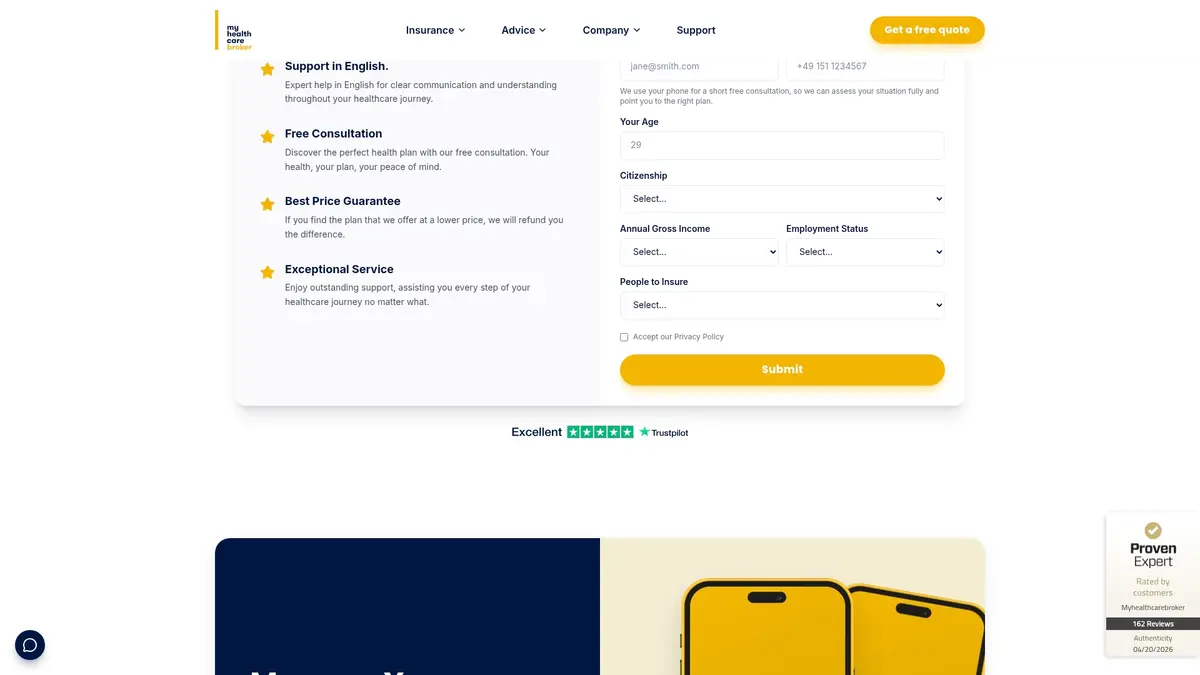
The service is free to you. Myhealthcarebroker is commission-based on the insurer side, so there is no fee for the eligibility check, the tariff comparison, or the application support. Once you are enrolled, the support continues: help with claims, insurer communications, and questions about your coverage as your situation changes.
If you want to understand exactly what Private health insurance in Germany covers before committing to a tariff, or if you already have a policy and want to confirm whether Chefarztbehandlung is in it, that is exactly the kind of question Myhealthcarebroker handles every day. Start with the eligibility check and go from there.
This article provides general information about German health insurance and is not a substitute for professional insurance or medical advice. Confirm current tariff terms and coverage details with your insurer or a qualified broker.
Recommended
- Prescription Coverage in Germany Explained for Expats
- Private health insurance for internationals in Germany
- Beherrschender Gesellschafter Insurance: Guide for Expats
- Arbeitgeberanteil Insurance Explained for Expats in Germany
Written by Marco Maurelli, editorial lead ·
Reviewed by Bettina Ostermann, insurance broker
(§ 34d Abs. 1 GewO) · Last reviewed: 2026-08-12
*This article is general information, not individual advice. Your age, income,
residence status and health history change the answer. Get a free quote
or book a consultation before you decide.*
*Myhealthcarebroker is an insurance broker registered under § 34d GewO.
See our initial information and imprint.*
*Parts of this article were drafted with AI assistance and reviewed by a
licensed broker. Images marked "AI-generated" were created with generative AI.*
 Written and reviewed byBettina Ostermann