
Arbeitgeberanteil Insurance Explained for Expats in Germany
Arbeitgeberanteil insurance is defined as the mandatory employer contribution covering half of an employee's statutory social insurance premiums in Germany. Every employer subject to German labor law must pay this share directly to the relevant social security authorities. It covers statutory health, pension, unemployment, and nursing care insurance. If you work in Germany as an expat or high earner, understanding how this contribution works shapes every decision you make about private vs. statutory health insurance.
What is arbeitgeberanteil insurance and how is it calculated in statutory health coverage?
The employer's share of social insurance, known in German as the Arbeitgeberanteil, is not a voluntary benefit. It is a legally fixed cost that applies automatically to every employee enrolled in compulsory social insurance. Your employer has no discretion over whether to pay it or how much to pay. The rate is set by law.
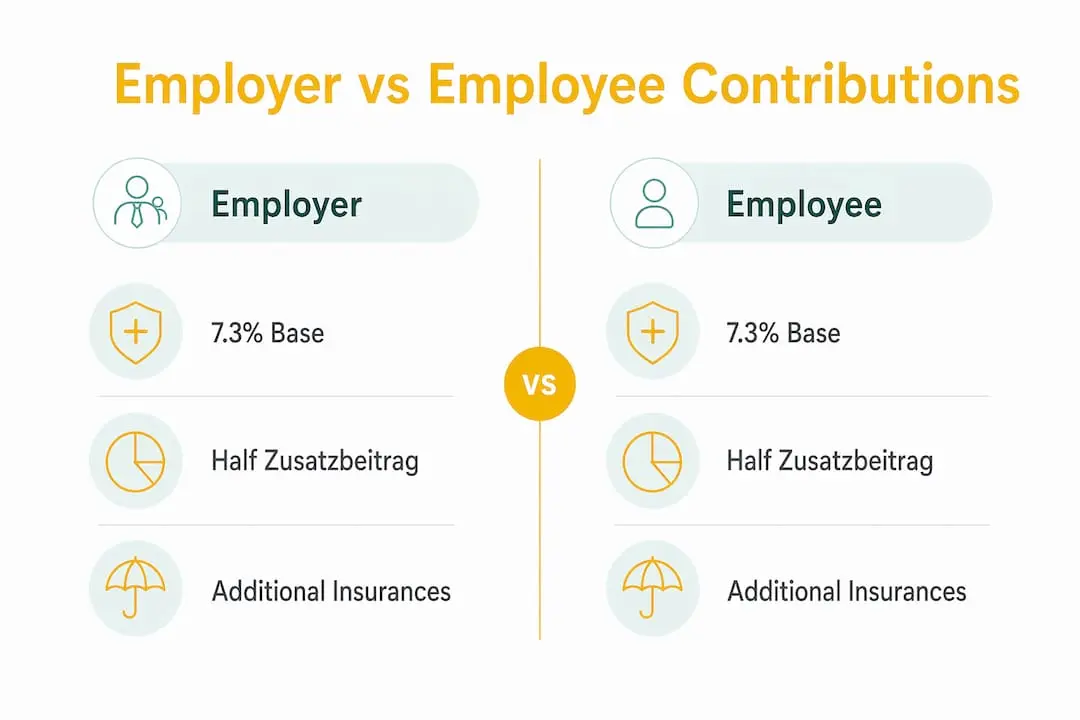
For statutory health insurance, the base contribution rate is 14.6% of gross salary. Employer and employee each pay 7.3%. On top of that, each statutory health insurer charges an additional contribution called the Zusatzbeitrag. In 2026, the average Zusatzbeitrag is 2.9%, split equally between employer and employee. That means your employer pays roughly 8.75% of your gross salary toward your statutory health insurance alone.

The table below shows the 2026 contribution split for statutory health insurance:
| Component | Total rate | Employer pays | Employee pays |
|---|---|---|---|
| Base health contribution | 14.6% | 7.3% | 7.3% |
| Average Zusatzbeitrag | 2.9% | 1.45% | 1.45% |
| **Combined health total** | **17.5%** | **~8.75%** | **~8.75%** |
These rates only apply up to the contribution ceiling, called the Beitragsbemessungsgrenze. Income above that ceiling is not subject to social insurance contributions. The ceiling changes annually, so the absolute euro amount your employer pays is capped even if your salary is high.
Beyond health insurance, employer contributions cover pension, unemployment, and nursing care insurance, all split roughly 50/50. Pension insurance, for example, runs at 18.6% total, with employer and employee each contributing 9.3%. These amounts form part of what German payroll calls Lohnnebenkosten, or ancillary wage costs.
When you start a new job, the social insurance number guide helps you sort out the paperwork your employer needs from you.
Pro Tip: Your employer pays the Arbeitgeberanteil on top of your gross salary. It never comes out of your paycheck. Your gross salary is the starting point, not the total cost your employer bears.
How does the employer contribution change when you choose private health insurance?
When you earn above the annual income threshold that makes private health insurance eligible, your employer's contribution structure changes. The percentage-based Arbeitgeberanteil no longer applies. Instead, your employer pays a capped subsidy called the Arbeitgeberzuschuss.
The key distinction matters financially. The Arbeitgeberzuschuss replaces the Arbeitgeberanteil for employees in private health insurance. It is not a percentage of your private premium. It is capped at the maximum amount the employer would have paid had you stayed in the statutory system.
Here is what that means in practice:
- The subsidy is limited to 50% of the maximum statutory health insurance contribution at the contribution ceiling.
- Employers do not subsidize the Zusatzbeitrag for private insurance plans.
- If your private premium exceeds the capped subsidy, you pay the difference entirely out of pocket.
- The subsidy amount is fixed regardless of which private insurer you choose or what your premium is.
- Switching to private insurance does not increase your employer's cost. It caps it.
A practical example: if the capped subsidy amounts to roughly €400 per month and your private premium is €600 per month, you cover the €200 gap yourself. That gap grows as you age, since private premiums rise with age and health status while the subsidy stays anchored to statutory system limits.
Pro Tip: Before switching to private health insurance, calculate the full premium you will pay at age 50, 60, and beyond. The employer subsidy stays flat while your private premium climbs. Use Myhealthcarebroker's [private insurance calculator](/calculator) to model the long-term cost.
Why does the Arbeitgeberanteil matter for expats and high earners?
Understanding the employer's contribution affects four concrete decisions you make as an expat or high earner in Germany.
- Your real cost of employment. Your employer pays roughly an additional 20% of your gross salary in social insurance contributions. That cost never appears on your payslip, but it shapes what employers can afford to offer. Knowing this affects your net salary and total compensation picture.
- Your health insurance choice. The moment you cross the annual income threshold for private health insurance eligibility, the employer contribution structure shifts from a percentage to a cap. That cap softens the blow of private premiums at first, but the math changes over time. High earners who switch to private insurance early often pay less in their 30s and more in their 50s.
- Your employment contract and registration. When you start a new job in Germany, your employer registers you with the relevant social insurance authorities. The Arbeitgeberanteil is calculated and transferred automatically. You do not need to arrange it. But you do need to confirm your insurance status with your employer on day one, especially if you are opting into private insurance.
- Your payslip literacy. Employees rarely see the employer's share listed separately on their payslips. The payslip shows only the employee's deductions. This creates a common misconception that social insurance costs less than it does. The employer handles all calculations and transfers directly to the authorities.
- Your switching strategy. If you plan to move from statutory to private health insurance, timing matters. The employer subsidy is capped, so switching at a younger age with a lower private premium gives you more years of favorable math before the premium gap widens.
What legal obligations protect employees regarding the employer's contribution?
The Arbeitgeberanteil is governed by the German Social Code, known as the Sozialgesetzbuch or SGB. The law is clear and leaves no room for employer discretion.
- Employers must pay their full share directly to social security authorities. They cannot pass this cost to employees.
- Deducting the Arbeitgeberanteil from an employee's gross salary is prohibited. Your gross salary is your gross salary.
- Non-payment is a legal violation. Employers face full personal liability and legal penalties for late or missing contributions.
- Employees have the right to demand proof of correct contribution payments.
- The Arbeitgeberanteil is not a voluntary benefit that employers can reduce, restructure, or negotiate away.
This last point catches many expats off guard. In some countries, employer health contributions are part of a negotiable benefits package. In Germany, they are not. The contribution is a statutory obligation, not a perk. If an employer tries to frame it as a benefit or offset it against your salary, that is a compliance problem worth flagging.
Key Takeaways
The Arbeitgeberanteil is a legally mandated employer contribution covering half of all statutory social insurance premiums, and it shifts to a capped subsidy when employees choose private health insurance.
| Point | Details |
|---|---|
| Statutory health split | Employer and employee each pay 7.3% base rate plus half the Zusatzbeitrag, averaging 8.75% each in 2026. |
| Private insurance subsidy cap | Employers pay a fixed subsidy capped at the statutory maximum, not a percentage of your private premium. |
| Legal protection | Employers cannot deduct the contribution from gross salary; non-payment triggers full legal liability. |
| Payslip invisibility | The employer's share never appears as a deduction on your payslip, which obscures the true cost of social insurance. |
| Switching strategy | Moving to private insurance caps employer costs and shifts premium risk to you as premiums rise with age. |
The part most expats get wrong about employer contributions
Most expats assume the Arbeitgeberanteil is somewhere between a bonus and a negotiable benefit. It is neither. It is a fixed legal obligation, and that distinction changes how you should think about your total compensation.
The more interesting misunderstanding is about private health insurance. Many high earners assume their employer will cover a meaningful share of their private premium. The reality is that the subsidy is capped at what the employer would have paid in the statutory system. If you choose a premium plan with comprehensive dental and vision coverage, you are paying the difference yourself. The employer's obligation ends at the statutory ceiling.
One practical step is genuinely useful: check your payslip, but do not stop there. Ask your HR department for the full breakdown of what your employer pays in social contributions on your behalf. That number is often 20% or more of your gross salary. Seeing it in writing changes how you evaluate job offers and salary negotiations.
For expats considering private health insurance, the employer subsidy calculation is worth modeling before you switch. The subsidy looks generous in your 30s. By your mid-50s, the gap between your private premium and the capped subsidy can run into hundreds of euros per month. That is not a reason to avoid private insurance. It is a reason to go in with clear numbers.
How Myhealthcarebroker helps you make sense of employer contributions
Understanding the Arbeitgeberanteil is one thing. Knowing how it affects your specific situation as an expat or high earner in Germany is another.
Myhealthcarebroker is an independent consultancy that works exclusively with people navigating the German health insurance system in English. Whether you are weighing statutory versus Private health insurance in Germany, calculating the real value of your employer subsidy, or switching plans for the first time, the team at Myhealthcarebroker compares options across providers without being tied to any single insurer. You get a clear picture of what you will actually pay, what your employer contributes, and which plan fits your life. Reach out for a free consultation at Myhealthcarebroker.
 Written and reviewed byBettina Ostermann