
Last checked 2 November 2026. Appointment rules and the planned family-doctor-first system can change, so check 116117.de before you rely on a detail.
Quick answer: Use the official doctor search with its foreign-language criterion, or a booking platform with a language filter, then confirm on the phone that the appointment itself runs in English. Publicly insured patients can book through the 116117 appointment service, which must find you an appointment offer within one week. The appointment itself may be up to four weeks away (three for radiology), and specialists need a referral with a 12-digit urgency code, except eye doctors and gynaecologists. Nobody avoids waiting entirely, but private health insurance in Germany usually shortens the path to a specialist.
Two problems hit newcomers first: finding a doctor who speaks English, and getting an appointment before the symptoms are gone. Both depend on how you are insured. This guide covers where to search, how the system works, what to say on the phone and what changes with private cover.
Where can I find an English-speaking doctor in Germany?
Start with the official tools, then add a platform. The doctor search of the statutory physicians' association (KBV) can take criteria such as foreign languages into account. The search itself runs through the 116117 doctor and psychotherapist search. The filter relies on what practices report about themselves, so it is a starting list, not a guarantee.
| Tool | What it does | Language filter | Status of our check |
|---|---|---|---|
| KBV doctor search (via 116117) | Official register of practices | Foreign languages can be used as a criterion | Confirmed on the KBV page |
| Doctolib | Online booking platform | English interface and language filter reported | Not officially verified, check |
| Doctena, Jameda | Booking and doctor profiles | Language filter reported | Not officially verified, check |
| Insurer doctor searches | Search inside your insurer's service | Language filter reported | Not verified, check with your insurer |
| Embassy and consulate lists | Lists of English-speaking doctors | Language is the point of the list | Not verified, check your embassy's website |
Source: KBV, kbv.de/html/arztsuche.php. Platform and insurer rows are not officially verified, so check the filter yourself.
Listings can be wrong. Some practices list a language they do not use in appointments, so ask when you book: "Sprechen Sie Englisch?" University hospitals can also be worth a call for specialist questions, but language support varies by department. Big cities have more English-speaking practices, and in small towns you may need to travel.
How does the family doctor (Hausarzt) system work?
A Hausarzt is a general practitioner and the usual first stop. You see them for most health problems, and they refer you on when you need a specialist. For publicly insured patients that referral also matters for the appointment service, covered below.
Register with a Hausarzt early, before you are sick. Bring your insurance card and ID, and say that you are new to Germany. If the first practice does not suit you, you can try another. Our guide to how specialist access works with private insurance explains the referral types in more depth, so we keep this section short.
Newcomers who still need to sort out their cover should start with health insurance for newcomers.
How long do you really wait for a specialist?
It depends on the specialty, the region and who you ask. The umbrella association of public health insurers surveyed 3,512 publicly insured adults aged 18 to 80 in March and April 2024 and published the results on 3 February 2025. Of those surveyed, 25 percent waited more than 30 days for a specialist appointment, and about half saw a specialist within 10 days. The insurers' association ordered the survey and covers only publicly insured people, so it shows no public versus private split.
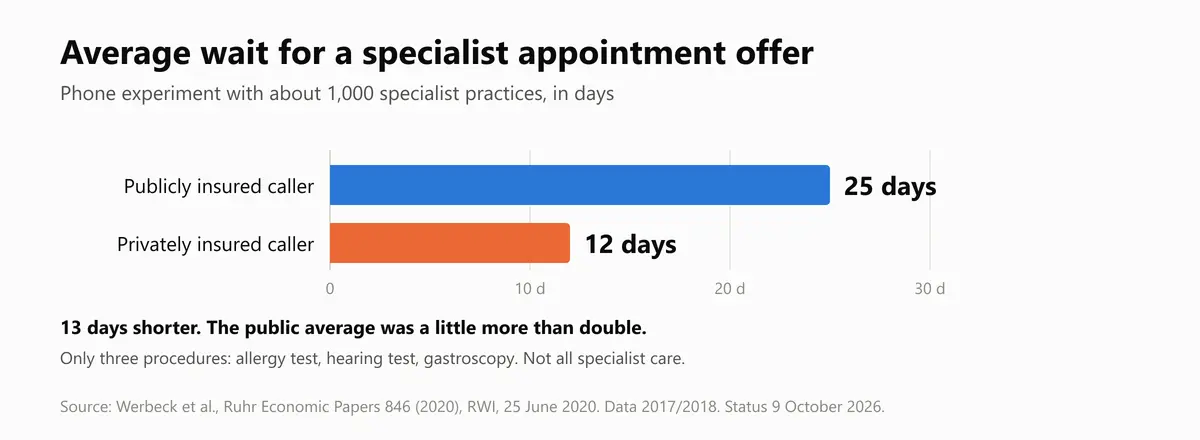
For that split, the best-documented source is a field experiment from the RWI research institute. Researchers phoned just under 1,000 specialist practices between April 2017 and May 2018 and randomly assigned an insurance status to the caller. The calls asked about only three procedures: an allergy test, a hearing test and a gastroscopy, so the result does not cover specialist appointments in general.
| Where an appointment was offered | Average wait |
|---|---|
| Publicly insured caller | 25 days |
| Privately insured caller | 12 days |
Source: Werbeck, Wübker, Ziebarth, Ruhr Economic Papers 846 (2020), via RWI press release of 25 June 2020, idw-online.de/de/news750098. Data from 2017 and 2018, working paper, not a peer-reviewed journal.
The arithmetic: 25 minus 12 is 13 days, and 25 divided by 12 is about 2.1, so the public average was a little more than double. Of all callers, 85 percent were offered an appointment, and private callers were 7 percent more likely to get one. The difference was significant for gastroscopy and allergy tests, but not for hearing tests, where the offer rate was equal and privately insured callers still got earlier slots. Other studies may find different gaps, so treat this as one dated data point for three procedures, not a promise.
What is 116117 and how does the four-week rule work?
116117 is the national number for the medical on-call service, and it also runs the appointment service and online booking. The line is open around the clock. It is for cases that are not life-threatening. The phone line may be handled in German only, so be ready with the phrases further down.
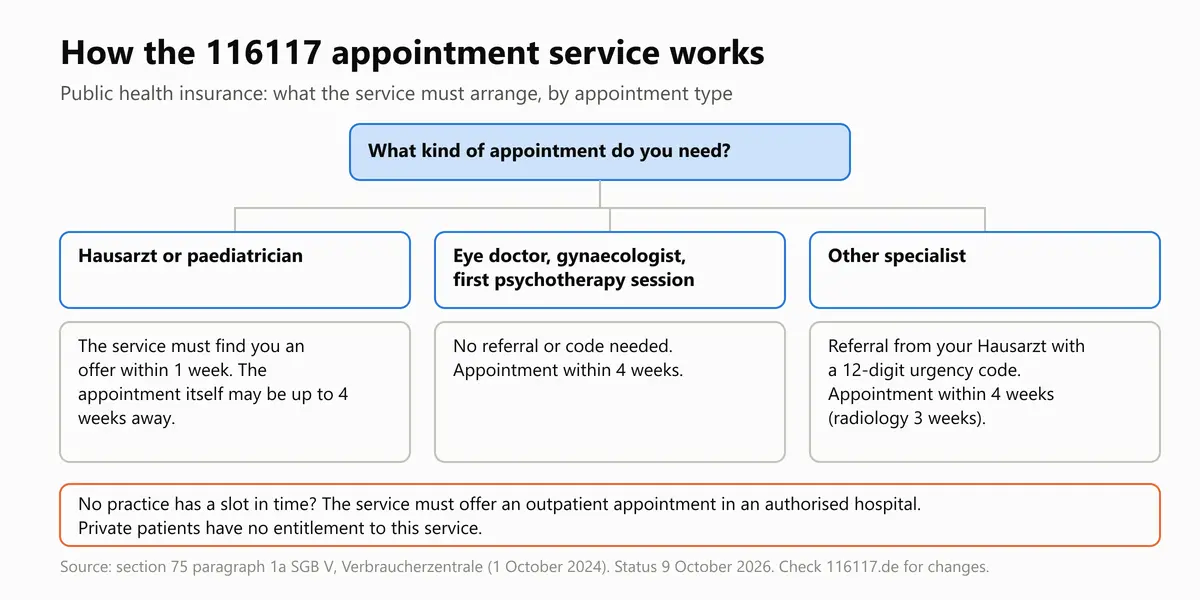
By law (section 75 SGB V), the appointment service must help publicly insured people find a Hausarzt and arrange specialist appointments. The waiting time for an arranged appointment may not exceed four weeks, and for radiology three weeks. If no practice can offer a slot in time, the service must offer an outpatient appointment in an authorised hospital.
| Situation | Referral needed | What the rule says |
|---|---|---|
| Hausarzt or paediatrician | Set by the federal contract between doctors and insurers, not by section 75 | The service must find you an appointment offer within one week; the appointment itself may be up to 4 weeks away |
| Specialist | Yes, from your Hausarzt, with a 12-digit urgency code | Within 4 weeks (radiology 3 weeks) |
| Eye doctor, gynaecologist | No referral or code | Within 4 weeks |
| Psychotherapy, initial session | No referral | Within 4 weeks |
Source: section 75 paragraph 1a SGB V, gesetze-im-internet.de/sgb_5/__75.html, and Verbraucherzentrale guidance dated 1 October 2024, seen 2 November 2026. The one-week period is the time the service has to mediate an offer, not the waiting time for the appointment. Possible changes from October 2026 were hinted at but not confirmed, so check 116117.de.
The service does not cover minor complaints or routine check-ups. Worked example: if your Hausarzt issues a referral with an urgency code on a Monday, the arranged appointment may be up to four weeks later, which is 4 x 7 = 28 days. The statute sets an upper limit for the arranged slot, and the 25-day average above comes from a different method, so do not compare the two directly.
Private patients have no entitlement to this service. It is a right of public insurance.
Why do private patients often get appointments faster?
Private patients are billed under a separate fee schedule, the GOÄ (Gebührenordnung für Ärzte). For general medical services the GOÄ allows a factor of 1.0 to 3.5 times the base rate, and a fee is normally set only between 1.0 and 2.3 times. A service billed at the 2.3 factor costs 2.3 times the base rate, which is 1.3 times more than the base rate alone. Nothing in the law ties this to faster appointments, and we do not claim a motive. What studies show is an average gap in waiting times, like the 13 days above.
In practice, private patients also do not use the public appointment service, so no referral and urgency code is involved on that route. How direct access works depends on the tariff. Some plans use an open referral, which means you can go to a specialist without a Hausarzt in between. Check your own terms before you assume it.
No law guarantees a quick slot for anyone. Private cover shortens the path, it does not remove the wait.
What should I say on the phone?
Short, polite German helps even if the practice turns out to speak English. Say your request first, then ask about English.
| German | English meaning | When to use |
|---|---|---|
| Guten Tag, ich möchte einen Termin vereinbaren. | Hello, I would like to make an appointment. | Opening line |
| Ich bin neu in Deutschland und suche einen Hausarzt. | I am new in Germany and looking for a family doctor. | Registering with a practice |
| Sprechen Sie Englisch? | Do you speak English? | Before you book |
| Ich habe seit ... Tagen Schmerzen. | I have had pain for ... days. | Describing the problem |
| Ist es dringend? | Is it urgent? | When you need to know how fast |
| Ich bin gesetzlich versichert. | I am publicly insured. | Public patients |
| Ich bin privat versichert. | I am privately insured. | Private patients |
Source: Myhealthcarebroker phrase list, native speaker check recommended.
Fill the gap with a number, for example "Ich habe seit drei Tagen Schmerzen" for three days of pain.
Which numbers do I call in an emergency?
Call 112 for life-threatening emergencies. For urgent but not life-threatening problems outside practice hours, call 116117. We could not confirm that English is spoken on 112, so keep your address and a few German words ready. A hospital emergency department can also help if you are unsure.
Is a GP-first system coming to Germany?
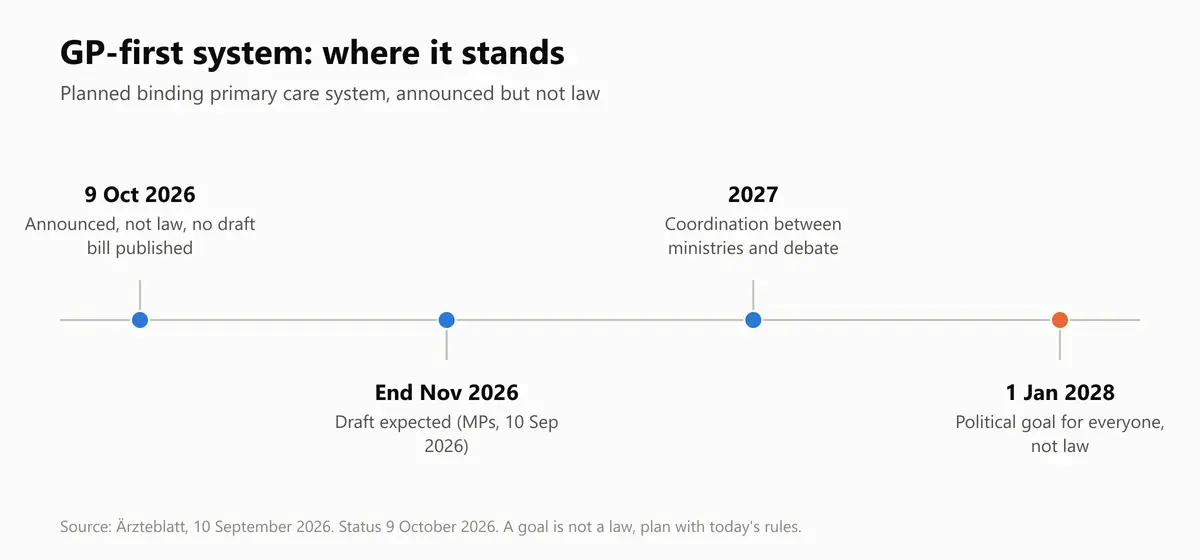
The coalition plans a binding primary care system, where a family doctor is the first contact, with free choice of doctor. Status on 2 November 2026: announced, not law, and no draft bill is published. Two members of parliament said on 10 September 2026 that a draft is expected at the end of November 2026, followed by coordination between ministries and debate in 2027. The political goal is for it to apply to everyone from 1 January 2028. A goal is not a law, so plan with today's rules.
When does private cover shorten the path to a specialist?
Private health insurance suits people up to about 45 best, and the longer you live in Germany, the better it gets, because old-age reserves build from the first month. For a closer look, see what private health insurance covers.
Whether you can choose it depends on your situation:
- Employees may choose private cover above the income threshold (Jahresarbeitsentgeltgrenze, JAEG) of EUR 77,400 in 2026. For 2027 the cabinet decided EUR 84,150 on 7 October 2026, with Bundesrat approval pending.
- Self-employed people and freelancers may choose freely.
Worked example: an employee with a regular income of EUR 7,000 per month earns 7,000 x 12 = EUR 84,000 per year. That is EUR 6,600 above the 2026 threshold (84,000 minus 77,400). Under the proposed 2027 figure the same income would be EUR 150 below the threshold (84,150 minus 84,000), so the 2027 decision matters. If you are already privately insured and exempt on 31 December 2026, a lower 2027 limit of EUR 80,550 applies to you (section 6(8) SGB V, amount pending Bundesrat approval), so EUR 84,000 would still be EUR 3,450 above it.
If you are below the threshold, read about public health insurance in Germany or check the income threshold for 2027. For quality of care in general, see quality of healthcare in Germany.
Want a free check of your options?
If you are an employee above the income threshold or self-employed, ask for a free quote and a free consultation to see how private cover would work for you. We look at your situation first and tell you plainly whether it fits. If you are below the threshold, start with public health insurance in Germany. To compare what you get, read our guide to private health insurance in Germany.
Sources and status
All sources seen 2 November 2026.
- Section 75 SGB V, appointment service (law): https://www.gesetze-im-internet.de/sgb_5/__75.htmlOfficial sourcegesetze-im-internet.de
- Verbraucherzentrale, specialist appointment within four weeks (page dated 1 October 2024): https://www.verbraucherzentrale.de/wissen/gesundheit-pflege/aerzte-und-kliniken/facharzttermin-hoechstens-vier-wochen-warten-12494verbraucherzentrale.de
- 116117 (24/7 line, online booking, on-call service): https://www.116117.de/116117.de
- KBV doctor search: https://www.kbv.de/html/arztsuche.phpOfficial sourcekbv.de
- Umbrella association of public health insurers, survey press release, 3 February 2025 (study ordered by the insurers' association): https://www.gkv-spitzenverband.de/gkv_spitzenverband/presse/pressemitteilungen_und_statements/pressemitteilung_1975066.jspOfficial sourcegkv-spitzenverband.de
- RWI press release, 25 June 2020 (Ruhr Economic Papers 846, working paper): https://idw-online.de/de/news750098idw-online.de
- Section 5 GOÄ, fee factors (law): https://www.gesetze-im-internet.de/go__1982/__5.htmlOfficial sourcegesetze-im-internet.de
- Ärzteblatt, 10 September 2026, GP-first draft expected end of November 2026 (statement of MPs, goal not law): https://www.aerzteblatt.de/news/gesetzentwurf-zum-primarversorgungssystem-soll-bis-ende-november-vorliegen-9ed8656b-f129-4755-8046-5882e3045cc8aerzteblatt.de
- Income threshold 2026 and 2027 cabinet decision of 7 October 2026 (Bundesrat approval pending): internal reference figures.
Myhealthcarebroker is an independent insurance broker. This article is general information, not legal or tax advice. Rules and figures can change, so check current guidance before you decide.
 Written byMarco Maurelli
 Reviewed byBettina Ostermann