
Germany is about to make private health insurance harder to reach. From 2027, the salary you need to earn before you can leave the public system and choose private cover is set to climb to roughly €84,000 per year, one of the largest single jumps in two decades. If you are an international professional weighing up private cover, 2026 is shaping up to be the decisive window. Here is what is changing, why it is happening, and how to decide whether to move now or wait.
How the income threshold works, and what changes in 2027
In Germany, employees can only choose Private health insurance once their gross salary passes a legal line known in German as the Jahresarbeitsentgeltgrenze, usually translated as the compulsory insurance limit or income threshold. Earn below it as an employee and you are required to stay in the public system. Earn above it for the year and you gain the freedom to switch.
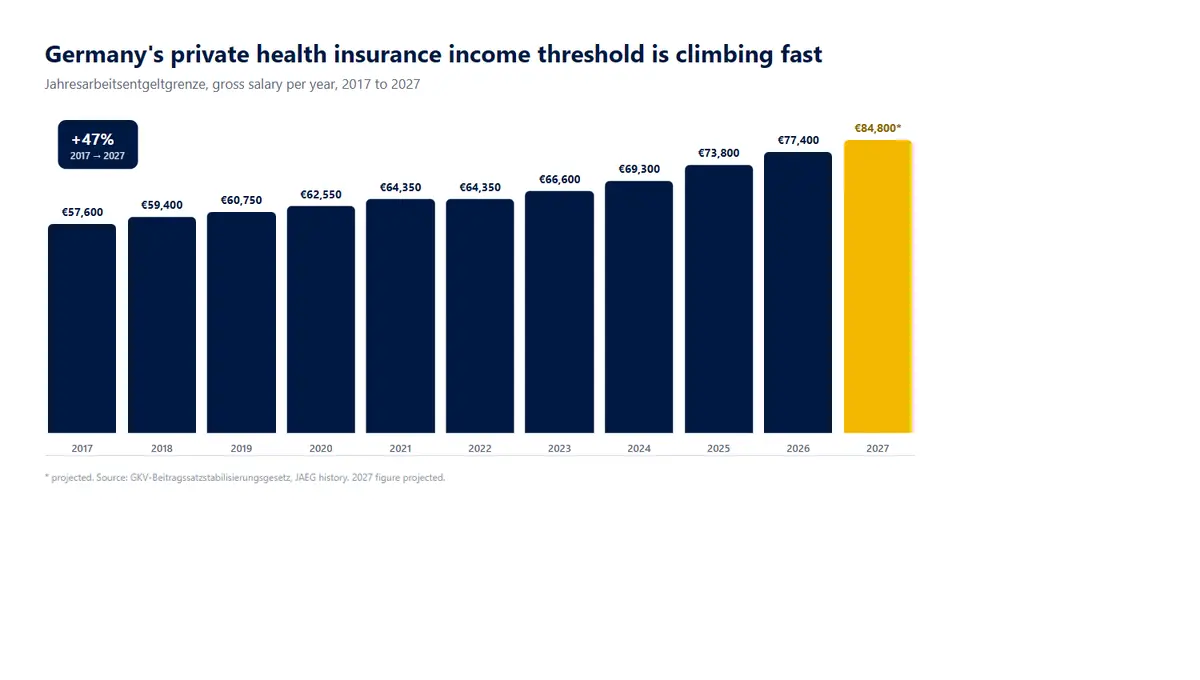
For 2026, that threshold sits at €77,400 per year, or €6,450 per month. For 2027, current government plans push it to approximately €84,000 to €84,800 per year, around €7,067 per month. These 2027 figures are projections, pending the final values that are confirmed each autumn.
That is not a routine adjustment. It combines the normal update for wage growth, about 4.53 percent based on 2025 earnings, with an extra, one off increase of €300 per month that has been written into a new federal law.
Why the jump is so large
The increase comes from a law called the public health insurance contribution rate stabilization act, known in German as the GKV-Beitragssatzstabilisierungsgesetz, which the federal cabinet has approved. The threshold for 2027 is built from two parts: the usual wage based adjustment, plus a deliberate extra rise of €300 per month, which works out to €3,600 over the year.
The political aim is to keep more high earners contributing to the public system rather than leaving for private cover. The scale is striking. Between 2017 and 2027, this threshold will have risen by nearly 47 percent, from €57,600 to a projected €84,000 and above. For anyone considering moving from public to private, the door is narrowing year by year.
Who can still switch in 2026, and who should think twice
Your salary relative to the threshold decides your options. Three broad groups stand out.
- Comfortably above €84,800. If your gross salary already clears the projected 2027 limit, your eligibility is secure either way. You can switch in 2026 or 2027 without the threshold itself being the obstacle. The decision becomes about cost, cover, and timing rather than eligibility.
- Between €77,400 and roughly €84,000. This is the group that needs to pay attention. You qualify under the 2026 rules, but you could sit below the higher 2027 limit. Acting in 2026 may secure your access before the bar rises.
- Below €77,400 as an employee. You are not eligible to switch yet. Rather than chase the threshold, it is usually smarter to make the most of the public system for now. Our guide to public versus private health insurance explains how to think about that choice.
A detail that makes 2026 matter: the grandfathering rule
The new law treats people who are already privately insured differently from those who switch later. The draft provides that if you are already in private cover, you continue to be measured against the previous threshold and its usual annual rise, without the extraordinary €300 per month increase.
In plain terms: switching in 2026 means you are assessed against the lower, regular threshold path going forward, not the sharply raised 2027 one. For someone whose salary sits in the middle band, that materially reduces the risk of being pulled back into the public system later. Wait until 2027, and you face the higher bar from the start.
This is exactly the kind of calculation worth getting right. The numbers depend on your salary trajectory, your employment status, and how the regular threshold is expected to rise. Not sure which side of the line you fall on? A short, free consultation is the fastest way to check. We will look at your salary, your status, and the grandfathering rule together, by phone, and tell you honestly whether switching in 2026 makes sense for you. Book your free consultation.
Staying public is not the cheap option it used to be
It is tempting to read all of this as "private is being squeezed, so just stay public." The numbers tell a more nuanced story. The same reform also lifts the ceiling on which public contributions are calculated, the Beitragsbemessungsgrenze. As that ceiling rises, the maximum monthly public contribution for higher earners is expected to climb above €1,300 per month.
For employees, there is a cushion on the private side too. Your employer pays a subsidy toward private premiums that is tied to that same ceiling, so as the ceiling rises, the subsidy rises with it, absorbing part of any premium increase. The net effect is that for many higher earners, private cover is becoming relatively more attractive, not less. If cost is your main worry, our breakdown of the cost of private health insurance puts real numbers against the comparison.
| Figure | 2026 | 2027 (projected) |
|---|---|---|
| Income threshold, per year | €77,400 | about €84,000 to €84,800 |
| Income threshold, per month | €6,450 | about €7,067 |
| Public contribution ceiling, per year | €69,750 | about €76,500 |
| Public contribution ceiling, per month | €5,812.50 | about €6,375 |
The 2027 figures above are projections based on current draft legislation and forecast wage growth. Final values are confirmed in the autumn before each year begins.
What it means if you have just arrived in Germany
For international professionals starting a new role, the timing rules work in your favour if you plan ahead. Eligibility is assessed on your agreed gross annual salary, so a signed contract that clearly clears the threshold can open the private option from the start of your employment, rather than after a full year of payslips. Variable pay such as bonuses can count toward the figure, but only the portion you can reliably expect, so it is worth confirming how your employer reports it.
The practical catch is the clock. When you begin a new job in Germany, the public system enrols you by default, and the window to opt out and arrange private cover is short, usually within the first 14 days. Miss it, and you may be locked into the public system until your next qualifying change. If you are new to the country and still mapping out your options, our overview of health insurance for internationals in Germany covers the essentials before you sign anything.
There is a second reason for newcomers to act deliberately in 2026. If your first German contract sits in the middle band, just above today's threshold but below the projected 2027 limit, the difference between deciding in your first weeks and drifting into 2027 could be the difference between qualifying and not. The rules reward people who plan the move, not those who postpone it.
How a broker helps you time the decision
The hardest part of this decision is rarely the headline number. It is the interaction between your salary outlook, the grandfathering rule, the notice periods, and the specific terms of each insurer's plan. Those pieces do not live in any single online calculator, which is why a conversation usually beats a comparison table.
An independent broker works for you, not for one insurer, and can model the realistic scenarios side by side: switch in 2026, wait for 2027, or stay public for now. Just as important, the right plan is not always the cheapest one this year, because private premiums are calculated over decades. We look at how each insurer has historically managed premium increases, what the cover actually includes, and how it fits your health and family plans. Our comparison of Private health insurance companies in Germany is a useful starting point, and a free consultation turns it into a decision tailored to you.
What to do now
If 2027 eligibility matters to you, a few practical steps make the decision clearer.
- Confirm your gross annual salary against the 2026 threshold of €77,400, and against the projected 2027 figure of roughly €84,000.
- Mind the notice periods. Leaving the public system generally requires two months notice. If you are starting a new job, you typically need to act within the first 14 days.
- Factor in the grandfathering rule. If you are eligible now and likely to stay close to the threshold, switching in 2026 can lock in the lower path.
- Get the math checked before you commit. Private cover is a long term decision, and the right answer depends on your health, age, family plans, and income outlook.
The window for a smooth move under the current rules is genuinely closing. If you think you might want private cover in the next year or two, it is worth pressure testing the decision now rather than discovering in 2027 that the bar has moved out of reach. Book a free consultation and we will walk through your numbers with you, no pressure and no jargon.
 Written byMarco Maurelli
 Reviewed byBettina Ostermann