
Statutory Health Insurance Contribution Rates in Germany (2026)
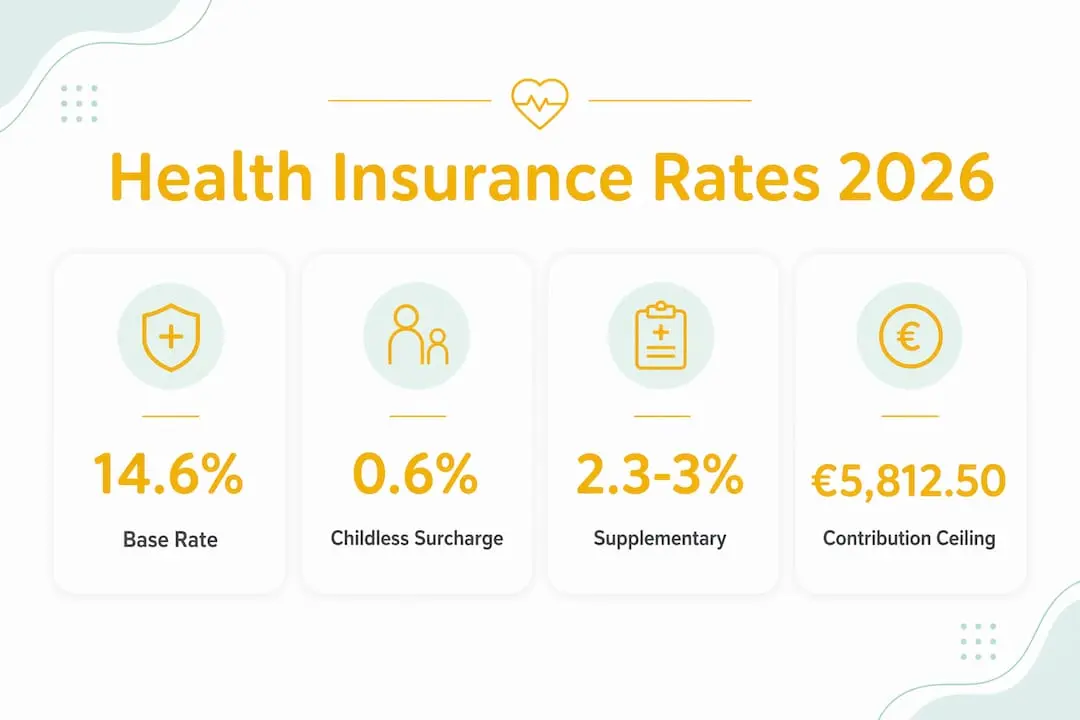
Statutory health insurance contribution rates in Germany are defined as a legally fixed base rate of 14.6% of gross income, split equally between employee and employer, plus a variable supplementary contribution that differs by fund. In 2026, the federal average supplementary contribution sits at 2.9%, bringing the effective total health insurance rate to roughly 17.5% before long-term care insurance is added. The contribution assessment ceiling is set at €69,750 per year, meaning income above that threshold generates no additional deductions. Understanding how these numbers work together is the first step toward smarter budgeting and better insurance decisions.
How are statutory health insurance contribution rates calculated?
The calculation starts with the 14.6% base rate, which is legally fixed and unchanged for 2026. Your employer pays exactly half, 7.3%, and you pay the other 7.3% directly from your gross salary. That split is mandatory across every statutory fund in Germany, with no exceptions.

On top of the base rate, each fund charges its own Zusatzbeitrag, the supplementary contribution. This is where funds compete. The federal average for 2026 is 2.9%, also split equally between you and your employer. Your total health insurance deduction from gross pay is therefore 7.3% plus half of your fund's supplementary rate.
To compare funds side by side, see our guide to the best public health insurers.
Here is a step-by-step example using a gross monthly salary of €4,000:
- Base rate employee share: €4,000 × 7.3% = €292.00
- Supplementary contribution employee share (at 2.9% average): €4,000 × 1.45% = €58.00
- Total health insurance deduction: €292 + €58 = €350.00 per month
- Employer pays the same amount: €350.00 per month
- Combined monthly contribution to the fund: €700.00
For an employee earning €7,000 per month, the calculation hits the monthly ceiling of €5,812.50. Any income above that cap is simply ignored for contribution purposes. The maximum monthly health insurance deduction at the average supplementary rate is capped accordingly, which softens the blow for higher earners.
Pro Tip: Your payslip shows the deduction as "KV-Beitrag." Check that your employer is applying the correct supplementary rate for your specific fund, not the federal average. A small error here adds up over 12 months.
What impact does the contribution ceiling have on your contributions?
The contribution assessment ceiling is set at €69,750 per year (€5,812.50 per month) in 2026. Income above this threshold is not subject to statutory health insurance deductions. This means your monthly contribution is capped regardless of how much you earn above that level.
A separate and often confused figure is the compulsory insurance threshold, set at €77,400 per year in 2026. This is the income level above which you become eligible to opt out of statutory coverage entirely and switch to Private health insurance. The two figures are not the same, and confusing them is a common and costly mistake.
| Figure | 2026 Value | What it controls |
|---|---|---|
| Contribution assessment ceiling | €69,750/year | Maximum income subject to contributions |
| Monthly contribution ceiling | €5,812.50/month | Maximum monthly deduction base |
| Compulsory insurance threshold | €77,400/year | Eligibility to switch to private insurance |
The gap between the two thresholds matters. You can earn above the contribution ceiling and still be legally required to stay in statutory coverage if your income has not yet cleared €77,400. Only once you consistently exceed the compulsory threshold can you check your eligibility for private insurance.
Pro Tip: The compulsory threshold must be exceeded for at least one full calendar year before you can switch to private insurance. Plan your timing carefully if you are approaching that income level.
What additional charges affect your total health insurance cost?
Long-term care insurance (Pflegeversicherung) is a mandatory addition on top of your health insurance contributions. The rate is 3.6% with children, split equally between you and your employer. If you are childless and over 23, the rate rises to 4.2%, with the extra 0.6% paid entirely by you. That surcharge is one of the most overlooked costs on a German payslip.
Here is a clear breakdown of what the total all-in rate looks like for an average employee in 2026:
- Base health insurance rate: 14.6% (7.3% employee, 7.3% employer)
- Average supplementary contribution: 2.9% (1.45% employee, 1.45% employer)
- Long-term care with children: 3.6% (1.8% employee, 1.8% employer)
- Long-term care childless surcharge: 0.6% (paid fully by employee)
- Total effective rate with children: roughly 21.1%
- Total effective rate without children: roughly 21.7%
The childless surcharge of 0.6% is fully your responsibility. At a monthly salary of €4,000, that adds about €24 per month to your costs compared to a colleague with children. Over a year, that is roughly €288 in additional deductions that many employees never notice until they look closely at their payslip.
The supplementary contribution rate also varies significantly between funds. In 2026, rates range from roughly 2.3% to 3.2%. Choosing a fund at the lower end of that range versus the higher end can make a real difference to your monthly take-home pay.
How can you reduce your statutory health insurance costs?
Choosing a fund with a lower supplementary contribution is the single most direct way to reduce your mandatory health insurance costs. The difference between funds can reach up to €50 per month for employees at the income ceiling. Over a year, that is €600 in savings without changing your coverage level.
Practical steps to optimize your costs:
- Compare supplementary rates annually. Funds adjust their Zusatzbeitrag every january, so a fund that was cheap last year may not be the best option this year. Check rates at the start of each calendar year.
- Factor in service quality. A lower rate is only worth it if the fund processes claims efficiently and covers the services you actually use. Read reviews and check fund ratings before switching.
- Understand the switching window. You must generally stay with your fund for at least 12 months before switching to another. If your fund raises its supplementary rate mid-year, you may have a special right to switch earlier.
- Check if private insurance makes sense. If your income exceeds €77,400 per year, you have the option to leave statutory coverage. For high earners in Germany, private insurance can offer better value depending on age and health status.
- Account for the childless surcharge in your budget. If you are over 23 and have no children, build the extra 0.6% into your monthly budget from the start.
Pro Tip: Switching funds beats a calculator. Even a 0.3% difference in supplementary rates translates to real money at higher incomes. Run the numbers on your actual gross salary, not a hypothetical average.
Key Takeaways
Statutory health insurance contribution rates in Germany combine a fixed 14.6% base rate with a variable supplementary contribution, and the total cost depends on your fund choice, income level, and whether you have children.
| Point | Details |
|---|---|
| Fixed base rate | The 14.6% base rate is legally set and split equally between you and your employer. |
| Supplementary contribution varies | Fund rates range from 2.3% to 3.2% in 2026; the federal average is 2.9%. |
| Income ceiling caps costs | Contributions stop increasing once your income exceeds €69,750 per year. |
| Childless surcharge adds cost | Employees over 23 without children pay an extra 0.6% in long-term care contributions. |
| Fund choice saves money | Picking a lower-rate fund can save up to €50 per month at the income ceiling. |
What matters most when managing statutory contributions
One pattern stands out across employees in Germany. Most accept whatever fund they were enrolled in at their first job and never revisit the decision. That passivity is expensive.
The base rate is fixed, so there is nothing to negotiate there. The supplementary contribution, though, is within your control. Switching to a fund with a lower Zusatzbeitrag can save several hundred euros per year, and the coverage stays functionally identical at the statutory level. The only real variables are price and service quality.
The childless surcharge is the detail that surprises people most. It does not appear as a separate line on every payslip, so employees often do not realize they are paying it. If you are over 23 and have no children, that 0.6% comes out of your pocket every month. At a €5,000 gross salary, that is €30 per month, or €360 per year, easily missed.
Rising contribution assessment ceilings also mean that higher earners pay more in absolute terms each year, even when the percentage rates stay flat. The ceiling has increased consistently, and that trend is unlikely to reverse. If you are approaching the €69,750 threshold, your absolute monthly contribution will grow as the ceiling rises.
Myhealthcarebroker's advice is straightforward: review your fund's supplementary rate every January. If you are approaching the compulsory insurance threshold of €77,400, get a proper comparison of statutory versus private options before you decide. The numbers matter, and so does timing.
How Myhealthcarebroker helps you manage your health insurance costs
Choosing the right statutory fund or deciding whether private insurance makes sense requires more than a quick online search. Myhealthcarebroker offers independent, English-language advice to employees in Germany who want a clear picture of their options without wading through German bureaucracy.

Whether you want to compare supplementary contribution rates across statutory funds or understand whether your income qualifies you for Private health insurance in Germany, Myhealthcarebroker guides you through the process step by step. The team is not tied to any single insurer, so the advice reflects your situation, not a sales target. You can also use the private insurance calculator to get a fast, personalized cost estimate and see how statutory and private options compare for your income level.
 Written and reviewed byBettina Ostermann