
Versicherungspflichtgrenze Explained: 2026–2027 Guide
The Versicherungspflichtgrenze, formally known as the Jahresarbeitsentgeltgrenze (JAEG), is the annual gross income threshold that gives employees in Germany the legal right to leave statutory health insurance and choose private health insurance instead. Cross it, and you gain a genuine choice. Stay below it, and public health insurance membership remains compulsory. Für 2026 liegt die Versicherungspflichtgrenze (JAEG) bei 77.400 € brutto jährlich; dieser Wert wurde durch die Sozialversicherungs-Rechengrößenverordnung festgelegt.
Table of Contents
- How the threshold is set and what's changing in 2027
- Who can actually opt for private insurance?
- What counts toward your annual working remuneration?
- Key dates and deadlines you need to know
- What switching to private health insurance actually means for you
- Exceptions and special cases that change the picture
- Your checklist when your salary crosses the threshold
- Key Takeaways
- The decision most people get wrong
- How Myhealthcarebroker helps you navigate this decision
- Useful sources
How the threshold is set and what's changing in 2027
The JAEG isn't a fixed number. It adjusts each year based on the development of gross wages and salaries per employee from prior calendar years, then gets formalized in the Sozialversicherungs-Rechengrößenverordnung. Think of it as a wage-indexed moving target: when average salaries rise across Germany, the threshold rises with them.
For 2026, the official figure announced by authorities is used by employers to determine whether you're subject to compulsory public health insurance membership or free to choose private health insurance.
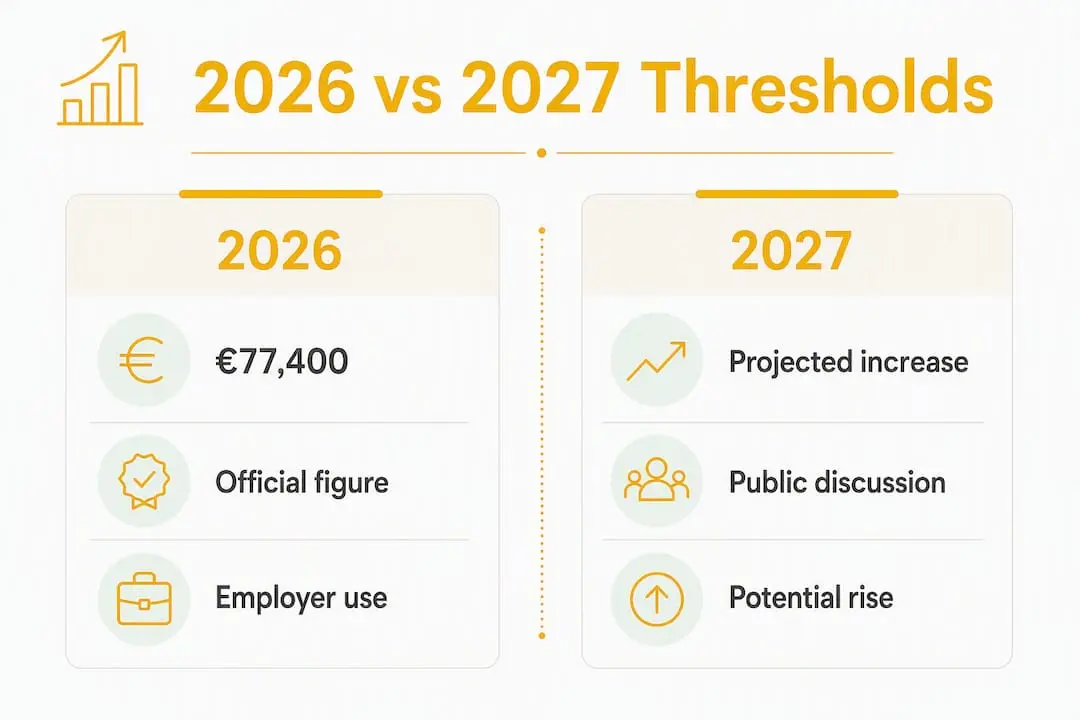
Looking ahead, public discussion in 2026 flagged a potentially substantial 2027 increase, with some commentary suggesting the JAEG could push toward €85,000 in certain scenarios. Nothing is confirmed until the regulation is published, but the direction is clear: the threshold is rising. If you're currently earning just above €77,400, a higher 2027 JAEG could pull you back below the line and end your private health insurance eligibility for that year. Checking the updated figure each autumn is not optional; it's the kind of detail that changes your insurance status without any warning.

Why does the threshold exist at all? Insurer guidance explains the social-policy rationale: the JAEG is designed to keep lower-income earners in the solidarity-based public health insurance system, where premiums are income-linked rather than risk-based. Private insurance prices are determined by health risk and age, which can become unaffordable in later life. The threshold is the mechanism that limits who can make that trade-off.
Who can actually opt for private insurance?
The rule applies to employees whose regular gross annual pay exceeds the JAEG. "Regular" is the operative word here. One-off payments don't automatically count, and the classification of your income components matters.
Groups who become eligible to choose private health insurance when their salary crosses the threshold:
- Standard employees with a regular employment contract whose projected annual gross salary exceeds €77,400 in 2026.
- Employees with multiple jobs where the combined regular income from all positions exceeds €77,400 in 2026.
- New hires whose agreed salary is expected to be above €77,400 from day one in 2026.
Groups who are treated differently or remain in public health insurance regardless:
- Students in standard student health insurance are subject to separate rules and are generally not eligible for private health insurance via the JAEG route.
- Civil servants (Beamte) are not covered by public health insurance compulsory membership rules at all; they access private health insurance through a different framework (Beihilfe).
- Mini-jobbers earning below the marginal employment threshold are not subject to compulsory public health insurance membership in the same way and are excluded from this calculation.
- Employees below the threshold remain in compulsory public health insurance membership regardless of personal preference.
There is also a special lower threshold for employees who were already privately insured on December 31, 2002. Under this Bestandsschutz rule, the special threshold is €69,750 in 2026.
One point worth emphasizing: being "versicherungsfrei" means you are exempt from compulsory public health insurance membership, not exempt from holding health insurance. You must still be covered, either through voluntary public health insurance or through a private plan.
What counts toward your annual working remuneration?
The JAEG calculation is based on your regular annual working remuneration, and not every euro that hits your bank account qualifies.
What generally counts:
- Base salary and regular contractual pay increases.
- Regular bonuses that are contractually guaranteed and paid consistently (e.g., a fixed 13th-month payment).
- Taxable allowances that form a regular part of your compensation package.
What generally does not count:
- One-off or discretionary bonuses with no contractual guarantee.
- Overtime pay that is not a fixed, predictable part of your compensation.
- Expense reimbursements and non-taxable benefits.
For part-year employment, the rule uses a projected annual figure. If you start a job in July with a monthly salary of €6,800, the employer projects your annual earnings as though you had worked the full year (€6,800 × 12 = €81,600), which would place you above the 2026 threshold immediately. New hires are assessed on this projected basis, not on what they actually earn in the partial year.
Multiple jobs are combined. If you hold two part-time roles and the combined regular income exceeds €77,400 in 2026, you cross the threshold even if neither job alone would do so.
Pro Tip: Before making any insurance decision, ask your HR department for a written confirmation of how your salary components are classified. Payroll teams determine whether a bonus is "regular" or "one-off," and that classification directly affects your JAEG status. Getting it in writing protects you if the classification is later disputed.
Payroll classification and salary projections are the practical gatekeepers here. Your HR team's determination, not your own estimate, is what your employer reports.
Key dates and deadlines you need to know
Timing is where many employees get caught out. The rules differ depending on whether you're already employed or starting a new job.
For new hires whose agreed salary already exceeds the JAEG, the exemption from compulsory public health insurance membership is immediate from the first day of employment. You don't wait until year-end.
The two-week window matters. Once you formally declare your intention to leave public health insurance, you have a short window to arrange private health insurance coverage and have it take effect without a gap. Missing this window can leave you in a coverage limbo that's difficult to resolve quickly. Notify both your employer and your public health insurance provider in writing, and confirm the exact deadlines with your insurer.
The September 30 reference that appears in many coverage guides relates to planning for the following year. If you want to switch to private health insurance at the start of the next calendar year, getting your private health insurance application, medical underwriting, and formal public health insurance exit notification completed before the end of September gives you enough runway. Applications submitted later in the year can still work, but the timeline gets tight.
What switching to private health insurance actually means for you
Moving from public health insurance to private health insurance is a significant financial and personal decision, not just an administrative one. The benefits are real for the right profile; so are the risks.
Typical advantages for higher earners:
- Faster specialist access and shorter waiting times in many cases.
- More flexible reimbursement models and broader coverage options, including what private health insurance covers in terms of dental, vision, and specialist care.
- Premiums that are not income-linked, which can be favorable for very high earners who would otherwise pay maximum public health insurance contributions.
- Individual plan customization, including choice of deductible levels.
Key risks to weigh carefully:
- Private health insurance premiums are risk-based and age-based. They rise as you get older, sometimes sharply.
- Medical underwriting at entry means pre-existing conditions can lead to exclusions or premium surcharges.
- If you have a non-working spouse or children, they are not automatically covered under private health insurance the way they are under public health insurance's family insurance. Each family member needs their own policy, which adds significant cost.
- Returning to public health insurance after switching to private health insurance is genuinely difficult. After age 55, it becomes extremely hard to return to statutory insurance for most employees.
The age-55 barrier deserves direct attention. Once you're over 55, the legal routes back into public health insurance are narrow: you'd generally need to become unemployed and meet specific conditions, or your income would need to fall below the threshold while you're still young enough for public health insurance to accept you. Many people who switch to private health insurance in their 30s or 40s find themselves locked in by their 50s, paying premiums that have grown substantially while their health situation has changed.
Families with a non-working spouse or planned career breaks often find public health insurance more cost-effective long-term, even for high earners. The free family coverage in public health insurance is a benefit that private health insurance simply doesn't replicate.
Pro Tip: Model your costs over a 20–30 year horizon, not just the next few years. A broker can run a side-by-side long-term projection that accounts for age-based premium increases, family coverage needs, and likely career trajectory. That projection often changes the decision entirely.
Exceptions and special cases that change the picture
The headline rule covers most employees, but several groups operate under different conditions.
- Bestandsschutz (pre-2003 private members): Employees who were privately insured on December 31, 2002 qualify for a lower threshold. In 2026, that special threshold is €69,750.
- The over-55 rule: Employees who are over 55 and have been in public health insurance for most of the preceding ten years generally cannot switch to private health insurance even if their salary exceeds the JAEG. This is one of the most consequential and least-understood restrictions. It's designed to prevent older, higher-risk individuals from moving into private insurance when public health insurance has already covered their health costs for decades.
- Students: Standard student health insurance in Germany operates under a separate framework. Students are generally not eligible to use the JAEG route to access private health insurance. Those interested in Private health insurance as students should check the specific student rules, which differ significantly.
- Civil servants: Beamte access private health insurance through the Beihilfe system, which provides a government subsidy toward private insurance costs. The JAEG does not apply to them in the same way.
- Mini-jobbers and marginal employment: Employees in mini-jobs (below the marginal employment threshold) are not subject to standard compulsory public health insurance membership rules and are excluded from the JAEG calculation.
Your checklist when your salary crosses the threshold
If your income is approaching the JAEG in 2026, or you're starting a new role above that level, here's what to do:
- Step 1: Confirm your payroll classification. Ask HR for a written breakdown of which salary components count as regular annual working remuneration. Don't rely on your own estimate.
- Step 2: Project next year's income. If you're in ongoing employment, the threshold test applies to both the current and following year. Confirm with HR whether your salary is expected to remain above the JAEG in 2027, especially given the anticipated increase.
- Step 3: Model both options. Compare your current public health insurance contribution (including the Zusatzbeitrag) against realistic private health insurance quotes. Factor in family coverage, deductibles, and long-term premium trajectory. A Public health insurance vs private health insurance comparison can help frame the trade-offs.
- Step 4: Notify employer and public health insurance if switching. Submit written notice to both your employer and your public health insurance provider within the required window. Confirm the exact deadline with your insurer, and keep copies of everything.
- Step 5: Complete private health insurance medical underwriting. Obtain quotes from multiple private insurers, disclose your health history accurately, and confirm coverage details including deductibles and family implications before signing anything.
Pro Tip: A broker who handles both public and private health insurance comparisons can run the long-term cost model, manage the notification timeline, and flag underwriting issues before they become problems. The consultation is free, and it typically saves clients from decisions they'd regret at 55.
Key Takeaways
The Versicherungspflichtgrenze (JAEG) is the single most important income threshold in the German health insurance system for employees considering private coverage.
| Point | Details |
|---|---|
| 2026 threshold | The JAEG stands at €77,400 per year; only regular gross salary components count toward this figure. |
| Annual adjustment | The threshold changes every year via the Sozialversicherungs-Rechengrößenverordnung; a substantial 2027 increase has been discussed publicly. |
| Timing rules | Ongoing employees become insurance-free at year-end; new hires with salaries above the JAEG are exempt immediately. |
| Age-55 return barrier | Returning to public health insurance after switching to private health insurance becomes extremely difficult after age 55, making the decision effectively permanent for many. |
| Myhealthcarebroker | Myhealthcarebroker provides free eligibility checks, long-term cost modeling, and full application support in English for employees navigating this decision. |
The decision most people get wrong
The most common mistake is treating the Versicherungspflichtgrenze as a simple on/off switch. Salary crosses €77,400, switch to private health insurance, done. The reality is more layered, and the consequences of getting it wrong compound over decades.
Expat professionals in particular often underestimate the family coverage gap. A couple where one partner earns above the threshold and the other is not working pays nothing extra for the non-working partner under public health insurance. Under private health insurance, that same family pays a full additional premium for the non-working partner. For a family with two children, the cost difference can be substantial enough to make public health insurance the smarter financial choice even at salaries well above the threshold.
The age trap is the other recurring pattern. Employees in their late 30s switch to private health insurance attracted by lower premiums and better access, then find themselves in their mid-50s with rising premiums, changed health circumstances, and no practical route back to public health insurance. The decision that felt right at 38 can feel very different at 54.
The JAEG gives you a choice. It doesn't tell you which choice is right. That depends on your age, family structure, health history, career trajectory, and long-term financial plan. Getting those variables into a model before deciding is the difference between a good outcome and an expensive lesson.
How Myhealthcarebroker helps you navigate this decision
Crossing the Versicherungspflichtgrenze is the starting point, not the finish line. Myhealthcarebroker offers exactly the kind of independent, English-language support that makes the next steps manageable: a free eligibility check to confirm whether you qualify for private health insurance, a side-by-side long-term cost model comparing your current public health insurance contributions against realistic private health insurance quotes, and full application support from underwriting through to policy activation.
Unlike going directly to a single insurer, Myhealthcarebroker compares options across all major private providers, so you see the full picture rather than one company's best offer. The service is free to you; the broker is paid a regulated commission by the insurer only when a policy is placed. Use the Private health insurance cost calculator to get an immediate estimate, or visit the Private health insurance guidance page to book a short consultation and get your questions answered in plain English.
This article is general information, not professional legal or financial advice. Confirm current thresholds and your personal eligibility with your HR department, your public health insurance provider, or a qualified insurance advisor before making any changes to your coverage.
Useful sources
The figures and rules in this article come from primary German government and regulatory sources. Use these to verify current numbers and follow up on specific questions.
| Source | What it covers |
|---|---|
| Jahresarbeitsentgeltgrenze, Wikipedia (DE) | Definition, annual adjustment methodology, and historical figures for the JAEG |
| Bundesgesundheitsministerium (BMG) | Official government page on statutory health insurance membership, timing rules, and the two-week notification window |
| ERGO: Was ist die Versicherungspflichtgrenze? | Insurer guidance on the social-policy rationale and practical implications of the threshold |
| [Myhealthcarebroker: 2027 income threshold analysis](/blog/private-health-insurance-income-threshold-2027-germany) | Client-facing analysis of 2027 JAEG proposals and what employees should do now |
| Myhealthcarebroker: public health insurance vs private health insurance comparison | Side-by-side breakdown of statutory and private insurance differences |
| Myhealthcarebroker: private health insurance cost calculator | Interactive tool for modeling private health insurance vs public health insurance costs based on your personal situation |
Recommended
- Private Health Insurance 2027: Germany's New Income Limit
- Public Health Insurance 2027: What Higher Earners Pay
- Private Health Insurance in Germany: 2026 Guide
- Blog: health insurance in Germany | Myhealthcarebroker
Written by Marco Maurelli, editorial lead ·
Reviewed by Bettina Ostermann, insurance broker
(§ 34d Abs. 1 GewO) · Last reviewed: 2026-08-12
*This article is general information, not individual advice. Your age, income,
residence status and health history change the answer. Get a free quote
or book a consultation before you decide.*
*Myhealthcarebroker is an insurance broker registered under § 34d GewO.
See our initial information and imprint.*
*Parts of this article were drafted with AI assistance and reviewed by a
licensed broker. Images marked "AI-generated" were created with generative AI.*
 Written and reviewed byBettina Ostermann