Last checked 2 November 2026. Figures follow the laws and sources listed at the end. Where a rule depends on the tariff, the text says so.
Quick answer: Core pregnancy care is almost the same in public and private health insurance: check-ups, three routine ultrasounds, midwife care and the birth. The real differences are comfort and choice, how your baby is insured, and what happens to your premium during parental leave. For couples with a high income, private health insurance for families is often the stronger long-term choice. For a single-income family planning two or more children, public insurance is clearly better.
What does public health insurance pay during pregnancy and birth?
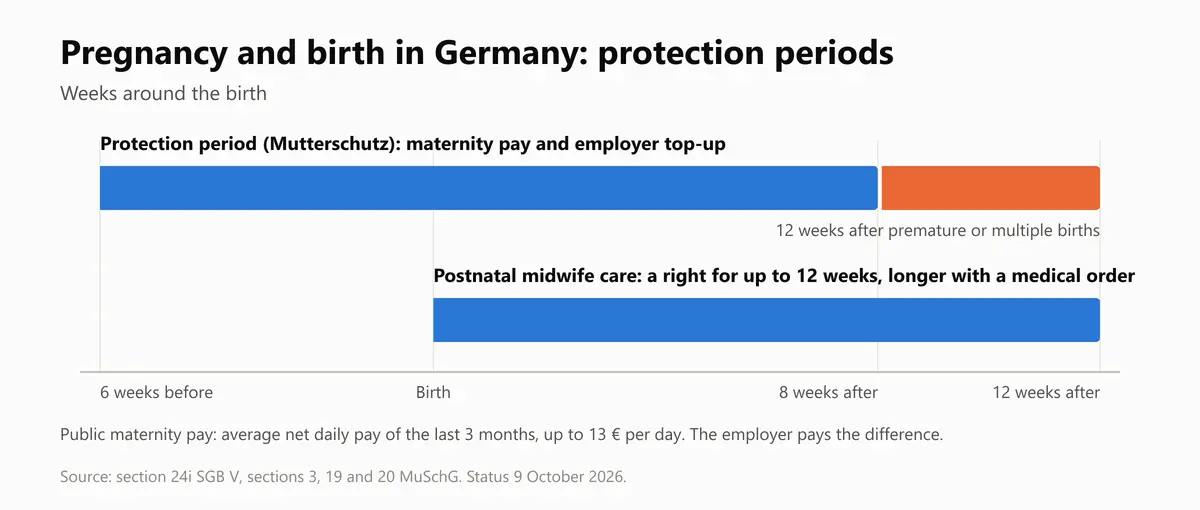
Public health insurance covers medical care and midwife help during pregnancy, at the birth and afterwards. The law also lists medicines, home nursing, household help and maternity pay (Mutterschaftsgeld). You can give birth in a hospital, a midwife-led facility or at home. Postnatal midwife help is a right for up to 12 weeks after the birth, and longer with a medical order.
Check-ups run about every 4 weeks, every 2 weeks from week 32, with three standard ultrasounds and a gestational diabetes test in weeks 25 to 28.
Maternity pay for employed members is your average net daily pay of the last 3 months, capped at EUR 13 per calendar day. Your employer pays the difference up to your full net pay during the protection periods: 6 weeks before the birth and 8 weeks after (12 weeks after premature or multiple births). Children are covered at no extra premium through free family insurance in public health insurance, as long as the usual income conditions are met.
What does private health insurance pay, and what can a better tariff add?
The core is the same as in public insurance: check-ups, routine ultrasounds, the diabetes screening, the birth and postnatal midwife care. For how private health insurance works in Germany, the difference lies in the extras. Some plans add extra infection screening, advanced genetic testing, closer monitoring, a non-invasive prenatal test, a single hospital room and a budget for birth preparation or postnatal exercise. Whether a plan includes them depends on the tariff, so read them as "some plans", not a market standard. In public cover, that test is usually paid out of pocket without a medical reason.
Privately insured patients usually receive invoices and claim the money back, while public patients pay nothing at the point of care.
IVF. Public insurance pays 50 percent of approved costs for married couples using their own egg and sperm cells, with a doctor's finding of a reasonable chance of success (not after 3 failed attempts) and an approved treatment plan. Entitlement runs from age 25 up to age 40 for women and 50 for men. Private tariffs vary widely, from no cover to high reimbursement, so check the conditions before you plan.
| Benefit | Public health insurance | Private health insurance | Note |
|---|---|---|---|
| Check-ups and 3 ultrasounds | Covered | Covered | Same core |
| Postnatal midwife care | Covered, 12 weeks as of right | Covered | Scope per tariff |
| Maternity pay | Up to EUR 13 per day | EUR 210 one-off | See money table below |
| Single room | No | Some plans | Check the tariff |
| Chosen doctor | Within the system | Broader choice | Invoices, then reimbursement |
| IVF | 50 percent, strict rules | Varies by tariff | Check conditions |
Source: sections 24c to 24f and 27a SGB V (gesetze-im-internet.de).
Is there a waiting period for pregnancy benefits in private health insurance?
The law caps waiting periods. The general waiting period may be at most 3 months. Special waiting periods, including childbirth, may be at most 8 months (section 197 VVG). So up to 8 months is allowed and common, but it is a ceiling, not a rule. Some tariffs use less or none.
Earlier cover helps. If you had uninterrupted public or other full health cover and you apply for the new policy within 2 months after the old one ends, the earlier cover counts toward the waiting periods. In practice the childbirth waiting period differs by tariff. Ask for the waiting periods in writing before you sign.
Can I take out private health insurance when I am already pregnant?
Possibly, with some insurers, and the terms differ. You must answer the insurer's written health questions truthfully before you sign (section 19 VVG), and pregnancy is part of that picture. If a childbirth waiting period applies, a switch during pregnancy often brings little benefit for this birth. Nobody can promise acceptance before the insurer decides. Ask for the exact childbirth waiting period before you apply, and compare it with staying public until after the birth. If you are only planning a pregnancy, a private plan in place first removes the question.
What happens to my newborn's health insurance?
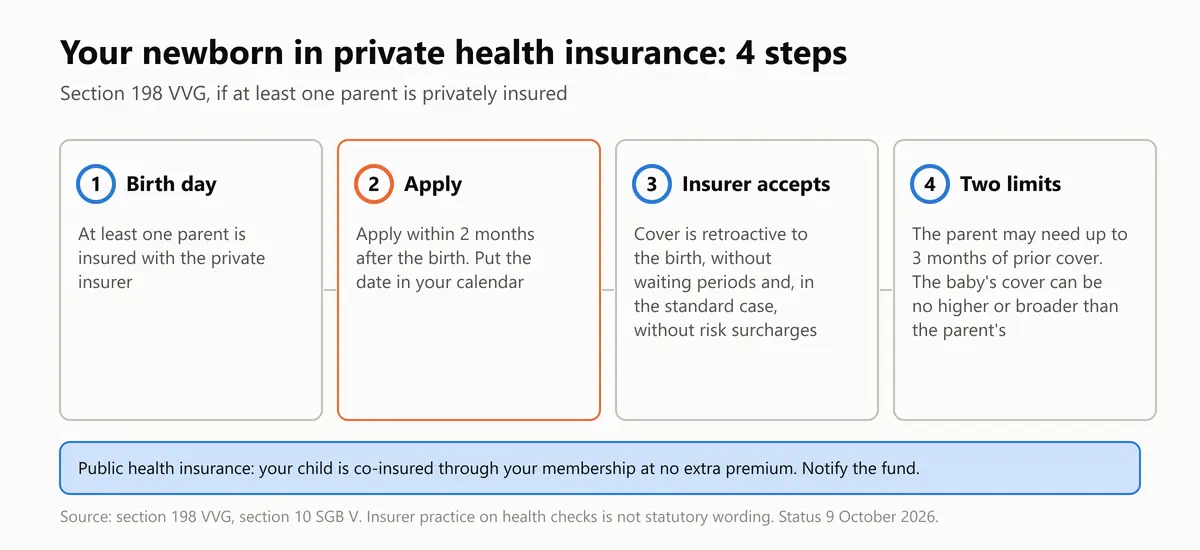
Public: your child is co-insured through your membership at no extra premium. One trap for mixed couples: a child is not family-insured if the other parent is not in a public fund, regularly earns more than one twelfth of the annual income threshold per month, and earns more than the public member. One twelfth of EUR 77,400 is EUR 6,450 per month (own arithmetic). If you are privately insured and your partner is public, check this before the birth.
Private: your baby needs an own contract, the child is not co-insured. The good news is section 198 VVG. If at least one parent is insured on the birth day, the insurer must accept the newborn from birth without waiting periods and without risk surcharges, if you apply at the latest 2 months after the birth. Two limits apply: the insurer may require that the parent has been insured for a minimum period of up to 3 months, and the baby's cover may not be higher or broader than the parent's cover. The cover is retroactive to the birth. The law rules out risk surcharges for newborns. Only for an adopted child with a higher health risk may the insurer charge a surcharge of up to one full premium. Put the 2-month date in your calendar the week the baby arrives.
| Question | Public | Private |
|---|---|---|
| Covered by the parent's contract? | Yes, family insurance | No, own contract |
| Deadline | Notify the fund | Apply within 2 months after birth |
| Extra premium for the child | None | Yes, see cost example |
| Waiting periods | None | None if applied within 2 months (parent may need up to 3 months of prior cover) |
| Health check | None | None and no risk surcharge if applied within 2 months |
Source: section 10 SGB V and section 198 VVG (gesetze-im-internet.de).
What does a child cost in private health insurance?
The premium for a child in private health insurance depends on the tariff, the deductible and the child's age, and every child needs an own contract. We calculate it for you in a free consultation.
Employees who hold private cover because their income is above the threshold receive an employer subsidy. It is one amount for you and your family members who would otherwise be family-insured, not a separate 50 percent entitlement per child: the subsidy covers up to half of the premiums for you and your child together, within the monthly cap of EUR 508.59 for health insurance in 2026 (half of the maximum public contribution) and never more than half of the premiums you actually pay. Your own premium uses part of that cap first, so the amount left for the child depends on your tariff. Check the exact figure with your employer. The subsidy rules are in our guide to the employer subsidy for private health insurance.
| Premium per month | |
|---|---|
| Child in private health insurance | Depends on tariff, deductible and age |
Child tariffs cost far less than adult tariffs, and the price depends on the insurer, the deductible and the age of the child. Ask for a written quote for your family.
Source: subsidy rule section 257 para 2 SGB V.
What happens to my premium during parental leave (Elternzeit)?
Employees are entitled to parental leave (Elternzeit) until the child's third birthday. Up to 24 months can be taken between the third and eighth birthday. Notice in text form is due 7 weeks before the start (13 weeks for later leave).
If you are privately insured, you stay insured and pay the premium yourself, including the share your employer paid before. There is no employer subsidy for the leave period. In special cases, such as part-time work during leave, ask your employer and your insurer. Put this in your budget before the leave starts.
Maternity pay if you are privately insured. The Federal Office for Social Security pays up to EUR 210 in total on application. The employer top-up still applies. Example: net pay of EUR 2,100 per 30 days is EUR 70 per day. The employer top-up is EUR 70 minus EUR 13 = EUR 57 per day during the protection periods. The one-off EUR 210 does not reduce your Elterngeld, while public maternity pay and the top-up do.
Elterngeld (parental allowance) is 65 to 67 percent of net income for most earners (up to 100 percent at very low income), with a minimum of EUR 300 and a maximum of EUR 1,800 per month (reached at about EUR 2,770 net), and can be drawn until the child's 14th month. Example: at a net income of EUR 2,000 the rate is 65 percent, so 0.65 x EUR 2,000 = EUR 1,300 per month. There is no entitlement if taxable income in the assessed tax year was above EUR 175,000 (couples: the sum of both). For privately insured parents the premium is not deducted when the base is calculated, so the base is higher than for compulsorily insured parents. Check the current rules on the federal family portal before the birth, as changes to the law were being discussed.
| Item | Amount | Who pays |
|---|---|---|
| Maternity pay (public members) | Up to EUR 13 per day | Public fund |
| Employer top-up | Net daily pay minus EUR 13 | Employer |
| Maternity pay (privately insured) | Up to EUR 210 in total | Federal Office for Social Security |
| Elterngeld | EUR 300 to EUR 1,800 per month | Elterngeld office |
| Elterngeld income limit | EUR 175,000 taxable income | Not applicable |
Source: section 24i SGB V, sections 19 and 20 MuSchG, sections 1 to 4 BEEG, federal family portal (familienportal.de).
Public or private for a couple expecting a child?
Private health insurance suits people up to about 45 best, and the longer you live in Germany, the better private gets, because old-age reserves build from the first month. Public is clearly better for a single-income family with two or more children, because children are co-insured at no cost.
Who can choose? Employees can choose private health insurance if their income is above EUR 77,400 in 2026. For 2027 the cabinet decided EUR 84,150 on 7 October 2026 (Bundesrat approval pending). Self-employed people and freelancers can choose freely. If your income is below the threshold, read health insurance in Germany or the income threshold for private health insurance. For the full comparison, see public vs private health insurance.
| Your situation | Better fit | Why |
|---|---|---|
| Couple, both employed, income above EUR 77,400 | Private is strong | Broader choice, old-age reserves from month one |
| Single-income family, planning two or more children | Public | Children co-insured at no cost |
| Self-employed parent | Private often strong | Check Krankengeld (sick pay) options |
| Existing health issues | Public, or a careful private application | Health questions must be answered truthfully |
| Privately insured higher earner, publicly insured partner | Check the child rule first | Child may not qualify for family insurance |
| Income below the threshold | Public | Private is not open to employees |
Source: own assessment, section 10 SGB V, section 257 SGB V, BEEG sections 1 and 2.
What should I do next?
Check whether you can choose private cover, ask for the childbirth waiting period and newborn terms in writing, and note the 2-month deadline for your baby's contract. For the wider picture, see private health insurance for families.
Want a free check of your options?
If you are an employee above the income threshold, or self-employed, you can get a free quote and we compare tariffs for you, including the newborn terms. For the family view, see private health insurance for families.
Sources and status
- Sections 24c, 24d, 24f, 24i, 10, 27a, 224, 257 SGB V, gesetze-im-internet.de/sgb_5/ (law, seen 2 November 2026)
- Sections 19, 197, 198 VVG, gesetze-im-internet.de/vvg_2008/ (law, seen 2 November 2026)
- Sections 3, 19, 20 MuSchG, gesetze-im-internet.de/muschg_2018/ (law, seen 2 November 2026)
- Sections 1 to 4, 15, 16 BEEG, gesetze-im-internet.de/beeg/ (law, seen 2 November 2026)
- IQWiG, prenatal care and maternity records in Germany, informedhealth.org/prenatal-care-and-maternity-records-in-germany.html (created 4 October 2023, seen 2 November 2026)
- Federal family portal, insurance during Elternzeit, familienportal.de/familienportal/familienleistungen/elternzeit/arbeit-versicherung/wie-bin-ich-waehrend-der-elternzeit-versichert--124862 (seen 2 November 2026)
- Income threshold EUR 77,400 (2026) and cabinet figures for 2027 of 7 October 2026 (Bundesrat approval pending): internal reference figures, status not final
Myhealthcarebroker is an independent insurance broker. This article is general information, not legal or tax advice. Tariffs and rules change, so check your own contract and the current law.
 Written byMarco Maurelli
 Reviewed byBettina Ostermann