
Last checked 2 November 2026. Public subsidy rules reflect the law passed on 10 July 2026 (BGBl. 2026 I Nr. 228). The 2027 income threshold is a cabinet decision of 7 October 2026, Bundesrat approval pending.
Quick answer: Public health insurance pays a fixed share of a standard solution for dentures and far less than the full bill for crowns, implants or cleanings. Comprehensive private health insurance includes dental care in the tariff, so what private health insurance covers already answers the question for readers who can choose it. Public members often add a Zahnzusatzversicherung (supplementary dental policy). On 1 January 2027 the public denture subsidy falls by 10 percentage points.
Does public health insurance pay for dental care in Germany?
Yes, but only for standard care. Public insurance covers medically necessary treatment such as check-ups, basic fillings and simple dentures. Anything above that standard, for example ceramic work, some filling materials and implants, you pay yourself. Professional cleaning is usually not a standard public benefit, though some funds contribute voluntarily.
The bonus booklet (Bonusheft) is the lever you control. Your dentist stamps it after each yearly check-up. Adults need at least one check-up per calendar year, children and teens one per half-year, without gaps. One missed year in ten can still be accepted at the fund's discretion. Five years of stamps raise your denture subsidy, ten years raise it further.
How much does public insurance pay for dentures, and what changes in 2027?
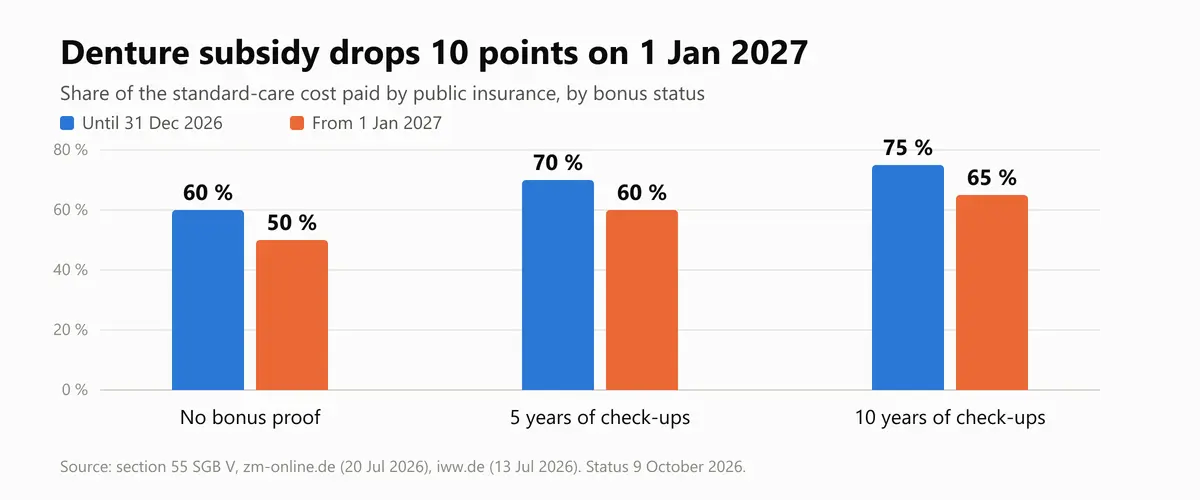
For dentures, bridges and crowns, public insurance pays a Festzuschuss (fixed subsidy). It is a percentage of the standard-care amount set for your finding, not of what the dentist invoices. The law (BGBl. 2026 I Nr. 228) was passed on 10 July 2026; the new subsidy rates apply from 1 January 2027. From that date every tier drops by 10 percentage points.
| Bonus status | Share of standard-care cost until 31 December 2026 | Share from 1 January 2027 |
|---|---|---|
| No bonus proof | 60 % | 50 % |
| 5 years of check-ups | 70 % | 60 % |
| 10 years of check-ups | 75 % | 65 % |
Source: section 55 SGB V (gesetze-im-internet.de) for the 2026 rates, Federal Ministry of Health for the law dates, zm-online.de (20 July 2026) and iww.de (13 July 2026) for the 2027 rates. Seen 2 November 2026.
A subsidy approved before 1 January 2027 keeps the old rates. The date on which your fund approves (bewilligt) the Festzuschuss decides, not the date of the treatment plan or the start of treatment. The law says the old rules apply to all subsidies approved before 1 January 2027. If timing matters to you, ask your fund when the approval will be issued. Low-income hardship rules stay in place.
In euros: an example case for 2026 has a standard-care amount of EUR 1,318.92. It is an example, not a universal price for every crown, bridge or denture. The 2027 column is our own calculation on the same amount, because the 2027 euro amounts are not published yet.
| Bonus status | 2026 subsidy | 2027 subsidy (calculation) | Difference |
|---|---|---|---|
| No bonus proof | EUR 791.35 | EUR 659.46 | EUR 131.89 |
| 5 years | EUR 923.24 | EUR 791.35 | EUR 131.89 |
| 10 years | EUR 989.19 | EUR 857.30 | EUR 131.89 |
Source: example case for 2026 (standard-care amount EUR 1,318.92), section 55 SGB V. 2027 column: own calculation at 50, 60 and 65 % of EUR 1,318.92, valid only if the standard-care amount stays unchanged.
Real invoices differ from the standard-care amount. Take a hypothetical invoice of EUR 2,500 for a larger piece of work with the same standard-care amount (an illustration, not a price quote):
- Best case, 10 years of stamps, 2026: EUR 2,500 - EUR 989.19 = EUR 1,510.81 out of pocket.
- Worst case, no bonus proof, 2027: EUR 2,500 - EUR 659.46 = EUR 1,840.54 out of pocket.
The step-by-step process, the written cost estimate and the bonus rules are in our plain-English guide to Zahnersatz. For the wider law, read the 2026 health insurance reform.
What do crowns, implants and cleanings cost in Germany?
There is no official price list for private dental work in Germany, so we do not quote fixed prices here. What you pay depends on the treatment, the material, the lab and the fee factor your dentist applies.
| Treatment | What drives the price |
|---|---|
| Professional cleaning | Time needed, practice and any extras |
| Filling | Size and material |
| Crown | Material (ceramic or metal-based) and lab costs |
| Implant including crown, per tooth | Number of teeth, bone building and materials |
No official price list exists. Ask your dentist for a written estimate.
Dentists bill private patients, and any upgrade, under the GOZ fee schedule, normally between 1.0 and 3.5 times the base rate. 2.3 is the usual ceiling without a written justification. Material and lab costs come on top. Ask for a Heil- und Kostenplan (written cost estimate) before any larger treatment and compare it with your cover.
What does a Zahnzusatzversicherung cost and cover?
A Zahnzusatzversicherung is a separate policy that public members buy to top up the Festzuschuss. The premium depends on your age, the tariff and the benefits, and it rises with age. Strong denture cover, paying 80 to 100 % of the cost, costs more than a basic tariff. We calculate it for you in a free consultation.
Tariffs differ in the percentage for dentures and implants, cleaning allowances, orthodontics and annual caps. None covers treatment already advised before you sign. A supplementary policy is a fair choice for public members who cannot or do not want to move to private health insurance, as long as they buy it early.
Why do waiting periods and staggered limits matter in the first years?
Supplementary policies, and some private tariffs, do not pay in full from day one.
| Mechanism | Typical pattern | What it means for you |
|---|---|---|
| Waiting period | None in some tariffs, several months in others | Planned treatment in that window is not paid |
| Staggered limit (Zahnstaffel) | Example: EUR 1,000 in year one, rising each year | Benefits are capped in the first years |
| Treatment already advised | Generally excluded | Sign before the dentist recommends work |
Source: allianz.de tariff document. Examples, not a promise by any insurer. Seen 2 November 2026.
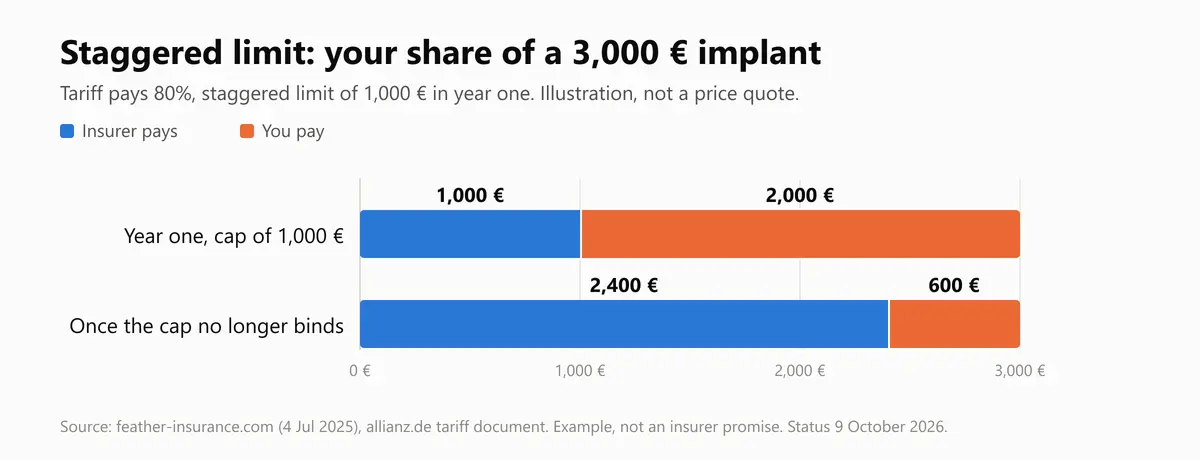
A worked example shows the effect. Your tariff pays 80 % of dentures and implants, with a staggered limit of EUR 1,000 in year one. You need an implant that costs EUR 3,000 in your first year.
- 80 % of EUR 3,000 = EUR 2,400 would be paid without the cap.
- The cap stops payment at EUR 1,000, so you pay EUR 3,000 - EUR 1,000 = EUR 2,000.
The same implant once the cap no longer binds would cost you EUR 3,000 - EUR 2,400 = EUR 600. Timing matters as much as the headline percentage.
What does private health insurance cover at the dentist?
In comprehensive private health insurance, dental benefits are normally part of the tariff. That includes dental treatment, dentures, professional cleaning, inlays, implants depending on the tariff, bite splints and orthodontics for children. Reimbursement ranges from partial to full, and premium tariffs pay up to 100 %. A separate dental policy is usually not needed, and usually not available once you are in a private tariff.
Two details decide the real value: the fee factor the insurer reimburses, because dentists bill with factors up to 3.5, and any staggered limit in the first years. Children's orthodontics follows the same logic. Public insurance pays in medically defined cases, private tariffs vary, so check the age limit and the percentage.
Dental benefits must be in the tariff from the start. Once treatment is advised or begun, most insurers will not let you take out or switch to a tariff with dental benefits.
Is comprehensive private cover better than public plus an add-on?
For readers who can choose, usually yes. Public insurance plus a Zahnzusatzversicherung means two contracts, two sets of waiting periods and caps, and a subsidy that falls in 2027. Comprehensive private health insurance is one contract in which dental sits next to everything else, and your old-age reserves build from month one.
| Public only | Public plus Zahnzusatzversicherung | Comprehensive private | |
|---|---|---|---|
| Dentures | Fixed subsidy, 60 to 75 % of standard care in 2026, 50 to 65 % from 2027 | Subsidy plus top-up to the add-on percentage | Percentage set by the tariff, premium tariffs up to 100 % |
| Implants | Implant itself: out of pocket. Fixed subsidy for the crown or denture on top, 50 to 65 % of standard care from 2027 | Covered per the add-on tariff, with caps | Covered depending on tariff |
| Professional cleaning | Usually not a standard benefit | Often a yearly allowance | Often included, tariff dependent |
| Children's orthodontics | Medically defined cases | Add-on terms vary | Tariff dependent, check age limit |
| Waiting periods or staggered limits | None | Common in early years | Check the tariff |
| Who can choose it | Everyone | Public members | Eligible employees, self-employed |
| Cost shape | Income-based contribution | Contribution plus a monthly premium | One premium based on age, health and tariff |
Source: section 55 SGB V, zm-online.de (20 July 2026), allianz.de. Qualitative comparison, tariff terms differ. Seen 2 November 2026.
Private health insurance suits people up to about 45 best, and the longer the cover runs, the more the old-age reserves work in your favour. Public insurance is clearly better only for a single-earner family with two or more children.
Who can choose? Employees may switch above the income threshold (Jahresarbeitsentgeltgrenze) of EUR 77,400 in 2026. For 2027 the cabinet decided EUR 84,150 on 7 October 2026, Bundesrat approval pending. Self-employed people and freelancers may choose freely. See private health insurance in Germany and public vs private health insurance for the full comparison, or the 2027 income threshold for the new figure. Employees below the threshold should start with health insurance options for employees below the threshold, where a Zahnzusatzversicherung is the route to better dental cover.
If you qualify and want your options compared, get a free quote.
What should you check in a dental tariff?
Eight points separate a good dental tariff from a weak one, whether it is a supplement or part of a private plan.
- Percentage for dentures and implants, and whether public benefits are credited against it.
- Fee factor reimbursed, and whether the 3.5 factor is covered.
- Staggered limit: amounts per year and how many years it runs.
- Waiting period before benefits start.
- Orthodontics: age limit and percentage.
- Professional cleaning allowance per year.
- Exclusions for treatment already advised or begun.
- Deductible or co-payment.
Ask for the tariff conditions, not the sales sheet.
Want a free check of your options?
If you are self-employed, or an employee above the income threshold, we compare comprehensive private tariffs for your age, health and plans, and show you what dental cover each one includes. Get a free quote or book a free consultation to assess your situation. Employees below the threshold can start with our guide to public health insurance. For everything else a tariff pays for, see what private health insurance covers beyond dental.
Sources and status
- Section 55 SGB V, Festzuschuss rules (2026 rates): https://www.gesetze-im-internet.de/sgb_5/__55.html seen 2 November 2026.Official sourcegesetze-im-internet.de
- Federal Ministry of Health, law page with dates (passed 10 July 2026, promulgated 29 July 2026): https://www.bundesgesundheitsministerium.de/service/gesetze-und-verordnungen/detail/gkv-beitragssatzstabilisierungsgesetz seen 2 November 2026.Official sourcebundesgesundheitsministerium.de
- Der Paritaetische, vote count and transition rule (13 July 2026): https://www.der-paritaetische.de/alle-meldungen/gkv-beitragssatzstabilisierungsgesetz-verabschiedet-gkv-bstabg-wirkungen-ausgewaehlter-regelungen/ seen 2 November 2026.der-paritaetische.de
- zm-online, 2027 subsidy rates (20 July 2026): https://www.zm-online.de/news/detail/krankenkassenreform-verteuert-zahnersatz seen 2 November 2026.zm-online.de
- IWW, 2027 subsidy rates (13 July 2026): https://www.iww.de/aaz/abrechnungswissen/gesetzgebung-gkv-beitragssatzstabilisierungsgesetz-laesst-die-festzuschuesse-fuer-zahnersatz-sinken-f175738 seen 2 November 2026.iww.de
- BGBl 2026 I Nr. 228, new section 55 SGB V (rates, approval cut-off in section 55(6), crowns and Suprakonstruktionen): https://www.recht.bund.de/bgbl/1/2026/228/regelungstext.pdf?__blob=publicationFile&v=1 seen 2 November 2026.Official sourcerecht.bund.de
- Zahnaerztekammer Niedersachsen, GOZ fee factor (Steigerungssatz): https://zkn.de/wp-content/uploads/2023/06/Der-Steigerungssatz.pdf seen 2 November 2026.zkn.de
- Allianz, dental cover for privately insured (Stand 2026): https://www.allianz.de/gesundheit/zahnzusatzversicherung/fuer-privatversicherte/ seen 2 November 2026.allianz.de
- Allianz, tariff document with staggered limit example: https://goa-eportale.allianz.de/B5U/232/B5U232000Z0.pdf.download.pdf seen 2 November 2026.goa-eportale.allianz.de
- Income thresholds: Myhealthcarebroker reference figures of 2 November 2026. The 2027 values are a cabinet decision of 7 October 2026, Bundesrat approval pending.
Status: denture subsidy rates and the approval cut-off (section 55(6) SGB V) are law, BGBl. 2026 I Nr. 228. Price and premium figures are not quoted because they depend on the tariff, age and treatment.
Myhealthcarebroker is an independent insurance broker. This article is general information, not legal or tax advice. Rules and prices change, so confirm details with your insurer or dentist before deciding.
 Written byMarco Maurelli
 Reviewed byBettina Ostermann