Last checked 2 November 2026. 2027 figures are a cabinet decision of 7 October 2026, Bundesrat approval pending.
Quick answer: Employees are enrolled in public health insurance through their employer, unless they earn more than EUR 77,400 a year in 2026. Above that line they can choose private health insurance instead. Self-employed people choose freely, students at state universities are usually publicly insured until they turn 30 (not if an EHIC or home-country entitlement applies), and visa applicants need qualifying cover before they arrive. Whatever your status, avoid a gap in cover.
The route depends on your status, so this guide goes status by status. For the full picture of public and private options, see our guide to health insurance for newcomers in Germany.
Do you need health insurance in Germany, and from when?
Yes. Section 193 of the insurance contract act (VVG) requires every resident to hold a policy that at least pays for outpatient and inpatient treatment. People already in public insurance are exempt because they are covered.
The law sets no fixed number of days to sign up. It does set a price for delay. If you apply for private cover more than one month after the duty begins, you pay a late-entry surcharge once, on top of your regular premium. It is one monthly premium for each further started month without cover, and from the sixth month of non-insurance only one sixth of a monthly premium per further started month. If the length of the gap cannot be established, at least 5 years is assumed. On request the insurer must agree to instalments, with interest. The details are in what happens without health insurance. The practical rule is simple: have cover from the day you move in.
Which type of health insurance applies to you?
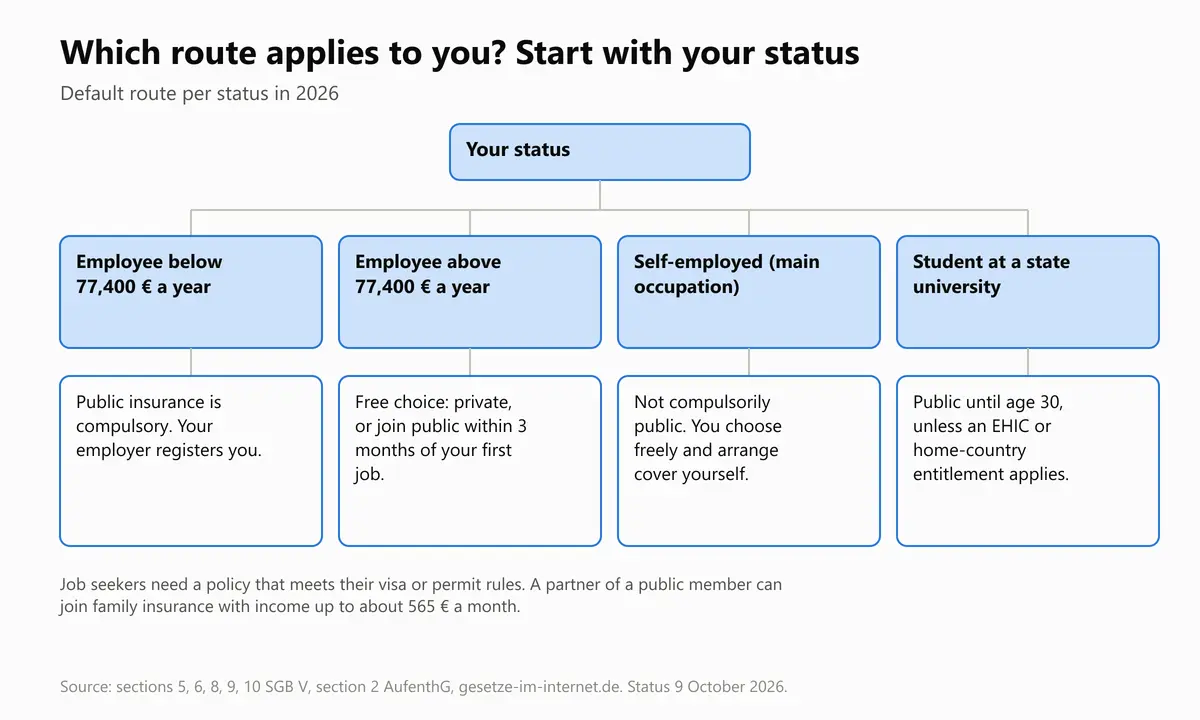
Your employment status decides it. This table shows the default route and whether private health insurance is an option.
| Status | Default route | Can you choose private? | Legal basis |
|---|---|---|---|
| Employee below the income threshold | Public, compulsory | No | Section 5 SGB V |
| Employee above EUR 77,400 (2026) | Free choice | Yes, or join public within three months of starting your first job | Sections 6 and 9 SGB V |
| Self-employed (main occupation) | Not compulsorily public | Yes | Section 5 para 5 SGB V |
| Student at a state university | Public until age 30, unless an EHIC or home-country entitlement applies | Only through a formal exemption, check first | Sections 5 and 8 SGB V |
| Job seeker | No automatic cover | You need a policy that meets your visa or permit rules | Section 2 AufenthG |
| Partner of a public member | Family insurance if income is up to about EUR 565 a month | Not needed | Section 10 SGB V |
| EU citizen visiting | EHIC from the home country | Not for a move, see below | Federal administration portal |
Source: gesetze-im-internet.de (SGB V sections 5, 6, 8, 9, 10 and AufenthG section 2) and verwaltung.bund.de, seen 2 November 2026. EUR 565 is our calculation, see the partner section.
How do you get health insurance as an employee?
- Compare before you choose. Public insurers charge different additional contributions, more on that below.
- Tell your employer your insurer without delay. If you name none within two weeks of starting, your employer registers you with your last insurer or, if you had none, with an eligible one.
- Your employer does the registration. The social insurance number and the insurance card follow from there.
Above the threshold you have a real choice. You can go private, or join public insurance within three months of starting your first job in Germany. Employees below the threshold are publicly insured by law, see public health insurance in Germany. If you arrive on an EU Blue Card, read EU Blue Card and health insurance.
| Figure | 2026 | 2027 (cabinet, Bundesrat pending) |
|---|---|---|
| Income threshold per year | EUR 77,400 | EUR 84,150 |
| Income threshold per month | EUR 6,450 | EUR 7,012.50 |
| Contribution ceiling per year | EUR 69,750 | EUR 76,500 |
| Contribution ceiling per month | EUR 5,812.50 | EUR 6,375 |
Source: Deutsche Rentenversicherung press release of 10 September 2025 (2026 figures), Bundesregierung page on the 2027 limits (cabinet decision of 7 October 2026), seen 2 November 2026.
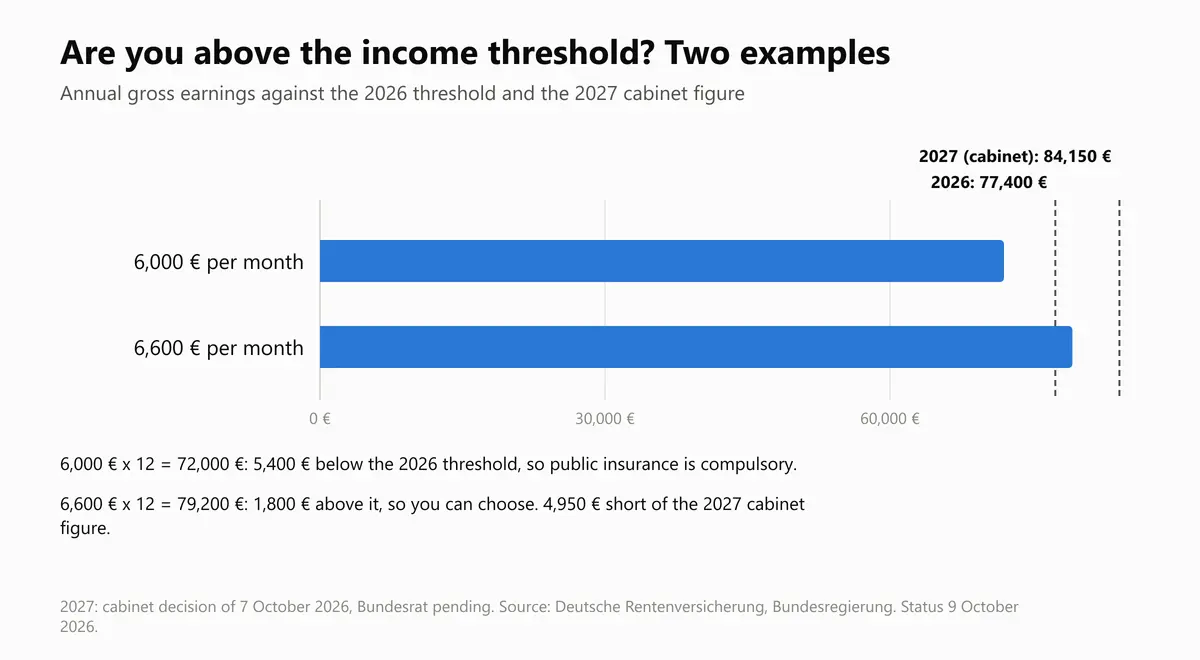
Example. You earn EUR 6,000 a month. That is 6,000 x 12 = EUR 72,000 a year, which is EUR 5,400 below the 2026 threshold (77,400 - 72,000), so public insurance is compulsory. At EUR 6,600 a month you reach 6,600 x 12 = EUR 79,200, which is EUR 1,800 above it, so you can choose. Watch the year: against the 2027 cabinet figure, EUR 79,200 falls EUR 4,950 short (84,150 - 79,200), if the Bundesrat confirms it. For the 2027 detail, read the 2027 income threshold.
How do you get health insurance as self-employed or a freelancer?
If your main occupation is self-employment, you are not compulsorily insured in public insurance. The duty to hold a policy still applies, so you must arrange cover yourself.
You choose freely between public and private. Private health insurance suits people up to about 45 best, and the longer you stay in Germany, the better it gets, because old-age reserves build from the first month. The clear exception is a family with a single earner and two or more children, where free family insurance makes public cheaper. For the private route, start with private health insurance in Germany.
Self-employed or above the threshold? Ask for a free quote and we compare the options for your situation.
How do students get health insurance in Germany?
Students at a state or state-recognised university are compulsorily insured in public insurance until they turn 30, but only if no entitlement to benefits in kind exists under EU or international law. EU and EEA students with a valid EHIC or home-country entitlement are therefore not compulsorily insured. After 30, public cover continues only if the type of study or personal or family reasons justify it. Insurer figures for 2026 put the monthly total at around EUR 140 to 150, made up of a fixed health contribution of EUR 87.38, the insurer's additional contribution and long-term care.
Older students, language courses and preparatory courses follow different rules. Ask your university and your insurer before you enrol.
What if you are a job seeker or moved for a partner?
A job seeker has no automatic cover. You need a policy that meets the requirement of your visa or permit, and proof of adequate cover is part of the application. Check your embassy's current list. If neither public nor private cover fits yet, look at international and incoming health insurance.
A partner who moves with you can join family insurance if you are a public member. The partner's regular income must not exceed one seventh of the monthly reference value: 3,955 / 7 = about EUR 565 a month in 2026. A partner of a privately insured person is not covered this way.
How do you get health insurance before your visa is approved?
For a national (D) visa, the German mission in the UK states that you need cover comparable to the minimum level of public insurance, and that "Travel insurance is not sufficient for any D visa application". The visa can only start from the day cover is proven.
An incoming policy that meets the statutory minimum scope is what some missions accept. A standard holiday policy usually is not. Confirm with your embassy, practice can differ. Temporary stays such as a year abroad can be covered by a valid EHIC for the whole period. Details are in which health insurance counts for a German visa.
After you register your address, replace the incoming policy with permanent cover. Leaving it running too long is a mistake, because it may not cover pre-existing conditions or long-term care.
What about EU citizens, the EHIC and the S1 form?
The EHIC is for temporary stays. Once you move your residence to Germany, the card from your former country can no longer be used, so you need German cover under your status above.
The S1 form is issued by the insurer of your former country and matters mainly for pensioners who receive only a pension from there. A German public insurer then exchanges it for a German card with the same benefits in kind. Ordinary employees do not need it. Doctors in the public system usually accept the EHIC, private clinics usually do not, so ask the provider.
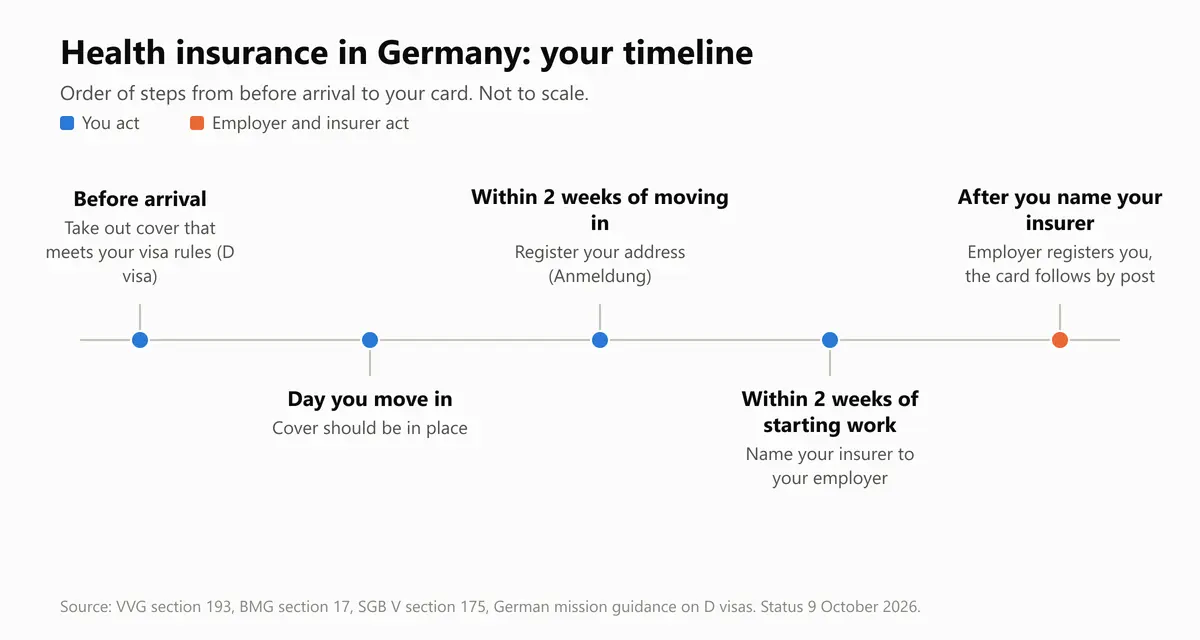
What is the timeline, step by step?
| When | What to do | Who acts |
|---|---|---|
| Before arrival | Take out cover that meets your visa rules (D visa) | You |
| Day you move in | Cover should be in place | You |
| Within two weeks of moving in | Register your address (Anmeldung) | You |
| Within two weeks of starting work | Name your insurer to your employer | You |
| After you name your insurer | Employer registers you, the social insurance number is usually generated at this point, the card follows by post | Employer, insurer |
Source: VVG section 193, BMG section 17, SGB V section 175, German mission guidance on D visas, seen 2 November 2026.
For the number itself, see your German social insurance number. As a broker estimate, a private application takes two to four weeks (insurers differ), the steps are in how to apply for private health insurance step by step.
Which documents do you need?
Insurers differ, but expect this list:
- Passport and visa or residence permit
- Proof of your registered address
- Employment contract or university enrolment certificate
- Proof of previous insurance
- Tax ID, if your employer asks for it
What are the most common mistakes?
A gap in cover. The late-entry surcharge applies as soon as you are more than one month late with private cover.
Letting the visa or travel policy run too long. It was built for arrival, not for living here.
Picking the first public insurer without comparing. The general rate is 14.6 percent, split equally between you and your employer. The additional contribution comes on top, averages 2.9 percent in 2026 and is set by each insurer. The Federal Ministry of Health has set the 2027 average at 2.9 percent as well (30 October 2026). On EUR 4,000 gross a month, below the ceiling of EUR 5,812.50, the total is 17.5 percent, which is EUR 700, so you pay EUR 350. An insurer charging one percentage point more adds EUR 40 in total, EUR 20 for you, which is EUR 240 a year, or EUR 1,200 over five years. Long-term care contributions come on top.
Assuming you can always join public insurance. Voluntary membership has set conditions and must be notified within three months. A foreigner without a job cannot simply sign up.
What should you do next?
Work out your status in the table, arrange cover before or on the day you move in, and compare insurers before you commit. Below the income threshold, your route is public health insurance in Germany. To go through every status in more depth, start with our complete guide to health insurance for newcomers in Germany.
Want a free check of your options?
If you are self-employed, or an employee earning above EUR 77,400 in 2026, ask for a free quote. Prefer to talk it through? Ask for a free consultation by phone and we assess your situation with you. Below the threshold, the better start is public health insurance in Germany.
Sources and status
- SGB V sections 5, 6, 8, 9, 10, 175, 241: https://www.gesetze-im-internet.de/sgb_5/ (law, seen 2 November 2026)Official sourcegesetze-im-internet.de
- VVG section 193: https://www.gesetze-im-internet.de/vvg_2008/__193.html (law, seen 2 November 2026)Official sourcegesetze-im-internet.de
- AufenthG section 2: https://www.gesetze-im-internet.de/aufenthg_2004/__2.html (law, seen 2 November 2026)Official sourcegesetze-im-internet.de
- BMG section 17: https://www.gesetze-im-internet.de/bmg/__17.html (law, seen 2 November 2026)Official sourcegesetze-im-internet.de
- German mission UK, health insurance requirements for visas: https://uk.diplo.de/uk-en/health-insurance-requirements/2616300 (official guidance, seen 2 November 2026)uk.diplo.de
- Federal association of public insurers, EHIC page: https://www.gkv-spitzenverband.de/krankenversicherung/digitalisierung/ehic_1/ehic_1.jsp (updated 1 July 2025, seen 2 November 2026)Official sourcegkv-spitzenverband.de
- Federal administration portal on EHIC and S1: https://verwaltung.bund.de/leistungsverzeichnis/de/rechte-und-pflichten/102837937 (updated 6 December 2022, seen 2 November 2026)Official sourceverwaltung.bund.de
- 2026 limits, Deutsche Rentenversicherung: https://www.deutsche-rentenversicherung.de/DRV/DE/Ueber-uns-und-Presse/Presse/Meldungen/2025/250910-sv-rechengroessen-vo-2026.html (10 September 2025, seen 2 November 2026)Official sourcedeutsche-rentenversicherung.de
- 2027 limits, Bundesregierung: https://www.bundesregierung.de/breg-de/suche/beitragsbemessungsgrenzen-2027-2454638 (cabinet decision of 7 October 2026, Bundesrat approval pending, seen 2 November 2026)Official sourcebundesregierung.de
- Student contributions 2026, insurer figures: https://www.tk.de/vertriebspartner/faq/beitragsuebersicht/studenten-und-fachschueler/was-muessen-studierende-beachten-2065514 (seen 2 November 2026)tk.de
- Average additional contribution 2026 (2.9 percent), Bundesanzeiger notice of 7 November 2025: https://www.bundesanzeiger.de/pub/publication/oUJYVk8GYRXybnb9Y4h/content/oUJYVk8GYRXybnb9Y4h/BAnz%20AT%2010.11.2025%20B7.pdf (official figure, seen 2 November 2026)bundesanzeiger.de
Myhealthcarebroker is an independent insurance broker. This article is general information, not legal or tax advice. Rules and figures change, and your immigration office or embassy has the final word on visa requirements.
 Written byMarco Maurelli
 Reviewed byBettina Ostermann