
Private health insurance Premium Rebate for a Healthy Year in Germany
Germany's private health insurance rewards you financially for staying healthy. The no-claims premium rebate, known in German as Beitragsrückerstattung (BRE), is a direct refund of 1–6 monthly premiums for every claim-free year you complete under your private health insurance tariff. For expat professionals navigating Germany's private health plans, this benefit can represent a meaningful annual saving, but only if you understand how it works, which tariff conditions apply, and how the tax rules affect your actual net gain. This guide covers all of it, with 2026 tariff context included.
What qualifies you for the premium rebate in Germany's private health insurance?
The BRE is not automatic across all private health insurance tariffs. Your eligibility depends on three conditions: your tariff must include the rebate clause, you must complete a full claim-free calendar year, and you must have paid your premiums in full throughout that period. Missing even one of these conditions typically disqualifies you for that year.
Private health insurance rebates come in two forms. A guaranteed rebate is written directly into your contract, so the insurer pays it regardless of their financial performance that year. A success-dependent rebate varies with the insurer's annual results and can be reduced or withheld entirely in a difficult year. Guaranteed rebates offer more planning certainty, which matters if you are budgeting around the benefit.
If you would rather lower your premium from day one, the guide to choosing a deductible that suits you covers the alternative.
The rebate scales with your claim-free streak. After one claim-free year, most tariffs return 1–2 monthly premiums. After two consecutive years, that rises to 2–3 months. After three or more years, rebates can reach 4–6 monthly premiums depending on the tariff. That scaling structure is what makes multi-year claim management so financially worthwhile.

| Rebate type | How it is set | Risk of reduction |
|---|---|---|
| Guaranteed BRE | Fixed in contract | None |
| Success-dependent BRE | Tied to insurer performance | Yes, can be cut |
| Scaled multi-year BRE | Increases with claim-free years | Resets on any claim |
Key eligibility requirements at a glance:
- Full claim-free calendar year (january 1 through december 31)
- Tariff must explicitly include a BRE clause
- Full premium payments made throughout the year
- No partial-year coverage gaps (joining mid-year often disqualifies year one)
How to manage claims strategically to protect your rebate
The most underused tool in private health insurance rebate management is retroactive invoice submission. Under § 195 BGB, you can submit medical invoices up to three years after the treatment date. This gives you a genuine buffer to decide whether a bill is worth claiming now or holding until after you have secured the rebate.
The decision logic is straightforward. If your annual rebate is worth three monthly premiums and a physio bill is €80, submitting that bill and losing the rebate costs you far more than the reimbursement is worth. Submitting minor claims below the net rebate value is counterproductive. You need to run the numbers before you submit anything.
Here is a practical four-step process for evaluating any claim:
- Calculate your gross rebate value. Multiply your monthly premium by the number of months your tariff would return for your current claim-free streak.
- Estimate the net rebate after tax. Apply your marginal tax rate to reduce the gross figure (more on this in the next section).
- Compare the bill amount to the net rebate. If the bill is smaller, hold it and submit retroactively in a later year when it no longer affects your rebate eligibility.
- Check whether the treatment is rebate-neutral. Some tariffs treat preventive check-ups and certain vaccinations as neutral, meaning you can submit them without losing your rebate status.
Delayed invoice submission is not a loophole. It is a legal right under German civil law, and using it thoughtfully is exactly how experienced private health insurance holders protect multi-year rebate streaks worth thousands of euros.
Pro Tip: Keep a simple spreadsheet of all medical invoices with their dates and amounts. At year end, compare the total against your projected rebate and decide which bills to submit and which to hold for the following tax year.
One caution worth stating clearly: never skip necessary medical treatment to protect a rebate. The financial math never justifies a health risk. The retroactive submission window exists precisely so you do not have to make that trade-off.
What are the tax implications of the private health insurance premium rebate?
The BRE looks more attractive on paper than it is in practice, especially for higher earners. Under § 10 Abs. 4b EStG, the rebate you receive reduces your tax-deductible insurance premium for that year. A smaller deduction means higher taxable income, which means a larger tax bill.
The gap between gross and net rebate widens as your income rises. Higher marginal tax rates create a larger offset between what the insurer pays you and what you actually keep after taxes. Many expat professionals in Germany fall into the 42% marginal rate bracket, which significantly reduces the real value of the rebate.
How the tax offset works in practice:
- Your insurer pays you a €2,400 gross rebate (equivalent to two monthly premiums at €1,200/month).
- That €2,400 reduces your deductible private health insurance premium by the same amount.
- At a 42% marginal rate, losing €2,400 in deductions costs you roughly €1,008 in additional tax.
- Your net rebate is approximately €1,392, not €2,400.
| Marginal tax rate | Gross rebate | Tax cost of lost deduction | Net rebate |
|---|---|---|---|
| 25% | €2,400 | €600 | €1,800 |
| 35% | €2,400 | €840 | €1,560 |
| 42% | €2,400 | €1,008 | €1,392 |
The net rebate is still real money. But the assumption that the BRE is pure profit is wrong. For a detailed breakdown of how to maximize tax savings across your private health insurance plan, the calculation requires your specific income and tariff details.
Pro Tip: Ask your Steuerberater (tax advisor) to model the rebate's net value against your actual marginal rate before you decide whether to claim or hold invoices. The difference can be several hundred euros.
How does the private health insurance rebate compare to public insurance wellness bonuses?
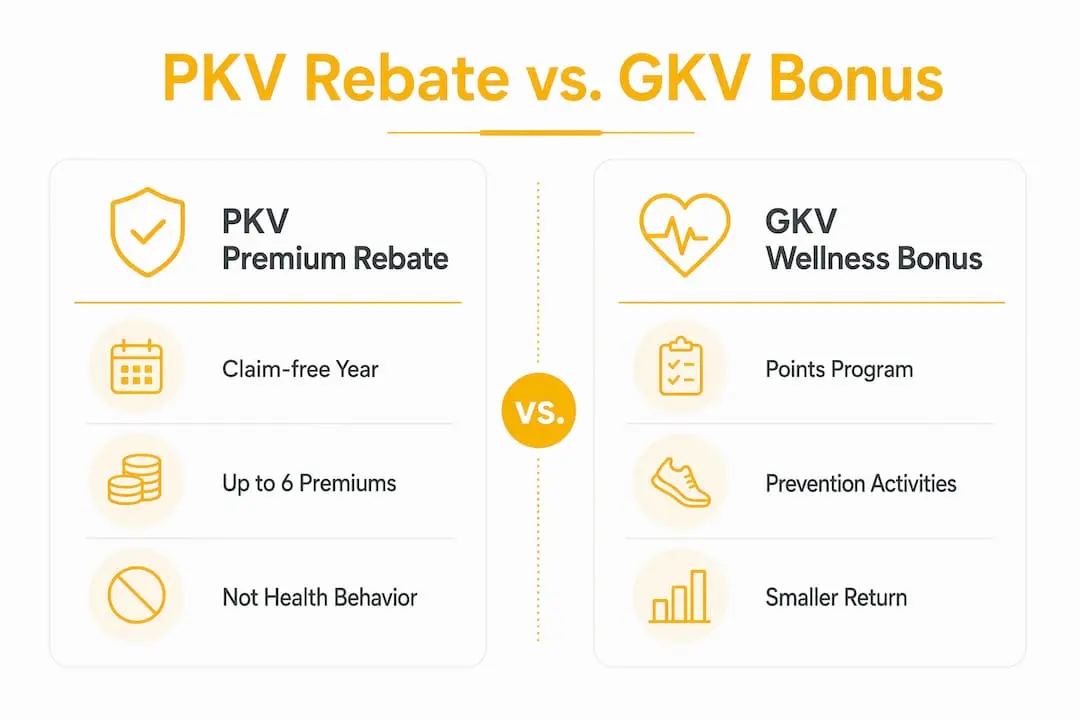
Germany's statutory public health insurance offers wellness bonuses through points-based programs tied to preventive activities, fitness participation, and vaccinations. Public health insurance bonus payouts typically range from €100–300 in cash or €300–800 in subsidies for health-related expenses, depending on the insurer and your activity level.
Private health insurance rebates operate differently. They are not tied to health behavior but to claim absence. A healthy person who simply avoids submitting bills receives the rebate, regardless of whether they exercised or attended check-ups. This makes the private health insurance rebate more passive in nature but also more predictable for people who genuinely use little healthcare.
| Feature | Private health insurance premium rebate (BRE) | Public health insurance wellness bonus |
|---|---|---|
| Basis | Claim-free year | Health activity points |
| Typical gross value | 1–6 monthly premiums | €100–800 |
| Tax treatment | Reduces deductible premium | Generally tax-free |
| Eligibility | Private health insurance tariff with BRE clause | Public health insurance membership + activity |
| Predictability | High (guaranteed BRE) | Variable by insurer |
For most expat professionals on higher incomes, the private health insurance rebate delivers a larger gross return than public health insurance bonuses. The tax nuance narrows that gap, but the private health insurance benefit still wins on volume for multi-year claim-free streaks. Public health insurance bonuses suit people who want to be rewarded for active health behaviors rather than simply avoiding claims. Understanding Private health insurance options in Germany helps you see which system aligns with your actual health usage patterns.
Key Takeaways
The private health insurance no-claims premium rebate is a real financial benefit, but its net value depends on your tariff type, claim-free streak, and marginal tax rate.
| Point | Details |
|---|---|
| Rebate scales with claim-free years | Tariffs return 1–6 monthly premiums based on consecutive claim-free years. |
| Tax rules reduce net value | The BRE reduces your deductible premium, raising taxable income and cutting your actual gain. |
| Retroactive submission protects streaks | You can hold invoices for up to three years under § 195 BGB to protect multi-year rebates. |
| Guaranteed BRE beats success-dependent | Fixed-contract rebates offer certainty; performance-linked rebates can be cut in a bad year. |
| Coverage quality comes first | Choosing a tariff for its rebate size alone, while ignoring coverage depth, is a costly mistake. |
The rebate is a bonus, not a strategy
Many expat professionals discover the BRE after signing their private health insurance contract and immediately start planning their finances around it. That enthusiasm is understandable. Getting two or three monthly premiums back at year end feels like a genuine win, and it is. But some people make poor tariff choices because they chase the highest rebate figure without reading the baseline coverage carefully.
A tariff offering a generous rebate but weak hospital coverage or high co-pays is not a good deal. Coverage quality must remain the primary selection criterion. The rebate is a bonus that rewards healthy years. It should not be the reason you pick a tariff.
For expats specifically, there is another layer of complexity. Your health usage patterns may differ from a German national's. You may travel frequently, use international coverage, or have specific specialist needs. A tariff optimized for rebate accumulation may not cover those needs well. Reviewing your tariff's actual benefit schedule before factoring the BRE into your financial planning is always worthwhile.
One more point worth stating: if your current tariff offers poor coverage and a small rebate, that is a signal to consider a tariff change. Tariff changes within private health insurance are possible under § 204 VVG, and the right move is often switching to a better-fitting tariff within the same insurer rather than staying put for the sake of rebate continuity.
How Myhealthcarebroker helps you get the most from your private health insurance
Choosing the right private health insurance tariff as an expat in Germany is genuinely complex. The rebate mechanics, tax rules, and 2026 tariff updates all interact in ways that are hard to evaluate without a clear picture of your income, health profile, and coverage priorities.
Myhealthcarebroker is an independent consultancy that compares private health insurance plans across providers in plain English, with no ties to any single insurer. You can use the 2026 private health insurance calculator to estimate your premiums and model potential rebate scenarios before committing to a tariff. For personalized advice on which tariff balances strong coverage with realistic rebate potential, a free consultation with Myhealthcarebroker gives you a clear, jargon-free starting point.
 Written and reviewed byBettina Ostermann