
Private Health Insurance for High Earners in Germany: Cost vs Public (2026)
For most high-income single employees and self-employed professionals in Germany, private health insurance is cheaper from day one than public health insurance, and delivers meaningfully better access to care. The Jahresarbeitsentgeltgrenze, the income threshold employees must clear before they can even choose private insurance, is €77,400 in 2026. Once you're above it, the math usually favors private health insurance quickly: a healthy employee earning €90,000 typically saves €240–€400 per month net versus staying in public health insurance, while a self-employed professional at a similar income level can save €600–€900 per month because they bear the full public health insurance contribution with no employer to split it. A self-employed high earner near the contribution ceiling can save up to roughly €918 per month in an illustrative model, never a guaranteed quote. The employer subsidy cap for private health insurance runs roughly €450–€496 per month in 2026 and halves your private premium up to that ceiling. The one scenario where public health insurance reliably wins is a one-earner household with a non-working spouse and children: public health insurance's Familienversicherung covers dependents for free, while private health insurance charges a separate premium for every family member. Before you switch, run a two-scenario model using your age at entry, family composition, employer subsidy, and expected career length in Germany. Myhealthcarebroker's free calculator is the fastest way to do that.
This guide focuses on the cost question for high earners. For the full side-by-side on benefits, access, waiting times, and who each system suits, start with our main private vs public health insurance in Germany guide, then come back here to run the numbers.
Table of Contents
- How do private and public health insurance compare at a glance for high earners?
- How does public health insurance calculate costs for high earners?
- How does private health insurance pricing work for high earners?
- Who is eligible for private health insurance in 2026?
- Modeled cost scenarios for typical high-income profiles
- What are the real pros and cons for high earners?
- How do taxes, aging reserves, and retirement costs affect your decision?
- What inputs do you need to model before deciding?
- Key Takeaways
- What high earners consistently get wrong when switching
- How Myhealthcarebroker can help you model the right choice
- Frequently asked questions
- Useful sources and further reading
How do private and public health insurance compare at a glance for high earners?
Employees must earn above the eligibility breakpoint gross per year to choose private health insurance. Self-employed professionals and civil servants (Beamte) can opt in regardless of income.
| Dimension | Public health insurance | Private health insurance |
|---|---|---|
| **Monthly cost today** | Employee share capped at ~€613–€648/month at the BBG | Net employee share often €140–€380/month after employer subsidy |
| **Lifetime/retirement trajectory** | Höchstbeitrag rises with the BBG; grew ~6.9%/yr from 2021–2026 | Premiums rise with age but Altersrückstellungen dampen increases |
| **Who is eligible** | All employees; mandatory below €77,400/yr | Employees above €77,400/yr; self-employed and Beamte at any income |
| **Family/dependent coverage** | Free for non-earning spouses and children (Familienversicherung) | Separate contract per family member; ~€80–€150/month per child |
| **Benefit breadth and access** | Standardized benefits; longer specialist wait times | Faster specialist access, private hospital options, broader dental/vision |
| **Billing/reimbursement** | Direct billing between insurer and provider | You pay the bill, submit for reimbursement |
| **Tax treatment** | Basic-coverage portion is deductible as Sonderausgaben under § 10 Abs. 1 Nr. 3 EStG | Basic-coverage portion is deductible under § 10 Abs. 1 Nr. 3 EStG |
| **Switching flexibility** | Can switch public health insurance funds freely; returning from private health insurance is very difficult after 55 | Switching back to public health insurance is effectively impossible after age 55 |
Top-line takeaways by profile:
- Single high earner (employee or self-employed): private health insurance almost always wins on cost and benefits in the short and medium term.
- Self-employed professional: private health insurance savings are largest because public health insurance charges the full contribution with no employer offset.
- One-earner family with non-working spouse and children: public health insurance's free dependent coverage usually makes it cheaper overall. The gap narrows with tariff selection and employer subsidy distribution.
How does public health insurance calculate costs for high earners?
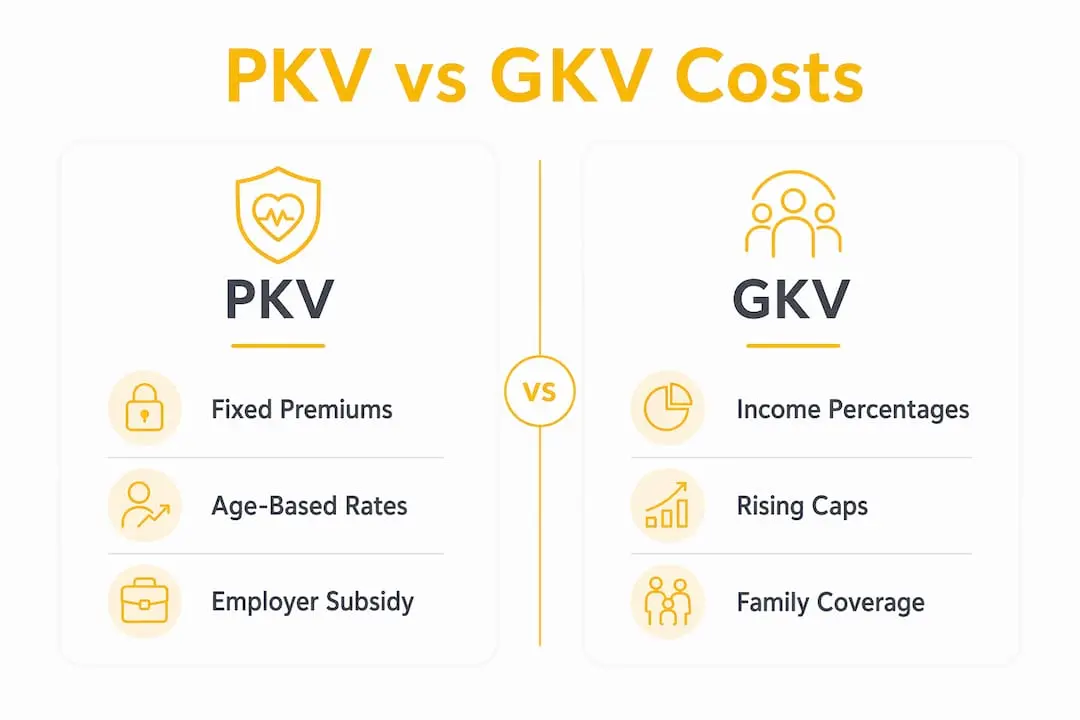
Public health insurance contributions are a percentage of your gross salary, not a flat fee. The all-in health insurance rate stacks to a base rate plus an average Zusatzbeitrag, combined with Pflegeversicherung rates that vary depending on whether you have children.
The Beitragsbemessungsgrenze (BBG) sets a ceiling on income assessment, so your public health insurance contribution stops climbing once you hit that cap. For employees, the total contribution splits 50/50 with the employer.
The public health insurance maximum monthly bill (Höchstbeitrag) in 2026 is around €1,261 per month at the contribution ceiling, with the employee's share capped at roughly €613–€648 depending on children, and the employer covering the other half.
That cap sounds reassuring. The catch is that it moves. The public health insurance Höchstbeitrag has risen significantly over recent years, climbing from around €893 to the current level. So while your contribution is capped today, the ceiling itself rises most years, and your employer's share rises with it.
Familienversicherung is public health insurance's most powerful feature for families. Non-earning spouses and children are covered at no additional cost, provided the dependent's own income stays below €565 per month. For a household where one partner earns well and the other does not work, this benefit alone can make public health insurance the cheaper system by several hundred euros a month. You can read more about how Public health insurance contribution rates are structured and calculated for employees in 2026.
How does private health insurance pricing work for high earners?
Private health insurance does not care what you earn. Premiums are set at the time you apply, based on three factors: your entry age, your health status at underwriting, and the tariff and deductible level you choose. Join young and healthy, and you lock in a competitive base premium that builds Altersrückstellungen (aging reserves) over your working life. Join at 48 with a few pre-existing conditions, and the premium will reflect that.
Employer subsidy mechanics
For employees, the employer is required to subsidize your private health insurance premium at 50% of your actual premium, up to a cap. In 2026, that cap sits at roughly €450–€496 per month, which is what the employer would have contributed had you stayed in public health insurance. In practice, this means a healthy 32-year-old paying a gross private health insurance premium of €380 per month would receive about €190 from their employer, leaving a net employee cost of roughly €190 per month. Compare that to the public health insurance employee share of €648 per month at the BBG cap, and the difference is immediate.
What private health insurance typically covers that public does not
- Faster access to specialists, often without a referral and with shorter wait times
- Private or semi-private hospital room options
- Broader dental and vision coverage, including higher-grade prosthetics
- Worldwide coverage in many tariffs, useful for expats who travel frequently
- Flexible tariff design: you can adjust deductibles and riders over time
Learn more about what private health insurance covers in Germany and how tariff tiers differ.
Age-driven premium differences
The gap between a 32-year-old and a 50-year-old entering private health insurance is not trivial. Entry age is the single biggest lever you control, which is why delaying the switch by even five years can cost you significantly more over a career.

Who is eligible for private health insurance in 2026?
Eligibility depends entirely on your employment status.
Employees must earn at least the JAEG threshold per year to opt out of public health insurance and choose private health insurance. Earning below this threshold means public health insurance is mandatory, regardless of preference.
Employees must clear the Jahresarbeitsentgeltgrenze (JAEG) of €77,400 and must have done so for the current calendar year and the one prior (with some exceptions for new entrants to the German labor market). The threshold is reviewed annually, so checking the current figure each year matters. Myhealthcarebroker's guide on Private health insurance eligibility walks through the paperwork and edge cases in plain English.
Self-employed professionals and freelancers can choose private health insurance at any income level. There is no threshold requirement. This is why the savings calculus for self-employed people is so stark: public health insurance charges the full contribution with no employer to share it, making private health insurance almost always cheaper once income is moderate or above.
Civil servants (Beamte) receive a state subsidy (Beihilfe) that covers a portion of medical costs, making private health insurance the standard and often the only practical choice for them.
Eligibility checklist:
- Are you employed with a gross annual salary above €77,400? Or are you self-employed or a civil servant?
- Has your income been above the JAEG for at least one full calendar year (or are you a new market entrant)?
- Do you plan to remain in Germany long enough for the switch to make financial sense?
- What is your family situation: single, partnered with a working partner, or one-earner household with children?
- Do you have pre-existing conditions that could affect underwriting?
Red flag on income volatility: If your salary fluctuates around the JAEG threshold, a temporary dip below it can affect your ability to maintain voluntary public health insurance status or re-enter public health insurance if you later leave private health insurance. Contractors moving between employment and freelance work face particular complexity here, and it is worth modelling both scenarios before committing.
Modeled cost scenarios for typical high-income profiles
The numbers below use 2026 contribution rates and publicly reported private health insurance premium ranges. They are illustrative models, not guaranteed quotes. Your actual private health insurance premium requires underwriting.
Model assumptions
- Public health insurance employee share: 50% of total contribution (health + Pflegeversicherung), capped at BBG of €5,812.50/month
- Employer private health insurance subsidy: 50% of gross private health insurance premium, capped at ~€450/month
- Private health insurance premium ranges: mid-tier tariff, healthy applicant, sourced from 2026 market data
- No premium escalation modeled in year-1 figures; retirement projections assume continued Altersrückstellung accumulation
- Self-employed public health insurance: full contribution (no employer split)
Scenario data table
| Profile | Public health insurance monthly cost | Private health insurance gross premium | Employer subsidy | Private health insurance net cost | Monthly saving |
|---|---|---|---|---|---|
| Single employee, age 32, €90k/yr | ~€648 (childless) | ~€380 | ~€190 | ~€190 | ~€458 |
| Married employee, age 35, €90k/yr, non-working spouse + 2 kids | ~€613 (with kids, family free) | — | ~€450 | — | Public health insurance cheaper by ~€242 |
| Self-employed, age 36, €70k/yr | ~€1,176 (full share) | ~€520 | €0 | ~€520 | ~€656 |
| Self-employed, age 38, income at/above the BBG | ~€1,261 (full Höchstbeitrag) | ~€343 | €0 | ~€343 | ~€918 |
| Employee, age 50, €90k/yr | ~€648 (childless) | — | — | — | — |

Reading the scenarios
Scenario 1 (single employee, age 32): This is the textbook private health insurance case. A young, healthy, single professional above the JAEG saves roughly €458 per month from day one. Over five years, that is more than €27,000 in net savings, before accounting for any tax deductibility benefit. The Altersrückstellungen built during this period also reduce retirement-era premium pressure.
Scenario 2 (one-earner family, age 35): public health insurance wins by about €242 per month once you add private health insurance premiums for all four family members and apply the employer subsidy. The gap is real but not enormous. What the family gives up by staying in public health insurance is private-tier benefits across all members: faster specialist access, better dental for the children, and single-room hospital coverage. Whether that trade-off is worth €242 per month is a household decision, not a purely financial one.
Scenario 3 (self-employed, age 36): The savings for self-employed professionals are the largest of any profile because public health insurance charges the full contribution with no employer offset. At €70,000 income, public health insurance costs roughly €1,176 per month all in. A comparable private health insurance tariff runs around €520 per month, saving about €656 per month. Over three years, that is nearly €24,000.
Self-employed high earner at the contribution ceiling: The gap widens at higher incomes. A self-employed professional earning above the Beitragsbemessungsgrenze pays the full public health insurance Höchstbeitrag, roughly €1,261 per month in 2026, with no employer to share it. A competitive mid-tier private health insurance tariff for a young, healthy applicant can run near €343 per month, which points to a saving of up to roughly €918 per month. This is an illustrative model built on 2026 figures, not a guaranteed quote: your actual premium depends on underwriting, tariff, and deductible.
Scenario 4 (employee, age 50): private health insurance still saves money today, but the picture changes over time. A 50-year-old entering private health insurance faces a higher base premium than a 32-year-old, and has fewer working years to accumulate Altersrückstellungen before retirement. The switching-back window is also closing fast: returning to public health insurance is effectively impossible after age 55 for most people. At this age, the decision requires careful long-term modelling, not just a year-1 comparison.
Step-by-step model notes for replication:
- Find your public health insurance employee share: multiply your gross monthly salary (capped at €5,812.50) by about 8.75% for health (your 7.3% half of the 14.6% base rate plus roughly half of the ~2.9% average Zusatzbeitrag), plus 1.8%–2.1% (Pflegeversicherung, depending on children).
- Get a private health insurance quote for your age and health profile from a broker or insurer.
- Subtract the employer subsidy (50% of private health insurance premium, max ~€450/month) from the gross private health insurance premium.
- Compare net private health insurance cost to public health insurance employee share.
- Add family members' private health insurance premiums if applicable, and compare to public health insurance's €0 dependent cost.
- Apply the Sonderausgaben deduction to the private health insurance basic-coverage portion to find your true net annual cost.
What are the real pros and cons for high earners?
Public health insurance advantages for high earners
- Predictable contribution mechanic: once your salary hits the BBG, your employee share is capped and does not rise with income.
- Free family coverage: Familienversicherung covers non-earning spouses and children at no extra cost, a benefit worth hundreds of euros per month for larger households.
- No underwriting: pre-existing conditions do not affect your premium or coverage.
- Easier to manage: direct billing between insurer and provider; no reimbursement paperwork.
- Safer for long-term Germany residents: no risk of being locked into a system that becomes unaffordable in retirement.
Public health insurance disadvantages for high earners
- Higher employee share at the cap: €613–€648 per month is a significant monthly outlay for coverage that a private health insurance tariff often beats on benefits.
- Rising ceiling: the BBG and Höchstbeitrag have grown faster than wage inflation in recent years, so "capped" does not mean "stable."
- Longer specialist wait times: public health insurance patients typically wait longer for specialist appointments than private health insurance patients.
- No tariff customization: benefits are standardized; you cannot upgrade dental or hospital room class.
Private health insurance advantages for high earners
- Lower net cost for young, healthy singles: the employer subsidy and competitive entry-age premiums often cut the monthly bill by more than half versus public health insurance.
- Better access and benefits: faster specialist appointments, private hospital options, and broader dental and vision coverage are standard in mid-tier tariffs.
- Tax deductibility: the basic-coverage portion of your private health insurance premium is deductible as Sonderausgaben, reducing your taxable income.
- Premium not tied to income: a salary increase does not raise your private health insurance premium.
Private health insurance disadvantages for high earners
- Family costs scale linearly: each family member needs a separate contract, and premiums add up quickly for households with a non-working spouse and children.
- Underwriting at entry: pre-existing conditions can lead to higher premiums, exclusions, or outright rejection.
- Age-driven premium increases: premiums rise as you age, and the increase accelerates if you entered late or chose a tariff without strong Altersrückstellungen.
- Reimbursement model: you pay bills upfront and submit claims, which requires more administrative discipline.
- Switching risk: leaving private health insurance after age 55 is effectively off the table for most people.
Pro Tip: If private health insurance saves you €300–€450 per month in your early career, consider directing a portion of that saving into a Beitragsentlastungstarif (premium-relief rider). This rider builds a reserve that reduces your private health insurance premium in retirement by a fixed amount, typically €250–€500 per month depending on how long you contribute. It is one of the most underused tools for managing long-term private health insurance cost.
How do taxes, aging reserves, and retirement costs affect your decision?
Tax deductibility of private health insurance premiums
The basic-coverage portion of your private health insurance premium (the Basisabsicherung, equivalent to public health insurance benefits) is deductible as Sonderausgaben under § 10 Abs. 1 Nr. 3 EStG. For a high earner in the 42% income tax bracket, a deductible premium of €300 per month translates to roughly €126 per month in tax savings, or about €1,512 per year. That meaningfully lowers the true net cost of private health insurance. Public health insurance contributions receive the same treatment: the portion covering basic benefits is likewise deductible as Sonderausgaben under § 10 Abs. 1 Nr. 3 EStG (broadly the contribution minus the small share attributable to Krankengeld), so tax deductibility applies to both systems rather than being an advantage exclusive to private health insurance.
Altersrückstellungen: how aging reserves work
Private health insurance tariffs that include Altersrückstellungen set aside a portion of your premium during your working years to offset the higher actuarial cost of insuring you in old age. The reserves partially dampen premium growth in retirement, acting as a structural counterweight to age-based increases. They do not eliminate premium growth, but they reduce it compared to a tariff without reserves. Entering private health insurance young maximizes the accumulation period and the retirement-era benefit.
Public health insurance's retirement-era cost is not static either. Pensioners in public health insurance pay contributions on their pension income, and the Höchstbeitrag itself continues to rise. Between 2021 and 2026, it grew from roughly €893 to €1,261 per month. Projecting forward, neither system offers a guaranteed stable cost in retirement, but the mechanisms differ: private health insurance cost is driven by your individual health and reserve accumulation; public health insurance cost is driven by system-wide policy decisions.
The age-55 switching constraint
This constraint turns the private health insurance decision into a long-term commitment. If you switch at 35 and your circumstances change at 52 (a non-working spouse, a health event, a career shift), you cannot simply return to public health insurance. That permanence is the single most important risk factor in the decision, and it is the reason modelling retirement-era scenarios matters as much as the year-1 cost comparison.
Red flags that should make you lean toward public health insurance:
- You expect to retire in Germany and your retirement income will be modest.
- You have a non-working spouse and children and the family private health insurance cost exceeds public health insurance's free coverage.
- You have chronic health conditions that could lead to exclusions or surcharges at underwriting.
- You are already close to 55 and the remaining accumulation period for Altersrückstellungen is short.
- Your income is not durably above the JAEG (salary fluctuates or you cycle between employment and freelance work).
For high earners who want to dig deeper into optimization strategies, Myhealthcarebroker's guide on high earner insurance cost optimization covers tax-aware approaches in more detail.
What inputs do you need to model before deciding?
The right answer for your situation comes from running the numbers with your actual figures, not from a general heuristic. Here is what to gather before you model or book advice.
Your decision checklist
- Current gross income: is it durably above €77,400 per year, or does it fluctuate?
- Entry age: the younger you are, the stronger the private health insurance case on both cost and reserve accumulation.
- Family situation: single, partnered with a working partner, or one-earner household with dependents?
- Expected length of stay in Germany: private health insurance savings start from day one, but the long-term mechanics (Altersrückstellungen, retirement transition) reward longer stays.
- Health status: any pre-existing conditions that could affect underwriting?
- Deductible appetite: a higher annual deductible lowers your private health insurance premium significantly; are you comfortable self-insuring smaller claims?
- Retirement plans: do you plan to retire in Germany? If yes, model retirement-era costs in both systems.
- Employer subsidy: confirm with HR exactly how your employer calculates the subsidy and whether it applies to family members' premiums.
Questions to ask HR
- How does your employer calculate the private health insurance subsidy, and is it capped at the public health insurance equivalent contribution?
- Does Familienversicherung interact with your payroll in any way (e.g., for a working spouse)?
- What documentation does HR need to process a switch to private health insurance?
Questions to ask your broker
- What mid-tier private health insurance tariffs are available for your age and health profile, and what do they include?
- How does the insurer's underwriting approach handle your specific health history?
- What Altersrückstellung policies does the tariff include, and what is the projected retirement-era premium reduction?
- What is the expected premium trajectory over 10, 20, and 30 years under different escalation assumptions?
Hard stops before switching:
- Pre-existing conditions that could lead to exclusions or surcharges: get a preliminary underwriting assessment first.
- A household with a non-working spouse and children where the family private health insurance cost exceeds public health insurance's free coverage by a meaningful margin.
- Plans to retire in Germany with income that may not sustain a high private health insurance premium in later years.
Key Takeaways
For most high-income single employees and self-employed professionals in Germany, private health insurance delivers lower net monthly costs and better benefits from day one, but the decision is irreversible after age 55 and must account for family composition and retirement-era projections.
| Point | Details |
|---|---|
| 2026 eligibility threshold | Employees must earn above the JAEG threshold to choose private health insurance; self-employed can opt in at any income. |
| Single high earner savings | A healthy employee in their early 30s typically saves a meaningful amount per month net by switching to private health insurance. |
| Family coverage trade-off | Public health insurance's Familienversicherung covers non-earning spouses and children for free; private health insurance charges a separate premium per child, often reversing individual savings. |
| Retirement switching risk | Returning to public health insurance is effectively impossible after age 55; model retirement-era costs before committing to private health insurance. |
| Myhealthcarebroker | Myhealthcarebroker offers free, independent, English-language advice and a calculator to model both systems against your specific profile. |
What high earners consistently get wrong when switching
A common mistake is treating the private health insurance decision as a year-1 cost comparison and stopping there. The monthly saving is real and often substantial, but it is only part of the picture. People who switch on their own frequently do not model family costs at all. They calculate their own premium, see the saving, and switch, without accounting for a spouse who might stop working in two years or a second child that was already planned. By the time those family members need coverage, the private health insurance family bill can reverse the original saving entirely.
A second mistake is underestimating underwriting risk. Private health insurance prices you at entry based on your health at that moment. People who delay the switch by a few years, thinking they will "get around to it," sometimes find that a new diagnosis or a routine medication changes their underwriting outcome significantly. Joining young and healthy is not just a cost advantage; it is a coverage quality advantage.
The third mistake, and the one with the longest tail, is ignoring the age-55 constraint. People in their late 40s sometimes switch to private health insurance for the short-term saving without fully internalizing that they are making a decision they cannot reverse. If their circumstances change at 52, the exit options are extremely limited. Myhealthcarebroker asks every client over 45 to model at least two retirement scenarios before recommending a switch.
What makes modelling accurate quickly is straightforward: recent payslips (last three months), a clear picture of family composition and any planned changes, a basic medical history summary, and a sense of how long you expect to stay in Germany. With those inputs, a good broker can produce a meaningful comparison in a single conversation.
How Myhealthcarebroker can help you model the right choice
Choosing between private and public health insurance is one of the most financially significant decisions you will make as a professional in Germany, and the cost of getting it wrong compounds over decades. Myhealthcarebroker gives you independent, English-language advice across all major German private insurers, with no obligation and no cost to you. The service is commission-based: you pay nothing, and the insurer pays a regulated commission only if you take out a policy.
Before your first conversation with an advisor, gather your last three payslips, a note on your family composition (and any planned changes), a basic summary of your medical history, your preferred deductible range, and an honest estimate of how long you plan to stay in Germany. With those inputs, Myhealthcarebroker can run a side-by-side model of public health insurance versus private health insurance for your exact profile, including the tax deductibility effect, the employer subsidy calculation, and a retirement-era projection. Use the private health insurance calculator to get a first estimate now, or browse the Private health insurance companies Myhealthcarebroker works with to see the range of tariffs available. When you are ready to talk through the numbers, book independent advice in English and get a model built around your actual situation.
Frequently asked questions
Is private health insurance cheaper than public health insurance in Germany?
For single high earners it usually is. A healthy employee in their early 30s often pays €140–€380 net per month in private health insurance after the employer subsidy, versus a €613–€648 public health insurance employee share at the contribution ceiling. For a one-earner family with children, public health insurance is frequently cheaper because dependents are covered for free.
How much can a high earner save with private health insurance in Germany?
In our 2026 illustrative models, a single employee earning €90,000 saves roughly €458 per month, and a self-employed professional near the contribution ceiling can save up to about €918 per month, because the self-employed carry the full public contribution with no employer split. These are models, not guaranteed quotes; your actual premium depends on underwriting.
Is private health insurance worth it for high earners in Germany?
It usually is for young, healthy singles and self-employed professionals who plan to stay in Germany, thanks to lower net cost, faster specialist access, and tax deductibility. It is less clear-cut for one-earner families with children and for anyone close to age 55, when the decision becomes effectively irreversible.
Can you switch back from private to public health insurance?
Before age 55, it is possible under specific conditions (for example, your income drops below the €77,400 threshold as an employee). After age 55 it is effectively impossible for most people, which is why the private health insurance decision should be modelled as a long-term commitment.
What does private health insurance cost for a high earner in Germany in 2026?
A competitive mid-tier tariff for a young, healthy applicant commonly runs €340–€520 per month gross, before the employer subsidy of up to roughly €450–€496 per month for employees. Age at entry, health status, tariff, and deductible are the main drivers.
Who is eligible for private health insurance in Germany in 2026?
Employees must earn above the €77,400 Jahresarbeitsentgeltgrenze (JAEG); self-employed professionals and civil servants can opt in at any income. See our eligibility guide for the paperwork and edge cases.
Useful sources and further reading
Official thresholds and contribution rates change every January. Always verify the current JAEG and BBG figures directly from official German sources before making a decision, as the numbers in this article reflect 2026 rates.
- Bundesministerium für Gesundheit (Federal Ministry of Health): publishes the official public health insurance contribution rates and BBG annually at bundesgesundheitsministerium.de
- GKV-Spitzenverband: the umbrella body for statutory health insurers; publishes Zusatzbeitrag averages and contribution ceilings at gkv-spitzenverband.de
- Myhealthcarebroker — 2026 public health insurance contribution rates explained: Statutory Health Insurance Contribution Rates in Germany (2026)
- Myhealthcarebroker — private health insurance eligibility guide: Private health insurance eligibility in Germany (2026)
- Myhealthcarebroker — future threshold changes: Private Health Insurance 2027: Germany's New Income Limit
- Myhealthcarebroker — public health insurance cost projections for higher earners: Public Health Insurance 2027: What Higher Earners Pay
The JAEG and BBG are reviewed and adjusted each year by federal regulation. If you are reading this after December 2026, confirm the current thresholds before using any figures in this article for planning purposes.
This article provides general information about the German health insurance system and is not professional financial, tax, or legal advice. Your individual situation may differ from the scenarios modeled here. Confirm current thresholds and rates with official sources or a qualified advisor before making any insurance decision.
Recommended
- Private health insurance Premium Optimization for High Earners in Germany
- High Earner Insurance Cost Optimization Tips for Germany
- Private health insurance Premium Rebate for a Healthy Year in Germany
- Compare Private Health Plans in Germany: 2026 Guide
Written by Marco Maurelli, editorial lead ·
Reviewed by Bettina Ostermann, insurance broker
(§ 34d Abs. 1 GewO) · Last reviewed: 2026-08-12
*This article is general information, not individual advice. Your age, income,
residence status and health history change the answer. Get a free quote
or book a consultation before you decide.*
*Myhealthcarebroker is an insurance broker registered under § 34d GewO.
See our initial information and imprint.*
*Parts of this article were drafted with AI assistance and reviewed by a
licensed broker. Images marked "AI-generated" were created with generative AI.*
 Written and reviewed byBettina Ostermann