Last checked 2 November 2026. Figures are for 2026 unless marked. Anything planned for 2027 carries its legal status.
Quick answer: If you are employed in Germany, your employer pays your full salary for up to six weeks of illness. After that, public health insurance pays Krankengeld (public sick pay): 70 % of gross pay, capped at 90 % of net pay and at the contribution ceiling, for 78 weeks in total within three years. Higher earners lose a large part of their income from week 7. If you are employed and above the income threshold, private health insurance for employees in Germany lets you close that gap with a daily sickness allowance. Self-employed people get no employer pay at all.
How do I report sick and get a sick note in Germany?
Tell your employer about your illness and its expected length without delay. If you are unfit for work for longer than three calendar days, you need a medical certificate (Arbeitsunfähigkeitsbescheinigung, the "sick note") by the following working day at the latest. Your employer may ask for it earlier.
If you are in public health insurance, the certificate is electronic. Since 1 January 2023 your employer retrieves the data from your insurer (the "eAU"). You still have to tell your employer yourself. If you are privately insured, the electronic route is built for public insurance, so the note often still arrives on paper. Ask your insurer and employer how they handle it.
Can I get a sick note by telephone?
Yes, with limits. Since 7 December 2023 a doctor may issue a sick note after a telephone consultation. It only works if the practice already knows you, your symptoms are not severe and a video consultation is not possible. The first certificate should cover up to five calendar days. A follow-up usually needs a visit, unless the first note came after a personal examination. You have no right to it, the doctor decides.
Status box: planned, not yet law. On 1 July 2026 the coalition committee (CDU and SPD) agreed, and announced on 2 July 2026, to abolish the telephone sick note and to require a medical certificate from the first day of illness. As of 2 November 2026 we found no bill, no cabinet decision and no effective date. Until that changes, the rules above apply.
How long does my employer keep paying me?
For up to six weeks per illness, at full salary. The Entgeltfortzahlungsgesetz (continued pay act) grants this once you have been employed without a break for four weeks. The amount is the pay you would have earned for your regular working hours, so overtime pay is not included. A collective agreement can set a different basis.
A new six-week entitlement for the same illness starts only if you were not unfit for it for at least six months, or if twelve months have passed since the illness first began.
What is Krankengeld and how much sick pay do you get in Germany?
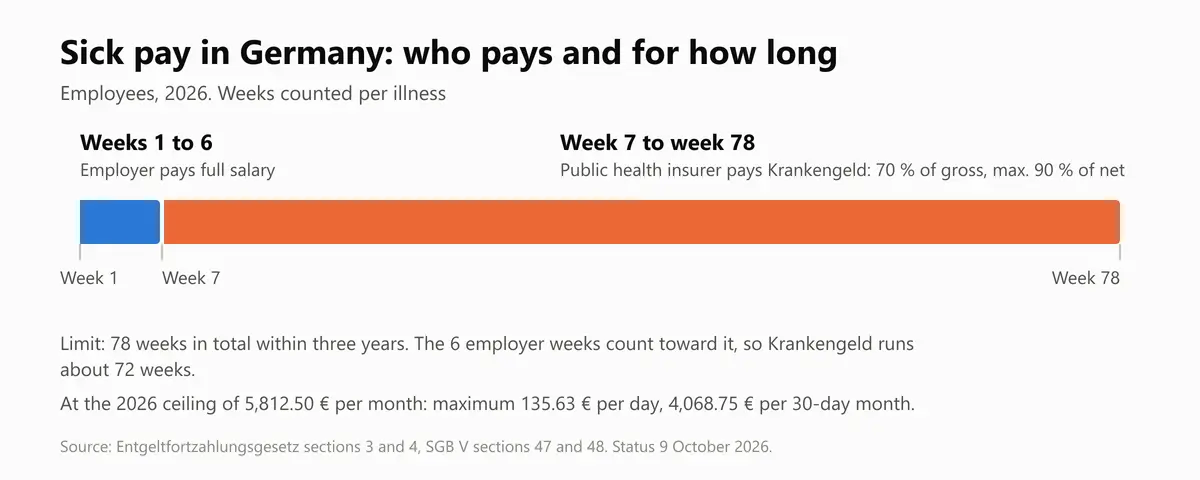
Krankengeld is paid by your public health insurer once the employer's six weeks end. It equals 70 % of your regular gross pay, but never more than 90 % of your net pay. Only pay up to the contribution ceiling counts, which is EUR 5,812.50 per month (EUR 69,750 per year) in 2026. It is paid per calendar day, and a full month counts as 30 days. At the ceiling that gives a maximum of EUR 135.63 per day, or EUR 4,068.75 per 30-day month.
Krankengeld is paid gross, and your insurer withholds your share of pension, unemployment and care contributions.
The 78-week limit is counted in total, and the first six weeks paid by your employer count toward it. Krankengeld itself therefore runs for about 72 weeks. A new claim for the same illness needs at least six months without unfitness for it, while you work or are available for work.
Table 1: Who pays when you are sick (2026)
| Period | Who pays | Amount | Legal basis |
|---|---|---|---|
| Weeks 1 to 6 | Employer | Full salary | Sections 3 and 4 Entgeltfortzahlungsgesetz |
| From week 7 | Public health insurer | 70 % of gross, max. 90 % of net, ceiling EUR 5,812.50 per month | Section 47 SGB V |
| Maximum | Employer, then insurer | 78 weeks in total within three years | Section 48 SGB V |
Source: gesetze-im-internet.de (Entgeltfortzahlungsgesetz sections 3 and 4, SGB V sections 47 and 48) and bundesgesundheitsministerium.de (Krankengeld, ceiling). Seen 2 November 2026.
How big is the income gap at EUR 5,000 and EUR 8,000 gross?
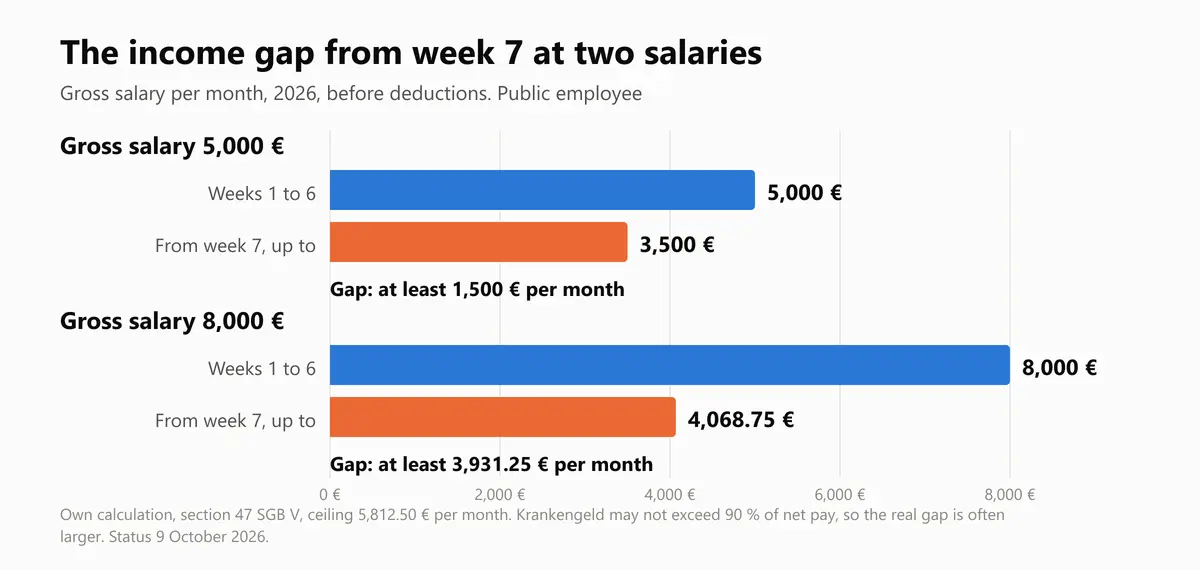
EUR 5,000 gross per month. Weeks 1 to 6: EUR 5,000. From week 7: 70 % of EUR 5,000 is EUR 3,500. That is only the upper limit, because Krankengeld may not exceed 90 % of your net pay. For a single employee in tax class I, net pay at this salary is roughly EUR 3,150 to 3,300, so Krankengeld is roughly EUR 2,800 to 3,000. The gap is therefore at least EUR 1,500 per month (30 % of your salary), and in this example roughly EUR 2,000 to 2,200 (about 40 to 44 %). The salary sits below the ceiling of EUR 5,812.50, so nothing is cut off by the ceiling.
EUR 8,000 gross per month. Weeks 1 to 6: EUR 8,000. From week 7 the Krankengeld base is capped at EUR 5,812.50, so 70 % gives EUR 4,068.75. The gap is EUR 8,000 minus EUR 4,068.75, which is EUR 3,931.25 per month. About 49 % of your salary is missing. At this salary the 90 % of net cap does not bite; the ceiling does. EUR 8,000 per month is EUR 96,000 per year, above the 2026 income threshold of EUR 77,400, so private health insurance is open to this employee.
Table 2: The income gap at two salaries (2026, per 30-day month, before deductions)
| Gross salary | Weeks 1 to 6 | From week 7 (Krankengeld) | Monthly gap |
|---|---|---|---|
| EUR 5,000 | EUR 5,000 | up to EUR 3,500 (upper limit before the 90 % of net cap; roughly EUR 2,800 to 3,000 for a single employee in tax class I) | at least EUR 1,500 (roughly EUR 2,000 to 2,200) |
| EUR 8,000 | EUR 8,000 | up to EUR 4,068.75 (ceiling applies) | EUR 3,931.25 |
Source: own calculation from section 47 SGB V and the 2026 contribution ceiling (bundesgesundheitsministerium.de). Krankengeld may not exceed 90 % of net pay (section 47(1) SGB V), so for most employees below the ceiling the real figure is lower than 70 % of gross and the gap larger, depending on your individual net pay. Seen 2 November 2026.
For 2027 the cabinet decided on 7 October 2026 a contribution ceiling of EUR 76,500 per year (EUR 6,375 per month), with Bundesrat approval pending. If it passes, 70 % gives EUR 4,462.50 per month, and the gap at EUR 8,000 gross would shrink to EUR 3,537.50.
What do self-employed people and freelancers get?
No employer pays you, so weeks 1 to 6 bring nothing. In public insurance, full-time self-employed people have no Krankengeld claim unless they send their insurer a declaration (Wahlerklärung) that their membership should include it. Then Krankengeld starts from week 7 of the illness. The option binds you for three years and costs about 0.6 percentage points more contribution, because you pay the general rate instead of the reduced one. If the declaration reaches your insurer during an illness, it only counts from the day after that illness ends.
Self-employed people who are privately insured have no Krankengeld at all. They need their own cover, described in the next section. See our guide to insurance options for the self-employed and our page on private health insurance for freelancers.
What changes in 2027?
A law dated 24 July 2026 (the Beitragssatzstabilisierungsgesetz for public health insurance, published in the Bundesgesetzblatt Part I No 228 on 29 July 2026) changes the declaration from 1 January 2027. The declaration takes effect on receipt only if you start voluntary public membership for the first time, or your earlier Krankengeld claim just ended through a change of status, and the declaration arrives within 14 days. Everyone else faces a new three-month waiting period after the declaration reaches the insurer, unless the incapacity during that period is caused by an accident. So decide on Krankengeld when you join. Status: law, BGBl. 2026 I Nr. 228. Also new from 1 January 2027 (section 47(2a) SGB V): if your employment ends while you are unfit for work, Krankengeld from the day after the job ends is 60 % of net pay, or 67 % if you or your spouse have a child within the meaning of section 32 of the income tax act and both spouses are fully taxable and not permanently separated. More in the 2027 reform for the self-employed.
How does a privately insured employee or freelancer cover sick pay?
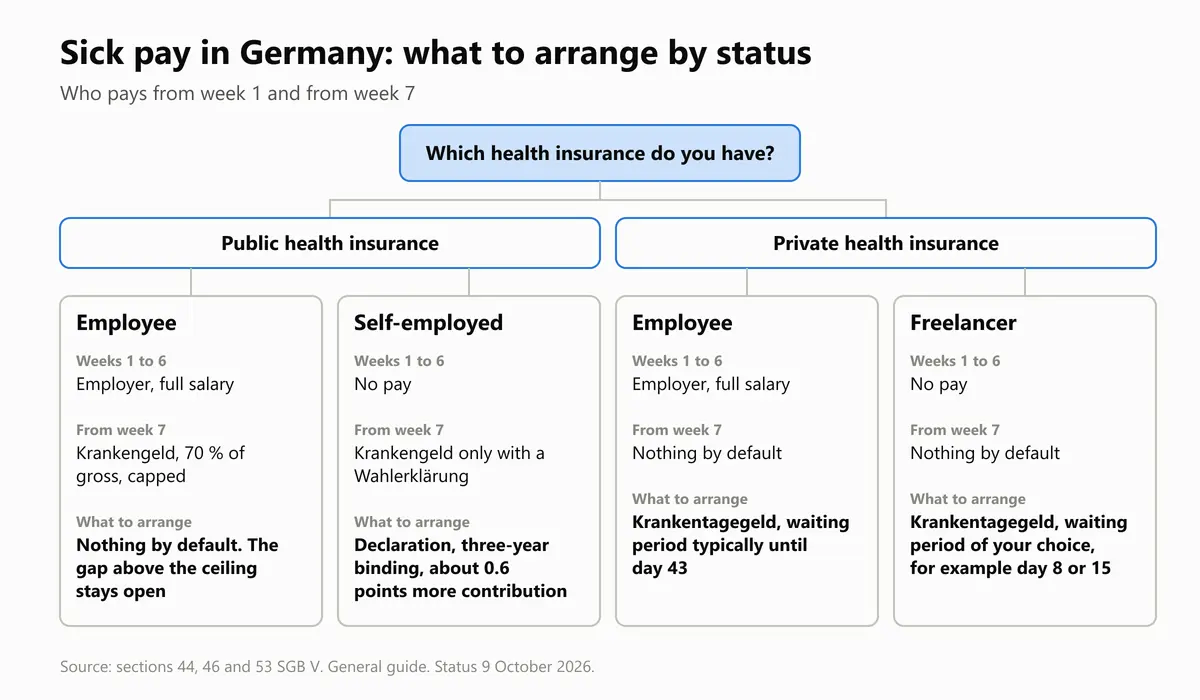
Private health insurance pays your treatment, not your income. Income replacement is a separate cover called Krankentagegeld (daily sickness allowance). You choose a daily amount, and after a waiting period the insurer pays it for every day you are fully unfit for work. If you want the basics first, read how private health insurance works in Germany.
The waiting period is typically until day 43 for employees, which matches the six weeks of employer pay. Self-employed people choose shorter waits, for example day 8 or day 15, in exchange for a higher premium. There is no statutory maximum duration. Benefits need full incapacity and usually end on occupational disability.
Worked example. A daily benefit of EUR 100 pays EUR 100 times 30, which is EUR 3,000 per 30-day month. A daily benefit of EUR 150 pays EUR 4,500. An employee on EUR 8,000 gross with a EUR 150 benefit from day 43 has EUR 4,500 coming in from week 7, a little above what public Krankengeld would pay at the ceiling (EUR 4,068.75). A freelancer with a EUR 100 benefit and a 15-day wait gets EUR 3,000 per month after the wait. How much benefit you can insure depends on your net income and on what your insurer allows. The premium depends on age, health, profession and waiting period, so we print no price here. A free quote shows the real figure for you.
Table 3: Sick pay options by status
| Status | Weeks 1 to 6 | From week 7 | What to arrange |
|---|---|---|---|
| Public employee | Employer, full salary | Krankengeld, 70 % of gross, capped | Nothing by default. The gap above the ceiling stays open |
| Public self-employed | No pay | Krankengeld only with a Wahlerklärung | Declaration when you join, three-year binding, about 0.6 points more contribution |
| Private employee | Employer, full salary | Nothing by default | Krankentagegeld, waiting period typically until day 43 |
| Private freelancer | No pay | Nothing by default | Krankentagegeld, waiting period of your choice, for example day 8 or 15 |
Source: sections 44, 46 and 53 SGB V (gesetze-im-internet.de) and Musterbedingungen MB/KT for the daily sickness allowance. Seen 2 November 2026.
Employees above the income threshold can compare options on our page about private health insurance for employees.
What about sick days when my child is ill?
In 2026 each parent with a Krankengeld entitlement can take up to 15 working days per child, and up to 35 working days in total. Single parents get 30 working days per child and up to 70 in total. The child must be under 12 (or disabled and dependent). From 1 January 2027 the standard rule applies again unless the law is extended: 10 working days per child and parent, up to 25 in total (single parents 20 and 50). Privately insured parents have no claim under this rule, so check what your policy offers.
What should I do next?
Your employer covers weeks 1 to 6. Public Krankengeld or a private daily benefit covers the time after. The question is whether that second layer replaces enough of your income. At EUR 5,000 gross the public gap is at least EUR 1,500 per month, at EUR 8,000 it is EUR 3,931.25.
Private health insurance suits people up to about 45 best, and the longer you live in Germany, the better it gets, because old-age reserves build from the first month. A Krankentagegeld fits that picture. Employees can read more about private health insurance for employees in Germany.
Employees can choose private health insurance above EUR 77,400 a year in 2026 (planned EUR 84,150 for 2027, Bundesrat approval pending). Self-employed people can choose freely. If you earn less, start with public health insurance in Germany or read about the 2027 income threshold.
Want a free check of your options?
If you are an employee above the income threshold, or self-employed, get a free quote. We show which daily benefit fits your income. A free consultation by phone is part of it.
Sources and status
- Entgeltfortzahlungsgesetz sections 3, 4 and 5: https://www.gesetze-im-internet.de/entgfg/__3.html https://www.gesetze-im-internet.de/entgfg/__4.html https://www.gesetze-im-internet.de/entgfg/__5.html (seen 2 November 2026, law)Official sourcegesetze-im-internet.de
- SGB V section 44: https://www.gesetze-im-internet.de/sgb_5/__44.html (seen 2 November 2026, law)Official sourcegesetze-im-internet.de
- SGB V section 45: https://www.gesetze-im-internet.de/sgb_5/__45.html (seen 2 November 2026, law)Official sourcegesetze-im-internet.de
- SGB V section 46: https://www.gesetze-im-internet.de/sgb_5/__46.html (seen 2 November 2026, law)Official sourcegesetze-im-internet.de
- SGB V section 47: https://www.gesetze-im-internet.de/sgb_5/__47.html (seen 2 November 2026, law)Official sourcegesetze-im-internet.de
- SGB V section 48: https://www.gesetze-im-internet.de/sgb_5/__48.html (seen 2 November 2026, law)Official sourcegesetze-im-internet.de
- SGB V section 53: https://www.gesetze-im-internet.de/sgb_5/__53.html (seen 2 November 2026, law)Official sourcegesetze-im-internet.de
- Federal Ministry of Health, Krankengeld: https://www.bundesgesundheitsministerium.de/service/begriffe-von-a-z/k/krankengeld (seen 2 November 2026, official figure)Official sourcebundesgesundheitsministerium.de
- Federal Ministry of Health, telephone sick note: https://www.bundesgesundheitsministerium.de/presse/pressemitteilungen/ab-sofort-krankschreibung-per-telefon-moeglich-pm-07-12-23 (seen 2 November 2026)Official sourcebundesgesundheitsministerium.de
- G-BA directive on telephone sick notes: https://www.g-ba.de/beschluesse/6324/ (seen 2 November 2026, law)g-ba.de
- KBV, eAU: https://www.kbv.de/praxis/verordnungen/arbeitsunfaehigkeit (seen 2 November 2026, official)Official sourcekbv.de
- Planned end of the telephone sick note: https://www.apotheken-umschau.de/gesundheitspolitik/krankschreibung-ab-tag-eins-das-plant-die-regierung-1547567.html (seen 2 November 2026, plan, not yet law)apotheken-umschau.de
- BGBl. 2026 I Nr. 228, Krankengeld rules from 2027 (section 44(2), section 47(2a) SGB V): https://www.recht.bund.de/bgbl/1/2026/228/VO.html (seen 2 November 2026, law)Official sourcerecht.bund.de
- Musterbedingungen MB/KT for the daily sickness allowance (general terms used by insurers, secondary reference for insurer practice; seen 2 November 2026)
- 2027 cabinet figures (income threshold EUR 84,150, ceiling EUR 76,500): cabinet decision of 7 October 2026, Bundesrat approval pending
Myhealthcarebroker is an independent insurance broker. This article is general information, not legal or tax advice. Figures checked 2 November 2026.
 Written byMarco Maurelli
 Reviewed byBettina Ostermann