
Last checked 2 November 2026. The 2027 figures are a cabinet decision of 7 October 2026 and still need Bundesrat approval.
Quick answer: Yes, but not by choice. You return to public health insurance only when a trigger makes it compulsory again, such as a regular salary below the income threshold, unemployment benefit or a move from self-employment into a job, or when you qualify for family insurance. From age 55 the door is usually closed. The most reliable plan is the right private tariff from day one, as explained in how the switch to private health insurance works.
Can you switch back from private to public health insurance in Germany?
Only if the law puts you back in. Public insurance is not an option you pick, it is a status that applies when certain conditions are met. Employees who work for pay are compulsorily insured in public health insurance (section 5 SGB V). The exception is an employee whose regular annual earnings exceed the income threshold, the Jahresarbeitsentgeltgrenze (section 6 SGB V). Main self-employed people are not compulsorily insured at all (section 5 para 5).
So the question is "does a trigger apply to me, and does the age rule allow it". If you are still weighing the move into private cover itself, our step-by-step guide to switching covers the entry side.
Which situations bring you back into public insurance?
| Situation | Public insurance compulsory? | Deadline | Condition to check | Legal basis |
|---|---|---|---|---|
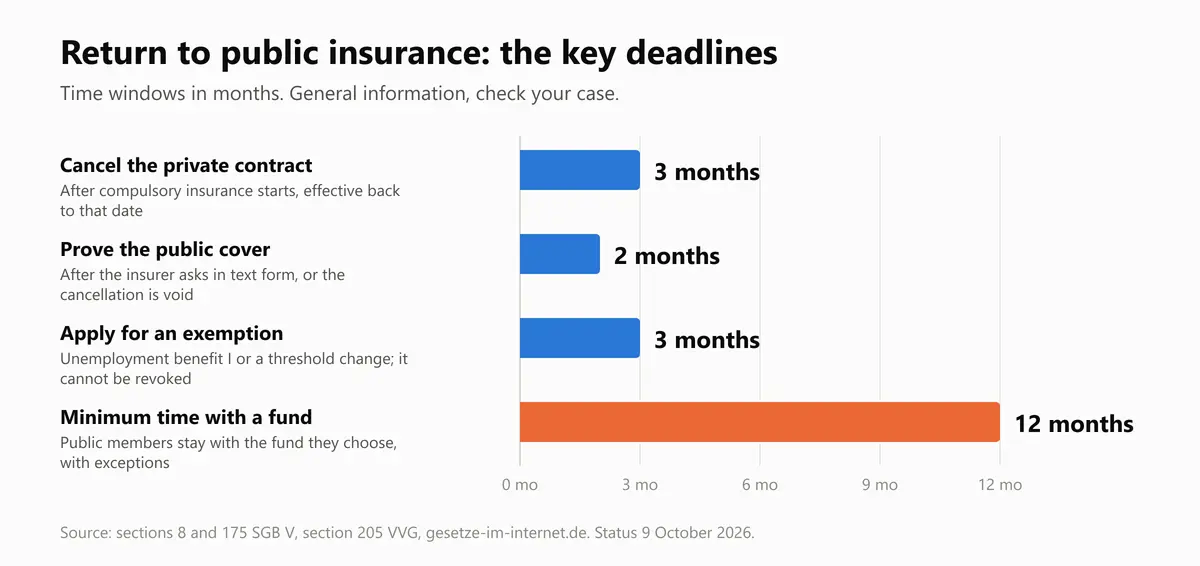
| Regular salary falls below the threshold | Yes | Cancel the private contract within 3 months of the start, effective back to that date | Earnings are regular, not a short dip. The age 55 rule must not block | Sections 5 and 6 SGB V, section 205 VVG |
| Unemployment benefit I | Yes, unless you apply for an exemption | Exemption application within 3 months | Exemption needs no public insurance in the previous 5 years and equivalent private cover | Sections 5 and 8 SGB V |
| Employee after self-employment | Yes, if pay is below the threshold | Cancel within 3 months of the start | Age 55 rule | Sections 5 and 6 SGB V |
| Family insurance | No own contribution | Income limit EUR 565 per month (EUR 603 with a mini job) in 2026 | A public member in the family, your own income test | Section 10 SGB V |
Source: sections 5, 6, 8, 10 SGB V and section 205 VVG, gesetze-im-internet.de, read 2 November 2026.
What if your salary falls below the threshold?
If your regular annual earnings are not above EUR 77,400 (2026), you are compulsorily insured as an employee. Example: you earn a regular EUR 6,000 gross per month. EUR 6,000 x 12 = EUR 72,000. EUR 77,400 - EUR 72,000 = EUR 5,400 below the threshold, so public insurance applies.
You can cancel the private contract within three months after compulsory insurance starts, with effect back to that date. The cancellation is void only if you do not prove the compulsory insurance within two months after the insurer asked for it in text form (unless the delay was not your fault). Family insurance counts like compulsory insurance for this right. Later you can still cancel to the end of the month in which you prove it. The law speaks of regular earnings, so a short dip is not a lasting fall.
What happens if you receive unemployment benefit I?
Unemployment benefit I (Arbeitslosengeld I) makes you compulsorily insured in public insurance. You can apply for an exemption if you were not publicly insured in the five years before the benefit and hold private cover with equivalent benefits. The application is due within three months of the start of compulsory insurance. Without it, you are in public insurance.
The law (section 8 para 2 SGB V) gives three months to apply for an exemption, and an exemption cannot be revoked, so it is worth checking your options early and with the full picture.
Can you return after self-employment?
Not while you are self-employed. Freelancers and main self-employed people are outside compulsory insurance (section 5 para 5). They return by taking a job with pay below the threshold, and only if the age 55 rule does not block it.
Does the 2027 threshold change affect your situation?
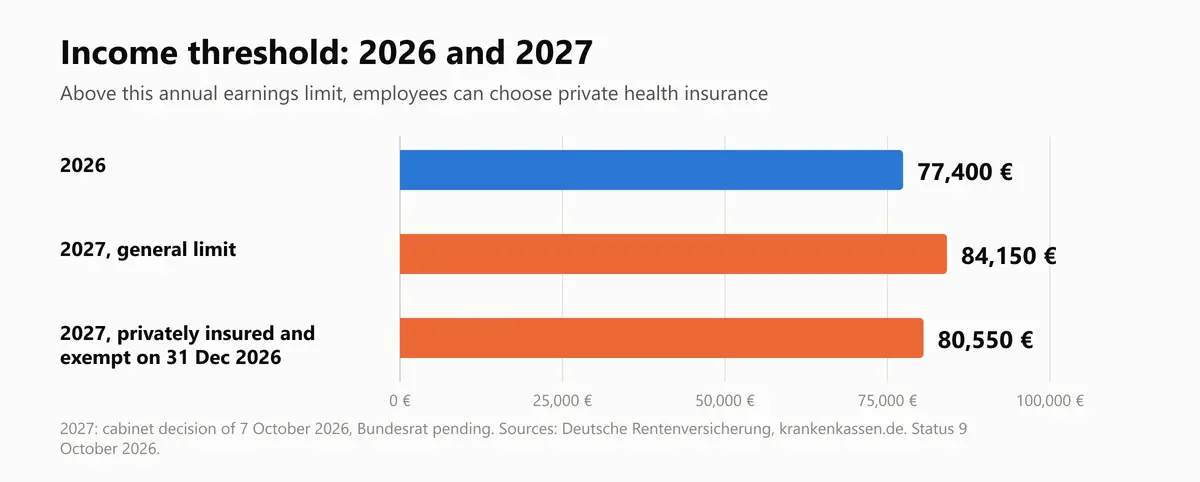
It can. The cabinet decided new figures on 7 October 2026. Bundesrat approval is still pending.
| Item | 2026 | 2027 (cabinet 7 October 2026, Bundesrat pending) |
|---|---|---|
| Income threshold, per year | EUR 77,400 | EUR 84,150 |
| Income threshold, per month | EUR 6,450 | EUR 7,012.50 |
| Contribution ceiling, per year | EUR 69,750 | EUR 76,500 |
| Lower special limit (privately insured and exempt on 31 Dec 2026) | not shown | EUR 80,550 |
Source: SVBezGrV 2026 (gesetze-im-internet.de) and the draft Sozialversicherungsrechengrößen-Verordnung 2027, Bundesrat document 576/26 of 7 October 2026 (dserver.bundestag.de), read 2 November 2026.
Example: you are privately insured and earn a regular EUR 80,000. In 2026 you are EUR 2,600 above the threshold (EUR 80,000 - EUR 77,400). Employees who are privately insured and exempt on 31 December 2026 have a special 2027 limit of EUR 80,550 (EUR 6,712.50 per month, draft ordinance, Bundesrat pending). Everyone else: EUR 84,150. If you were privately insured on 31 December 2026, you would be EUR 550 below the relevant limit (EUR 80,550 - EUR 80,000). If you were not, you would be EUR 4,150 below the general limit (EUR 84,150 - EUR 80,000). If the limit change makes you compulsorily insured, you can apply for an exemption within three months (section 8 para 1 no. 1 SGB V). It cannot be revoked and takes effect once you prove other cover.
The full background is in our article on the 2027 income threshold. If you earn below the threshold, public health insurance in Germany is the page to read.
What does the age 55 rule mean for returning?
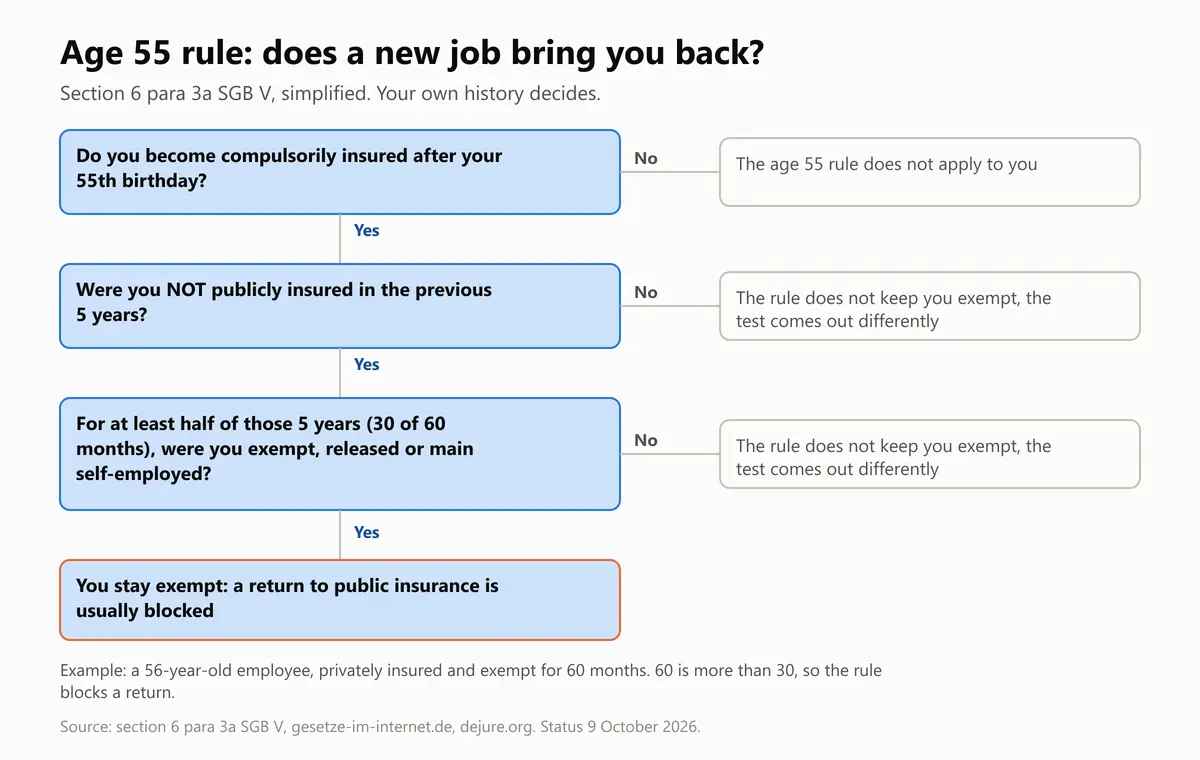
Section 6 para 3a SGB V says that if you become compulsorily insured after your 55th birthday, you stay exempt when two conditions are met. First, you were not publicly insured in the previous five years. Second, for at least half of that period you were exempt, released from compulsory insurance, or main self-employed.
In plain terms: after 55, a new trigger such as a job usually does not bring you back if you spent the last five years outside public insurance in those ways. Five years are 60 months, half is 30 months. Example: a 56-year-old employee has been privately insured as an exempt employee for 60 months. 60 is more than 30, so the rule blocks a return. Had the same person been publicly insured at some point in those five years, the first condition fails and the test comes out differently.
Your history decides, so the answer is rarely a flat yes or no. A free consultation can go through your five-year history with you.
Can family insurance bring you back?
Spouses, civil partners and children of a public member are insured without their own contribution if their regular monthly income does not exceed one seventh of the monthly reference value. In 2026 that is EUR 3,955 / 7 = EUR 565 per month, or EUR 603 with a mini job. In 2027 the limits are expected to rise to EUR 590 (EUR 4,130 / 7, draft, Bundesrat pending) and EUR 633 with a mini job.
From 1 January 2028 the public member pays a surcharge of 2.5 percentage points for a family-insured spouse, unless an exception applies, for example a child under 12 in the spouse's household (section 242b SGB V, BGBl. 2026 I Nr. 228). Children stay free.
For children there is an extra test. Children are not family-insured if the parent who is not a public member regularly earns more than one twelfth of the threshold per month (EUR 77,400 / 12 = EUR 6,450 in 2026) and more than the public member. Whether the age 55 rule also limits family insurance is disputed in the sources, so confirm it before you cancel anything. In general, it makes sense to keep your private contract until the public membership is confirmed in writing (general information, check your case).
How long are you tied to a choice?
There is no single one-year lock-in. Three real rules apply:
- An exemption from compulsory insurance cannot be revoked (section 8 SGB V).
- Public members stay at least 12 months with the fund they choose, with exceptions (section 175 para 4 SGB V).
- A private contract of more than one year can be cancelled at the end of an insurance year with three months' notice (section 205 para 1 VVG).
Cancelling a contract that satisfies the insurance obligation requires seamless cover, and you must send proof within two months of the cancellation. The mechanics are in our guide to cancellation deadlines for private health insurance. In general the order is to confirm the public membership in writing, then give notice to the private insurer within the legal period, then send proof of cover (general information, check your case).
What if you cannot switch back: Basistarif and Anwartschaft?
The Basistarif is a private tariff that insurers must offer to eligible people, with a capped premium. The cap follows public insurance. Calculation for 2026: EUR 5,812.50 x (14.6% + 2.9%) = EUR 5,812.50 x 17.5% = EUR 1,017.19, so about EUR 1,017 per month for health cover. The care premium comes on top: about EUR 209 at the lower care rate, about EUR 244 with the childless supplement. That gives about EUR 1,226 to 1,261 per month depending on the care rate. For 2027 the cap would be about EUR 1,116 (EUR 6,375 x 17.5%; the average additional rate stays at 2.9% per the Federal Ministry of Health, 30 October 2026), subject to Bundesrat approval of the ceiling. While you are in financial need, the health part is halved, to about EUR 509. Access depends on contract date and age. See the Basistarif explained.
An Anwartschaft is an insurer product that pauses your full cover and keeps your right to return without a new health check. The small version freezes your health status, the large one also keeps your entry age and lets reserves keep growing. You have no cover during the pause, and the price depends on the insurer.
| Option | What it is | Cost indicator | Best for |
|---|---|---|---|
| Tariff change within your insurer | A move to another tariff with equal cover, acquired rights and old-age reserve credited (section 204 VVG) | Surcharge only for extra benefits | Premiums or benefits that no longer fit |
| Basistarif | Private tariff with acceptance duty and capped premium | About EUR 1,017 health cover plus care premium | A safety net in hard times |
| Anwartschaft | Paused cover that keeps the way back to a private tariff | Depends on the insurer | A temporary public period or a stay abroad |
| Premium relief | Components that lower premiums in later life | Part of the tariff price | Planning for retirement years |
Source: section 204 VVG and section 152 VAG, gesetze-im-internet.de, bundesanzeiger.de, insurer information, read 2 November 2026.
How do you avoid needing to switch back?
Most people who ask this are not planning to go back. They want to know whether the choice is safe. Four points help.
- Choose the tariff at entry with care. Private health insurance suits people up to about 45 best. The longer you are insured, the better private gets, because old-age reserves build from month one. Public insurance is clearly better in one case, a single-income family with two or more children. Start with private health insurance in Germany or the blog on how to switch from public to private health insurance.
- Use the tariff change. Under section 204 VVG you can ask your own insurer for another tariff with equal cover. Acquired rights and the old-age reserve are credited, and a surcharge applies only to extra benefits. More in tariff change under section 204 VVG.
- Add premium relief. Components that reduce premiums in later life. See premium relief.
- Review when life changes. A new job, a child or a move are good moments for a free consultation.
Want a free check of your options?
If you are an employee earning above the income threshold (EUR 77,400 in 2026, EUR 84,150 in 2027 pending Bundesrat approval) or self-employed, you can get your free quote and talk through your situation in a free consultation. For background on the entry decision, read about switching from public to private health insurance in Germany.
If you are an employee below the threshold, start with public health insurance in Germany.
Sources and status
Read on 2 November 2026 unless stated.
- Sections 5, 6, 8, 10, 175 SGB V: https://www.gesetze-im-internet.de/sgb_5/__5.html https://www.gesetze-im-internet.de/sgb_5/__6.html https://www.gesetze-im-internet.de/sgb_5/__8.html https://www.gesetze-im-internet.de/sgb_5/__10.html https://www.gesetze-im-internet.de/sgb_5/__175.html (law, no "Stand" date shown on the pages)Official sourcegesetze-im-internet.de
- Sections 204 and 205 VVG: https://www.gesetze-im-internet.de/vvg_2008/__204.html https://www.gesetze-im-internet.de/vvg_2008/__205.html (law)Official sourcegesetze-im-internet.de
- Section 152 VAG, Basistarif: https://www.gesetze-im-internet.de/vag_2016/__152.html (law)Official sourcegesetze-im-internet.de
- Beitragssatzstabilisierungsgesetz (public health insurance), BGBl. 2026 I Nr. 228 (new section 6 para 8, section 242b SGB V): https://www.recht.bund.de/bgbl/1/2026/228/VO.htmlOfficial sourcerecht.bund.de
- 2026 figures, Deutsche Rentenversicherung, 10 September 2025: https://www.deutsche-rentenversicherung.de/DRV/DE/Ueber-uns-und-Presse/Presse/Meldungen/2025/250910-sv-rechengroessen-vo-2026 (official figure)Official sourcedeutsche-rentenversicherung.de
- 2027 figures: Bundesrat document 576/26, https://dserver.bundestag.de/brd/2026/0576-26.pdf and Deutsche Rentenversicherung, 24 September 2026: https://www.deutsche-rentenversicherung.de/DRV/DE/Ueber-uns-und-Presse/Presse/Meldungen/2026/260922-sv-rechengroessen-vo-2027 (draft regulation, cabinet decision of 7 October 2026, Bundesrat approval pending, not final)Official sourcedserver.bundestag.deOfficial sourcedeutsche-rentenversicherung.de
- Federal Ministry of Health, average additional rate 2027 (2.9%), 30 October 2026: https://www.bundesgesundheitsministerium.de/presse/pressemitteilungen/zusatzbeitragssatz-gkv-2027-festgelegtOfficial sourcebundesgesundheitsministerium.de
- Basistarif rate inputs: Bundesanzeiger, 10 November 2025 (average additional rate 2.9%): https://www.bundesanzeiger.de/pub/publication/oUJYVk8GYRXybnb9Y4h/content/oUJYVk8GYRXybnb9Y4h/BAnz%20AT%2010.11.2025%20B7.pdf?inline= (care premium: 3.6% x EUR 5,812.50 = about EUR 209 at the lower care rate, about EUR 244 at 4.2% with the childless supplement; own calculation, not confirmed against a primary source)bundesanzeiger.de
Status: the EUR 80,550 limit follows new section 6 para 8 SGB V (BGBl. 2026 I Nr. 228, in force 1 January 2027); the amount is a draft ordinance, Bundesrat pending. The interplay of family insurance with the age 55 rule and the care premium figure are not fully verified and are worded with care. The Anwartschaft is an insurer product without a statutory definition, so its terms depend on the insurer's tariff conditions.
Myhealthcarebroker is an independent insurance broker. This article is general information, not legal or tax advice. Rules can change, and your own situation decides, so confirm details before you cancel any contract.
 Written byMarco Maurelli
 Reviewed byBettina Ostermann