
Last checked 2 November 2026. Tax year 2026. 2027 figures are cabinet decisions of 7 October 2026, Bundesrat approval pending.
Quick answer: Yes. The basic-cover part of your premium is deductible as a special expense. It sits inside one annual cap that covers basic and other premiums together, EUR 1,900 for employees with an employer subsidy and EUR 2,800 for self-employed people. If your basic premiums alone exceed the cap, they are deducted in full and nothing else is added. The comfort part (single room, chosen doctor, daily sickness allowance) and other insurances share whatever headroom is left, which for most people is nothing. If you are still deciding whether it fits you, start with our guide to private health insurance in Germany.
Is private health insurance tax-deductible in Germany?
Yes, as special expenses (Sonderausgaben) under section 10 paragraph 1 number 3 of the Income Tax Act (EStG). The state lets you deduct the part of your premium that buys the same level of cover as public insurance. This "basic cover" (Basisabsicherung) applies to health insurance and to long-term care insurance. Sites that call private premiums "not deductible" are wrong, and so is the EUR 2,850 cap you may see quoted. The limit is EUR 2,800.
This article is for employees above the income threshold, for self-employed people and for Internationals filing their first German return. For the general logic of special expenses, see how special expenses work in general.
Which part of my premium counts, and who works out the split?
Your tariff mixes two things. One part buys public-insurance-level benefits. The other part buys extras: a single or two-bed room, chief-physician treatment, Heilpraktiker (alternative practitioner) treatment, dental prostheses and orthodontics, and a daily sickness allowance. A regulation, the KVBEVO, sets how each tariff is split with uniform percentage deductions.
You do not calculate this yourself. Your insurer determines the basic share, reports it to the tax office and sends you an annual tax certificate. The basic share is only part of the premium, because extras beyond the basic cover are not deductible in full, so your insurer certifies the exact figure for your tariff.
| Part of the premium | Examples | Treatment in the return | Cap |
|---|---|---|---|
| Basic cover, health | Benefits at public-insurance level | Special expense, section 10 para 1 no 3 | Shared cap, see below; deducted in full if basic alone exceeds it |
| Basic cover, care | Mandatory long-term care insurance | Special expense, section 10 para 1 no 3 | Shared cap, see below; deducted in full if basic alone exceeds it |
| Comfort share | Single room, chief physician, Heilpraktiker, dental extras, daily sickness allowance | "Other" provision expense, no 3a | Shared cap, see below |
| Other insurances | Liability, disability, accident, risk life | "Other" provision expense, no 3a | Shared cap, see below |
Source: section 10 paragraph 1 numbers 3 and 3a EStG, KVBEVO. Details in Sources and status.
What are the EUR 1,900 and EUR 2,800 limits, and do they apply to me?
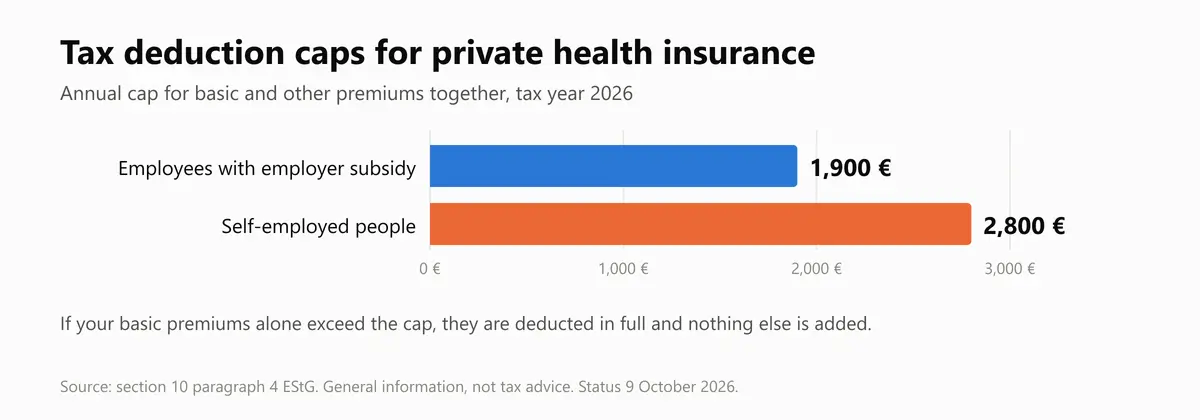
The cap applies to basic and other premiums together. Section 10 paragraph 4 EStG sets one annual cap for both groups (numbers 3 and 3a). If your basic premiums alone exceed it, they are deducted in full and nothing else is added. If they are below it, your other insurances share the remaining headroom.
| Group | Annual cap for basic and other premiums together | If basic premiums alone exceed it |
|---|---|---|
| Employees with an employer subsidy | EUR 1,900 | Basic deducted in full, nothing else added |
| Self-employed people | EUR 2,800 | Basic deducted in full, nothing else added |
Source: section 10 paragraph 4 EStG (gesetze-im-internet.de).
In practice, the basic share of a private premium often exceeds EUR 1,900 on its own. Then your comfort share and your liability or disability insurance bring no extra deduction. Check this before you count on them.
What is the employer subsidy and does it change my deduction?
If you are an employee who may choose private insurance because you earn above the threshold, your employer pays a subsidy. It is half of what you would owe in public insurance, but never more than half of your actual private premium. The subsidy is tax-free under section 3 number 62 EStG.
The catch: the tax-free subsidy is credited fully against your basic-cover contributions and reduces the deductible amount. In the worked example below, the subsidy cuts the deduction by EUR 3,600. For how this plays out on your payslip, read how insurance affects your net salary.
Do premium refunds reduce the deduction?
Yes. If your insurer refunds part of your premium (Beitragsrückerstattung), the refund of the basic share is netted against your basic contributions in the year you receive it, not the year it relates to. If refunds exceed your basic contributions, the excess is added to your income. Costs you pay yourself to keep a refund do not count as special expenses, so weigh a refund against the treatment you skip.
How do I enter private health insurance in my tax return?
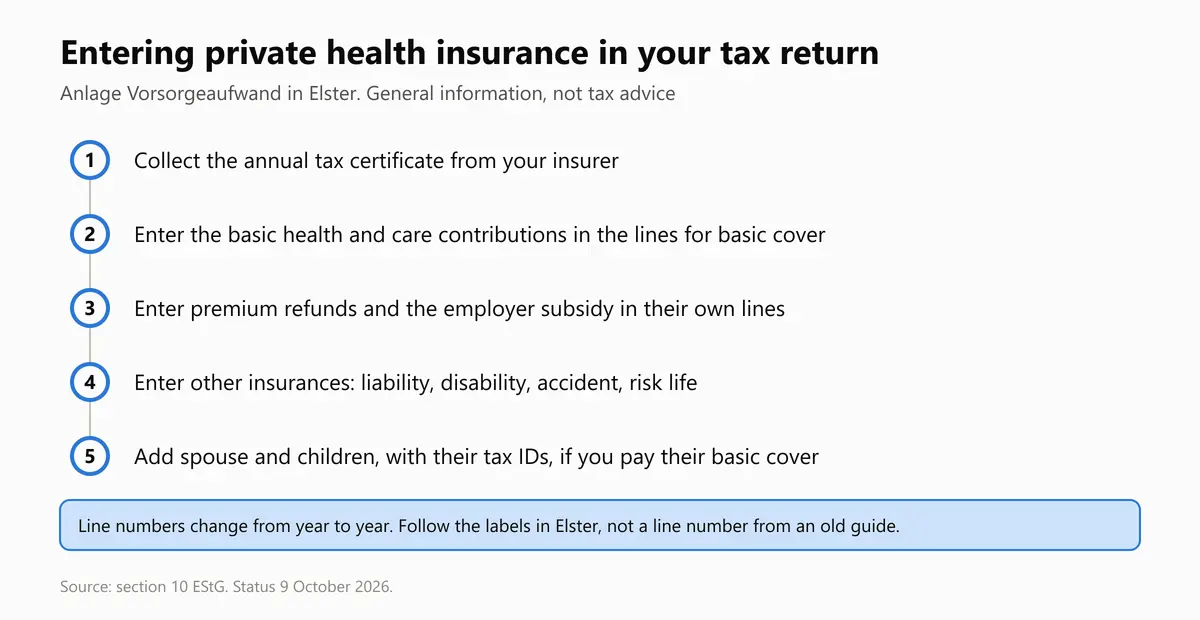
General information, not tax advice. In general, you use the Anlage Vorsorgeaufwand in Elster, the official online tax portal. The usual steps:
- Collect the annual tax certificate from your insurer.
- Enter the basic health and care contributions in the lines for basic cover.
- Enter premium refunds and the employer subsidy in their own lines.
- Enter other insurances (liability, disability, accident, risk life).
- Add spouse and children, with their tax IDs, if you pay their basic cover.
Line numbers change from year to year, so follow the labels in Elster rather than a line number from an old guide.
Can I prepay up to three years of premiums to save tax?
General information, not tax advice. Whether prepayment pays off depends on your income, subsidy and insurer, so ask a tax adviser.
Possibly, within a limit. You may pay contributions for future years in advance (Vorauszahlung). In the year of payment they count only up to three times the contributions attributable to that year. Amounts above that are deducted in the year they were paid for. Your insurer must accept the prepayment, and you need the cash.
For the basic share alone, prepaying mostly shifts timing. You deduct more now and less in the later years. A possible extra effect comes from the shared cap: in the years you skip, your basic premiums are already used, so some headroom under the cap may be free for other insurances. How much depends on your premium, your other insurances and your insurer.
Why we do not print a worked example. A simple year-by-year table would mislead, for three reasons:
- "Other insurances" (number 3a) also include your own unemployment-insurance contributions. At EUR 90,000 gross that is about EUR 1,170 a year, so the cap can bind sooner than a liability or disability policy alone suggests.
- A real prepayment is of the gross basic premium, not the premium after the employer subsidy. The subsidy keeps flowing and is netted as a refund in each year (section 10 paragraph 4b EStG), so a table of net figures does not describe what happens.
- A large prepayment can push your taxable income below the start of the 42 percent bracket (about EUR 69,879 in 2026), so a flat 42 percent overstates the effect.
Treat any promised saving with caution. Insurers differ, so check the tariff. A higher tax rate in the year of payment, for example after a one-off bonus, can add a timing benefit, but not a guaranteed one.
What changes if I am self-employed or a freelancer?
You get no employer subsidy, so your cap for other expenses is EUR 2,800. Your premium counts as a private special expense, not a business expense, so it does not reduce your business profit. Prepayment may leave more room because the cap is higher, but any gain depends on your income and insurer, so ask a tax adviser. Self-employed people may choose private health insurance freely, whatever their income. Details are in our guide to private health insurance for freelancers.
What does this look like at EUR 90,000 gross?
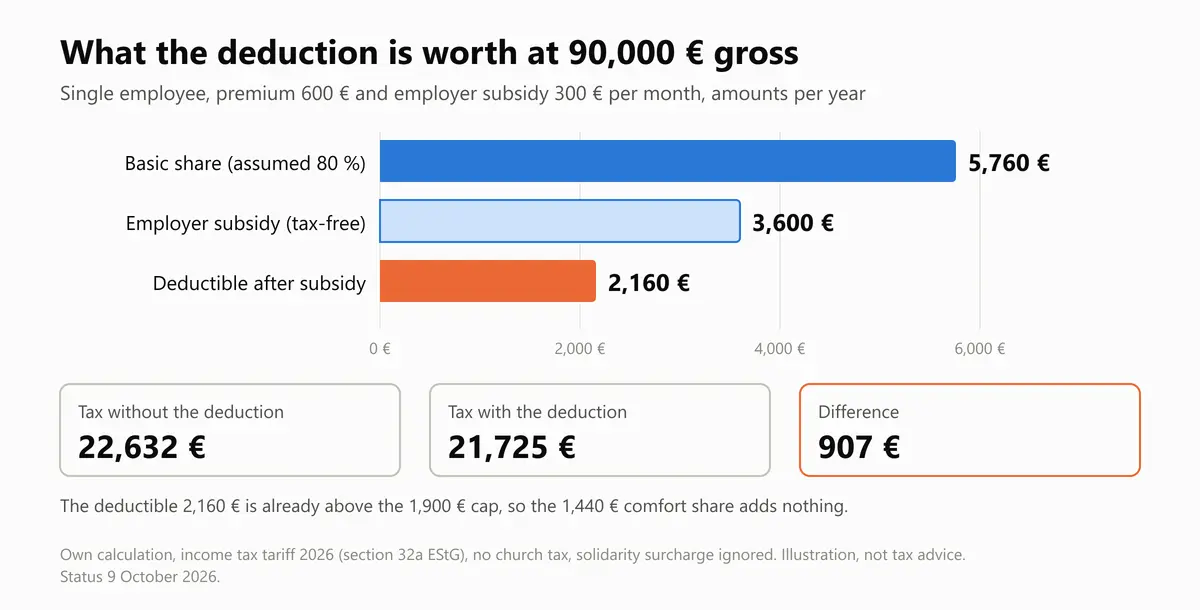
Assume a single employee at EUR 90,000 gross, taxable income of EUR 80,400 before the health deduction, a private premium of EUR 600 per month and an employer subsidy of EUR 300 per month. At EUR 90,000 an employee is above the 2026 income threshold of EUR 77,400. For 2027 the cabinet decided EUR 84,150 on 7 October 2026, with Bundesrat approval pending. If you are near the line, read the 2027 income threshold.
| Line | Amount per year | Note |
|---|---|---|
| Premium (health and care) | EUR 7,200 | EUR 600 x 12 |
| Employer subsidy | EUR 3,600 | EUR 300 x 12, tax-free |
| Basic share, assumed 80 percent (illustration only) | EUR 5,760 | Insurer certifies the real figure |
| Deductible after subsidy | EUR 2,160 | EUR 5,760 - EUR 3,600 |
| Comfort share | EUR 1,440 | Adds nothing, see below |
| Tax without the deduction | EUR 22,632 | 0.42 x 80,400 - 11,135.63 |
| Tax with the deduction | EUR 21,725 | 0.42 x 78,240 - 11,135.63 |
| Difference | EUR 907 | 2,160 x 0.42 |
Source: own calculation, income tax tariff 2026 (section 32a EStG). Assumptions: no church tax, solidarity surcharge ignored. Illustration, not tax advice.
The comfort share of EUR 1,440 brings nothing here. Your deductible basic share of EUR 2,160 is already above the EUR 1,900 cap, so the other expenses are dropped. The EUR 907 is a tax-bill effect, not a promised refund, because payroll already withholds tax with a flat allowance for insurance.
Should tax decide which insurance I choose?
No. Tax is a welcome extra, but medical cover and long-term cost decide. Private health insurance suits people up to about 45 best, and the longer you are in Germany, the better it gets, because old-age reserves build from the first month. Public insurance is clearly better only for a single-income family with two or more children. To compare, see what private health insurance costs in Germany. If you are an employee below the income threshold, read about public health insurance in Germany, because private insurance is not yet an option for you.
Want a free check of your options?
Tax is one factor, not the whole decision. If you are an employee above the income threshold or self-employed, request a free quote and we will compare tariffs for your situation. You can also book a free consultation to assess your situation. Employees below the threshold should start with public health insurance in Germany. To see how the system works end to end, read how private health insurance in Germany works. For your own return, ask a tax adviser.
Sources and status
- Section 10 EStG (paragraph 1 numbers 3 and 3a, paragraph 4, paragraph 4b), https://www.gesetze-im-internet.de/estg/__10.html seen 2 November 2026. Law.Official sourcegesetze-im-internet.de
- Section 3 EStG, number 62, https://www.gesetze-im-internet.de/estg/__3.html seen 2 November 2026. Law.Official sourcegesetze-im-internet.de
- Section 32a EStG, tariff 2026, https://www.gesetze-im-internet.de/estg/__32a.html seen 2 November 2026. Law.Official sourcegesetze-im-internet.de
- Section 257 SGB V, employer subsidy, https://www.gesetze-im-internet.de/sgb_5/__257.html seen 2 November 2026. Law.Official sourcegesetze-im-internet.de
- KVBEVO (split of tariffs), https://www.gesetze-im-internet.de/kvbevo/ seen 2 November 2026. Law.Official sourcegesetze-im-internet.de
- Income threshold 2026 (EUR 77,400): official figure. 2027 cabinet figures (EUR 84,150, 7 October 2026, Bundesrat approval pending): draft, Bundesrat document 576/26 (https://dserver.bundestag.de/brd/2026/0576-26.pdf).Official sourcedserver.bundestag.de
Myhealthcarebroker is an independent insurance broker. This article is general information, not legal or tax advice. For your individual case, ask a tax adviser. Updated 2 November 2026.
 Written byMarco Maurelli
 Reviewed byBettina Ostermann