
Last checked 2 November 2026. Insurance side of family reunion only. Figures are 2026 unless marked.
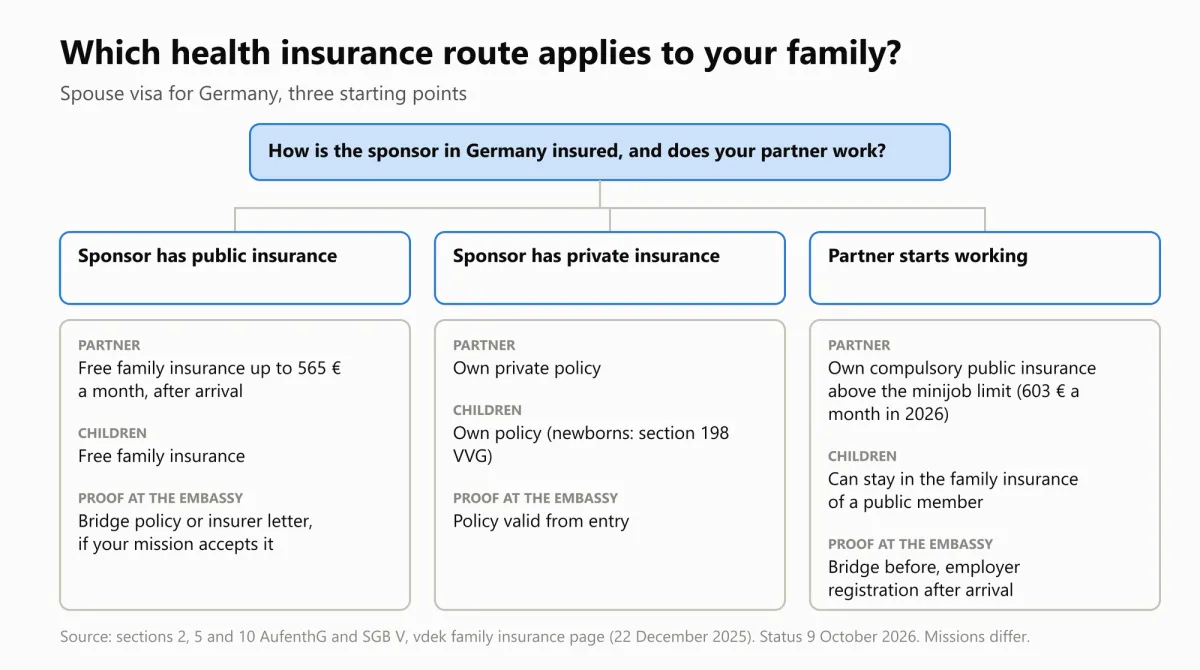
Quick answer: Your route depends on how the sponsor in Germany is insured, and private health insurance for families in Germany works differently from public. In public health insurance, a partner earning up to EUR 565 a month and the children join free of charge once they live in Germany. In private health insurance, every family member needs their own policy. If your partner starts working above the minijob limit, they get their own public insurance. In all three cases you need cover from the day of entry, so plan a short bridge policy early.
What health insurance proof does a spouse visa for Germany require?
A residence permit needs a secured livelihood, and that includes adequate health cover (section 2 (3) of the Residence Act, AufenthG). Membership in public health insurance counts as sufficient. Sections 27 to 32 AufenthG set who may join whom, and the livelihood test is softer for spouses of German citizens (section 28). The need for insurance stays the same.
Two moments matter:
- At the embassy or consulate: for the national visa you need proof of insurance valid from the day of entry. Travel insurance and the European Health Insurance Card are usually not enough for a long stay (guidance of the German missions, uk.diplo.de/uk-en/health-insurance-requirements/2616300).
- At the immigration office in Germany: the cover has to fit the residence permit. Some offices ask for open-ended cover instead of a short bridge policy.
Missions differ. Some accept a written confirmation from a public insurer that your partner joins family insurance on arrival, others do not. Check your mission's own list before you buy anything. For other visa types, see which health insurance counts for a German visa. If the sponsor holds a Blue Card, the rules for EU Blue Card health insurance apply as well.
What if my partner in Germany has public health insurance?
This is the simplest case. Under section 10 of the Social Code V (SGB V), a spouse and children are insured free of charge in Familienversicherung (family insurance) if they:
- live in Germany,
- are not insured elsewhere and are not self-employed as their main job,
- earn no more than one seventh of the monthly reference value, which is EUR 565 a month in 2026, or EUR 603 in a minijob.
Children are covered up to 18, up to 23 if not employed, and up to 25 in school or training. The same income limit applies to them. For the full rules, read our guide to free family insurance in public health insurance.
The catch is timing. Family insurance needs a residence in Germany, so your partner usually cannot join before arrival. Some insurers send a pre-entry confirmation letter, and whether your mission accepts it is the mission's call. Otherwise you cover the first weeks with a bridge policy, described below.
Does the 2028 spouse surcharge change this?
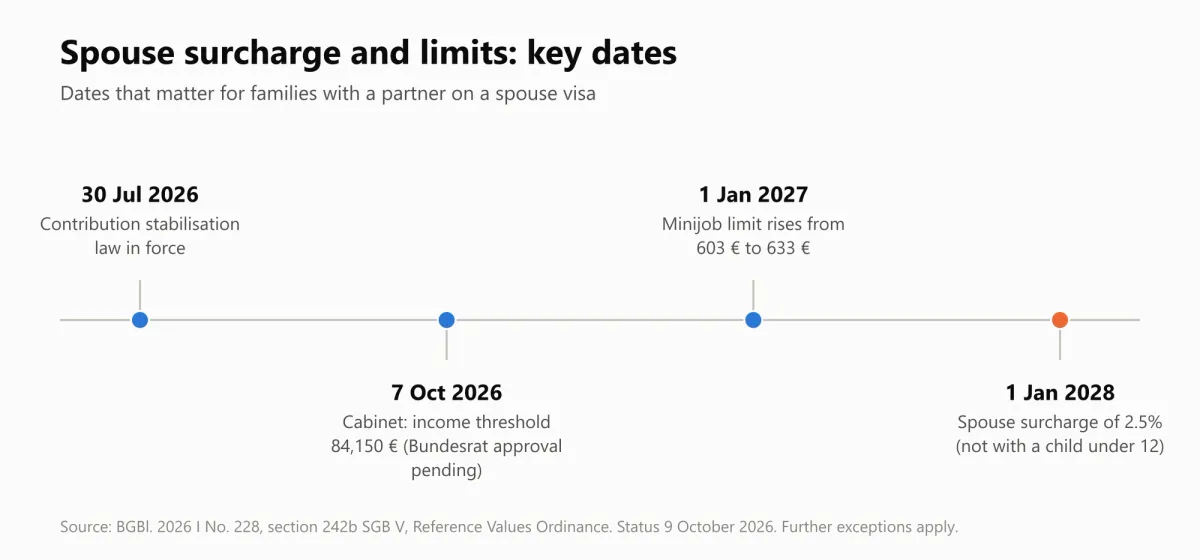
For some couples, yes. Under the 2026 health insurance contribution stabilisation law (passed 10 July 2026, in force 30 July 2026), a spouse in free family insurance triggers a surcharge of 2.5 percent of the member's contributory income from 1 January 2028. The member pays it alone, with no employer share. Children stay free. It is set in section 242b SGB V as 2.5 percentage points on the member's contribution rate. No surcharge applies if the member or the family-insured spouse has a child under 12, or a disabled child who cannot support itself, living in the household of the family-insured spouse. It also does not apply if the spouse cares for a relative with care grade 2 or higher (at least 10 hours a week), is on care leave, has reached the regular retirement age, has care grade 3 or higher, receives a full disability pension or Grundsicherungsgeld, or has a disability degree of 60 or more.
Worked example (estimate): a sponsor at the 2026 contribution ceiling earns EUR 5,812.50 a month. 5,812.50 x 2.5 percent = about EUR 145 a month. At EUR 4,000 income the same calculation gives EUR 100. A family with a child under 12 in the spouse's household pays nothing extra. A couple without young children, and without one of the other exceptions, should plan for it. A minijob does not remove the surcharge.
What if my partner in Germany has private health insurance?
Private health insurance has no free family cover. Your partner and each child need their own contract with their own premium, and usually their own health questions. Premiums depend on age, health, deductible and benefits.
Indicative 2026 figures, not offers:
- Private premiums for the employee and each child depend on age, health, deductible and benefits. We show no standard figure for them. We calculate them in a free consultation.
- A partner without income needs no daily sickness allowance. One top-tier tariff with long-term care and no sick pay (HanseMerkur Top Fit, EUR 1,000 deductible) costs EUR 515.09 at age 25 and EUR 631.15 at age 35 (insurer example for self-employed applicants; a quote for a non-working partner may differ).
- Employees receive an employer subsidy toward the premiums of the employee and of family members who would otherwise be family-insured, in one amount capped at EUR 508.59 a month for health insurance in 2026 (the care subsidy is separate).
Children need care here. Section 198 of the Insurance Contract Act (VVG) obliges the insurer to insure a newborn from birth without risk surcharge or waiting period, if at least one parent is insured with that insurer on the day of birth and the baby is registered within two months of birth (retroactive). The cover may not be higher or broader than the parent's, adopted minors are treated the same, except that a risk surcharge of up to one full premium is allowed for a higher health risk, and the insurer may require the parent to have been insured for up to three months. A child who arrives from abroad after birth is not a newborn and needs a regular own policy with normal health questions, or public family insurance through a publicly insured parent.
Who should choose private? It suits people up to about 45 best, and the longer you live in Germany, the better it gets, because old-age reserves build from the first month. A single-income family with two or more children is usually better off in public insurance. We say that plainly.
Who can choose? Employees can pick private health insurance in Germany above the income threshold (Jahresarbeitsentgeltgrenze) of EUR 77,400 in 2026. For 2027 the cabinet decided EUR 84,150 on 7 October 2026, with Bundesrat approval pending. Self-employed people and freelancers can choose freely. Below the threshold, public health insurance in Germany is your route, and the 2027 income threshold explains the new figure.
What happens when my partner starts working in Germany?
Once your partner earns above the minijob limit (EUR 603 a month in 2026, EUR 633 from 1 January 2027), they become a compulsory public member in their own right. Family insurance ends, because someone insured through their own job cannot also be a family member. The contribution rate is 14.6 percent, shared with the employer, plus an additional contribution that averages 2.9 percent officially in 2026.
Children are not affected. In a couple where one partner is publicly insured, they can stay in that member's family insurance. They are excluded only if the privately insured parent earns more than the public one and above EUR 6,450 a month in 2026 (one twelfth of EUR 77,400).
How do we cover the first weeks before regular insurance starts?
Use incoming insurance as a bridge. An embassy wants cover for all risks usually covered in Germany, valid from entry, without age limits or purpose-change exclusions. Prices differ by plan, age and insurer, so check the tariff before you buy. Look at incoming health insurance and check the wording against your mission's list.
Plan the switch to long-term cover before the permit stage, because some immigration offices ask for open-ended cover.
Table 1. Which route applies
| Sponsor's insurance | Partner | Children | Proof at the embassy |
|---|---|---|---|
| Public | Free family insurance up to EUR 565 a month, after arrival | Free family insurance | Bridge policy or insurer letter, if your mission accepts it |
| Private | Own private policy | Own policy (newborns: section 198 VVG) | Policy valid from entry |
| Partner starts working | Own compulsory public insurance | Via the better placed public member | Bridge before, employer registration after arrival |
Source: sections 2, 5 and 10 AufenthG and SGB V (gesetze-im-internet.de), vdek family insurance page (22 December 2025), seen 2 November 2026.
What does health insurance cost for a family of three?
Here is the monthly picture for a sponsor, a partner and one child, 2026. Only the public rows and the partner tariff have figures, because other private premiums are individual.
Table 2. Monthly cost for a family of three, 2026
| Case | Sponsor | Partner | Child | Status |
|---|---|---|---|---|
| Public, sponsor at the contribution ceiling | about EUR 613 | EUR 0 | EUR 0 | estimate |
| Private | own premium, depends on age, health, deductible and benefits | EUR 515 to 631 (HanseMerkur Top Fit, no sick pay, ages 25 to 35; insurer example for self-employed applicants) | own premium | partner estimate only, free quote |
| Public from 2028, no child under 12 | about EUR 613 plus about EUR 145 | EUR 0 | EUR 0 | law plus estimate |
Source: own calculation from the Deutsche Rentenversicherung Reference Values Ordinance 2026 and vdek, HanseMerkur cost page (read 2 November 2026), AOK on the 2028 surcharge and section 242b SGB V, seen 2 November 2026. Premiums depend on age, health, deductible and cover. Indicative figures, not offers.
Arithmetic for the public row: the employee share of health insurance at the ceiling is EUR 508.59 (8.75 percent x 5,812.50). Long-term care adds 1.8 percent of 5,812.50, which is EUR 104.63. 508.59 + 104.63 = EUR 613.22, so about EUR 613, and nobody else in the family pays a premium. For the private row, each family member needs an own contract with an own premium. The partner figure is the HanseMerkur Top Fit range for ages 25 to 35 and includes no sick pay, so a free quote shows your own figures.
Read it this way: public is cheapest for a family with one earner and children. Private premiums are paid per person, so the family total grows with each member, and private pays off for higher-earning people who build old-age reserves early.
Table 3. 2026 limits and the 2027 outlook
| Item | 2026 | 2027 | Status |
|---|---|---|---|
| Family insurance income limit | EUR 565 | EUR 590 (draft: reference value EUR 4,130 / 7) | draft, not final |
| Minijob limit | EUR 603 | EUR 633 | official figure |
| Income threshold (Jahresarbeitsentgeltgrenze) | EUR 77,400 | EUR 84,150 | cabinet decision 7 October 2026, Bundesrat approval pending |
| Contribution ceiling | EUR 69,750 | EUR 76,500 | cabinet decision 7 October 2026, Bundesrat approval pending |
Source: vdek (22 December 2025), Deutsche Rentenversicherung Reference Values Ordinance 2026 and 2027 draft, seen 2 November 2026.
Checklist: what to have ready
- The sponsor's insurance status letter (public or private)
- Insurer confirmation or a bridge policy that covers the entry date
- Policy wording stating that all usual risks are covered
- A child policy or a family insurance confirmation
- Proof of your address in Germany (family insurance needs a residence)
- Your partner's income statement against EUR 565 and EUR 603
- A note of the 2028 surcharge if no child under 12 lives in your partner's household
- A plan for the switch from bridge to long-term cover
- A copy of the residence permit once issued
Want a free check of your options?
Which route fits your family depends on income, age and health. If you are an employee above the income threshold, or self-employed, get a free quote and we compare private tariffs for your whole family. If you are below the threshold, start with public health insurance in Germany. In both cases a free consultation by phone is the quickest way to assess your situation. The full overview sits in our guide to family private health insurance in Germany.
Sources and status
- Residence Act sections 2, 5, 28, 29, 30, 32: https://www.gesetze-im-internet.de/aufenthg_2004/ (seen 2 November 2026, law)Official sourcegesetze-im-internet.de
- German missions, health insurance requirements for visas (official guidance, Auswärtiges Amt): https://uk.diplo.de/uk-en/health-insurance-requirements/2616300uk.diplo.de
- Social Code V section 10: https://www.gesetze-im-internet.de/sgb_5/__10.html (seen 2 November 2026, law)Official sourcegesetze-im-internet.de
- Insurance Contract Act section 198: https://www.gesetze-im-internet.de/vvg_2008/__198.html (seen 2 November 2026, law)Official sourcegesetze-im-internet.de
- vdek family insurance, EUR 565 and 603: https://www.vdek.com/vertragspartner/mitgliedschaftsrecht_beitragsrecht/familienversicherung.html (22 December 2025, official figure)vdek.com
- Deutsche Rentenversicherung Reference Values 2026: https://www.deutsche-rentenversicherung.de/DRV/DE/Ueber-uns-und-Presse/Presse/Meldungen/2025/250910-sv-rechengroessen-vo-2026.html (seen 2 November 2026, official figure)Official sourcedeutsche-rentenversicherung.de
- Reference Values 2027 draft: https://www.deutsche-rentenversicherung.de/DRV/DE/Ueber-uns-und-Presse/Presse/Meldungen/2026/260922-sv-rechengroessen-vo-2027 (draft of 21 September 2026, cabinet decision of 7 October 2026, Bundesrat approval pending)Official sourcedeutsche-rentenversicherung.de
- 2028 spouse surcharge, section 242b SGB V: https://www.recht.bund.de/bgbl/1/2026/228/regelungstext.pdf?__blob=publicationFile&v=1 (BGBl. 2026 I No. 228, seen 2 November 2026, law); employer subsidy section 257: https://www.gesetze-im-internet.de/sgb_5/__257.html secondary reading: https://www.aok.de/pp/selbsthilfe/inkontakt/beitragssatzstabilisierungsgesetz/ (seen 2 November 2026, law, secondary reading)Official sourcerecht.bund.deOfficial sourcegesetze-im-internet.deaok.de
- Partner tariff without sick pay: HanseMerkur website cost page (read 2 November 2026, no date stated, insurer figure)
Myhealthcarebroker is an independent insurance broker. This article is general information, not legal or tax advice. Rules differ by embassy and change, so confirm with your mission and the immigration office.
 Written byMarco Maurelli
 Reviewed byBettina Ostermann